Economy · Analysis
A faster permit still leaves a power project waiting for the grid
Hundreds of gigawatts of US projects with draft or signed interconnection agreements were still waiting to operate at the end of 2024.
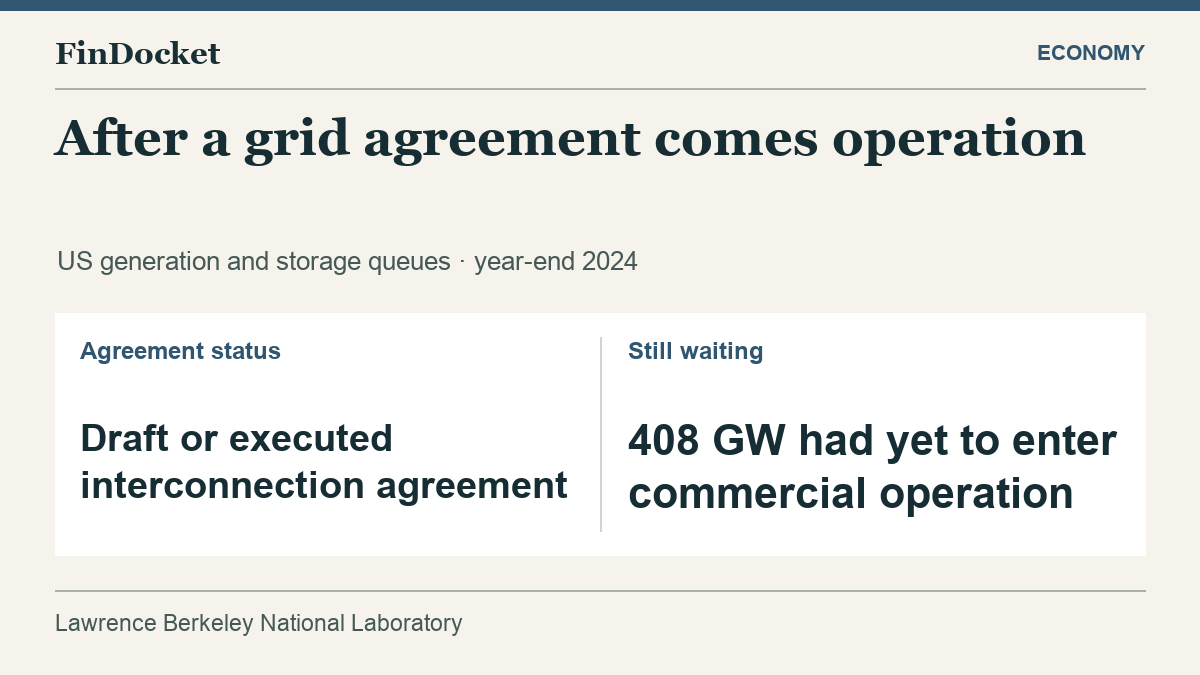
A power project needs more than permission to build. It needs a grid connection that can deliver its output. Berkeley Lab found 408 gigawatts of proposed generation and storage capacity with a draft or executed interconnection agreement that had yet to reach commercial operation at the end of 2024. This is a useful check on claims about what any single permitting reform could deliver.
Environmental review and interconnection study answer different questions. A review can change whether a project may go ahead in a particular place. A grid study considers what upgrades are necessary to connect it safely and who must bear the cost. A developer can advance on one issue while financing, equipment orders, transmission upgrades or another approval hold up the other.
The queue has a selection problem
Berkeley Lab found that only 13% of the capacity entering queues from 2000 through 2019 had reached commercial operation by the end of 2024. About 77% had withdrawn and 10% remained active. These are shares of requested capacity, rather than shares of individual projects. A few large applications can change the picture materially.
For projects that were built in regions with timing data, the median request-to-operation period rose from under two years for 2000–07 completions to more than four years for 2018–24 completions. The data cannot isolate the contribution of environmental reviews to that change. To evaluate a reform, measure the specific stage it changes and track subsequent completion, alongside the number of approvals issued.