Economy · Analysis
What a US wealth table can actually tell us about the richest 1%
The Fed's wealth tables permit some precise comparisons but group the entire lower half together. A claim about the bottom 53% needs more data.
A claim comparing a billionaire with a large fraction of the population sounds exact. To reproduce it, first establish the geography, date and unit. A global ranking of people, a US ranking of households and a public estimate of one person’s fortune are three different data objects.
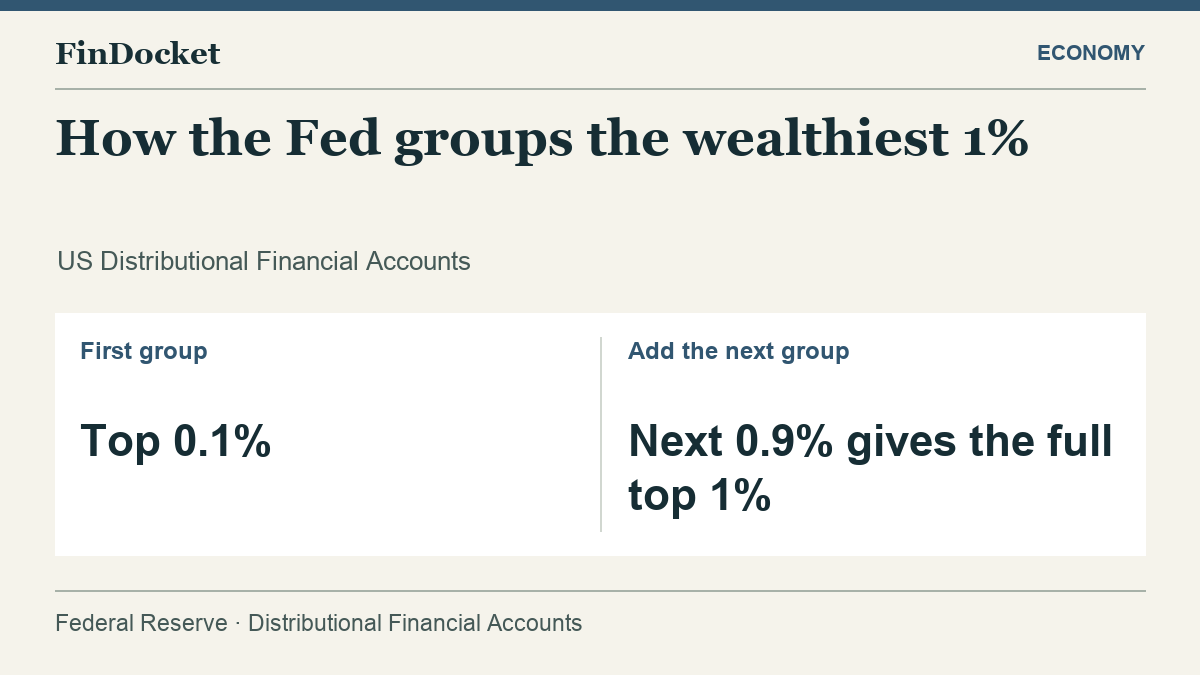
The Federal Reserve’s Distributional Financial Accounts provide a way to check a narrower US claim. They divide household wealth into the top 0.1%, the remainder of the top 1%, the next 9%, the next 40% and the bottom half. To calculate the US top 1% share, add the first two published shares for the same quarter. To compare that result with the bottom half, use the published bottom-half figure on the same basis. Net worth subtracts liabilities, so a household with substantial assets can still appear low in the distribution if it carries considerable debt.
Why three percentage points matter
The standard table combines households from the 50th through the 90th percentile into one group. It cannot directly tell a reader how much wealth belongs to households between the 50th and 53rd percentiles. Assigning them three-fortieths of the broad group’s wealth would assume an even distribution inside it.
The Fed reconciles information from its household survey with aggregate financial accounts. A defensible international comparison would also need consistent exchange rates, household or individual definitions and a matching valuation date. Those details determine whether the shared comparison can be reproduced.