Business · Analysis
Aflac Q3 2026: Portfolio Losses and Reserve Gains
Aflac's Q3 2026 filings show realized investment losses alongside large reserve gains. Our analysis examines the portfolio reset, earnings quality and capital returns.

Aflac's third-quarter 2026 results contain two large accounting effects with opposite signs. Realized investment losses depressed GAAP profit, while favorable reserve remeasurement supported insurance earnings. Understanding the business requires evaluating both: the investment reset determines what future returns must recover, and the reserve gain changes how much of today's adjusted profit represents recurring premium economics.
The useful question is whether the revised asset portfolio and the continuing insurance book can generate adequate future cash returns after the capital already consumed. Neither excluding investment losses nor annualizing a reserve benefit answers that question.
The investment reset carries a measurable cost
Aflac's earnings release reports net earnings of $303 million, versus $1.639 billion, and adjusted earnings of $1.214 billion, versus $1.327 billion. Quarterly net investment losses included $842 million from sales and redemptions, $146 million from derivatives and foreign-currency activity, and $102 million of expected credit losses. Management attributes the GAAP decline primarily to portfolio repositioning.
The $842 million sales-and-redemptions loss is approximately 2.8 times quarterly GAAP profit. Realizing a loss does not necessarily create a new economic loss on that date: part of the decline may already have appeared in the market value of securities. It does crystallize the difference between the proceeds received and the accounting basis, and it establishes a hurdle for the replacement assets.
For illustration, recovering an $842 million realized loss through an additional $100 million of annual pre-tax investment income would take about 8.4 years before discounting. At $200 million of additional annual income, the simple period would be about 4.2 years. These are deliberately hypothetical sensitivities, not Aflac guidance. They show why the future yield, risk and duration of the redeployed proceeds matter more than the label attached to the transaction.
A portfolio reset can also improve liquidity or reduce credit and currency exposure. Those benefits have economic value even if they do not maximize near-term income. The judgment still requires evidence about the replacement portfolio; the act of repositioning alone cannot establish that value was created.
Adjusted earnings retain a large reserve benefit
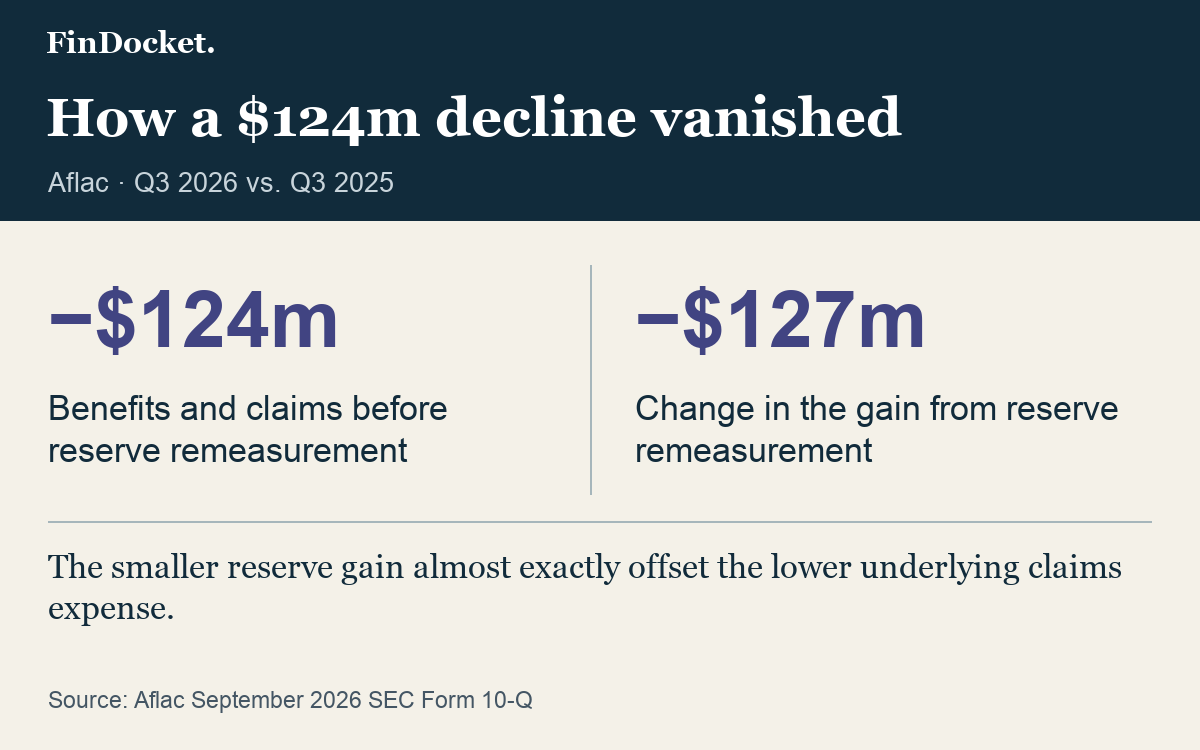
The 10-Q records $453 million of pre-tax reserve remeasurement gains, compared with $580 million previously. Benefits and claims before remeasurement declined to $1.892 billion from $2.016 billion. After remeasurement, the expense was almost unchanged at $1.439 billion versus $1.436 billion.
The arithmetic explains a seemingly flat claims line. Before remeasurement, benefits improved by $124 million. The favorable remeasurement benefit then fell by $127 million, almost exactly offsetting that improvement. Looking only at reported net benefits would miss the movement in both components.
The current gain equals about 24% of benefits and claims before remeasurement. It is therefore a major part of the quarterly insurance result. Applying a simple 21% tax assumption gives an illustrative after-tax benefit of roughly $358 million, approximately 29% of adjusted earnings. Actual tax treatment can differ, and this calculation is not a company-provided normalized profit figure.
Reserve remeasurement incorporates updated expectations about future insurance cash flows. Favorable experience can justify releasing a portion of previously recognized obligations. That improves shareholders' economic position if the new estimates prove accurate. It remains distinct from profit earned by collecting premiums and paying claims during the current quarter.
The fact that the prior-year gain was even larger is also important. Removing only the current benefit would make the comparison inconsistent. A meaningful operating assessment needs to evaluate both periods on a comparable basis and understand whether assumption changes reflect repeatable experience or a revision that will not recur.
U.S. margin expansion needs a careful reading
The earnings release shows U.S. pre-tax adjusted earnings increasing to $493 million from $375 million, while net earned premiums rose 3.3%. The segment's adjusted profit margin expanded to 27.7% from 21.7%. Management identifies higher reserve remeasurement gains, increased premiums and lower expenses among the drivers.
The segment generated $118 million more profit, a much faster increase than its premium growth. That indicates changes in claims and cost economics had greater near-term influence than volume alone. It does not establish that newly sold policies are immediately earning the reported aggregate margin.
For supplemental insurance, the duration of customer coverage and the timing of benefits matter. New premium production builds a future earnings base, while reserve revisions can change profit recognized on business sold previously. A stronger franchise should ultimately demonstrate both adequate new-business returns and reliable estimates on the existing book.
Currency and capital returns affect the per-share result
The Form 10-Q says the weaker yen reduced quarterly adjusted EPS by $0.03. It also reports $2.8 billion of share repurchases during the first nine months. Adjusted book value excluding accumulated other comprehensive income was $26.9 billion, or $54.21 per share, versus $28.0 billion, or $54.06 per share, at December 2025.
The adjusted capital amount declined by approximately 3.9%, while its per-share value increased about 0.3%. Those outcomes coexist because the share base contracted. Stable per-share capital therefore should not be interpreted as a stable total pool of adjusted equity.
The yen effect is real for dollar reporting but smaller than the gap between GAAP and adjusted quarterly EPS. Currency normalization can clarify local operating performance; it cannot explain away realized asset losses or the significance of reserve revisions. Each adjustment answers a different question.
What validates the next phase?
Aflac's Q3 filing establishes a substantial investment reset alongside meaningful support from revised insurance liabilities. The next test is whether replacement assets deliver attractive risk-adjusted income and whether the claims experience underpinning the reserve gains persists.
The strongest evidence would be improving premium economics and investment returns that replenish capital without relying on another unusually large assumption benefit. Capital distributions can increase each remaining share's ownership, but sustainable value still comes from the assets earning enough to fund the insurance promises after the full cost of those promises is recognized.