Business · Analysis
Why United Fidelity’s sale announcement lists two different deposit balances
Different deposit totals in the regulator’s and buyer’s announcements reflect what each included. The gap alone cannot measure depositor losses.
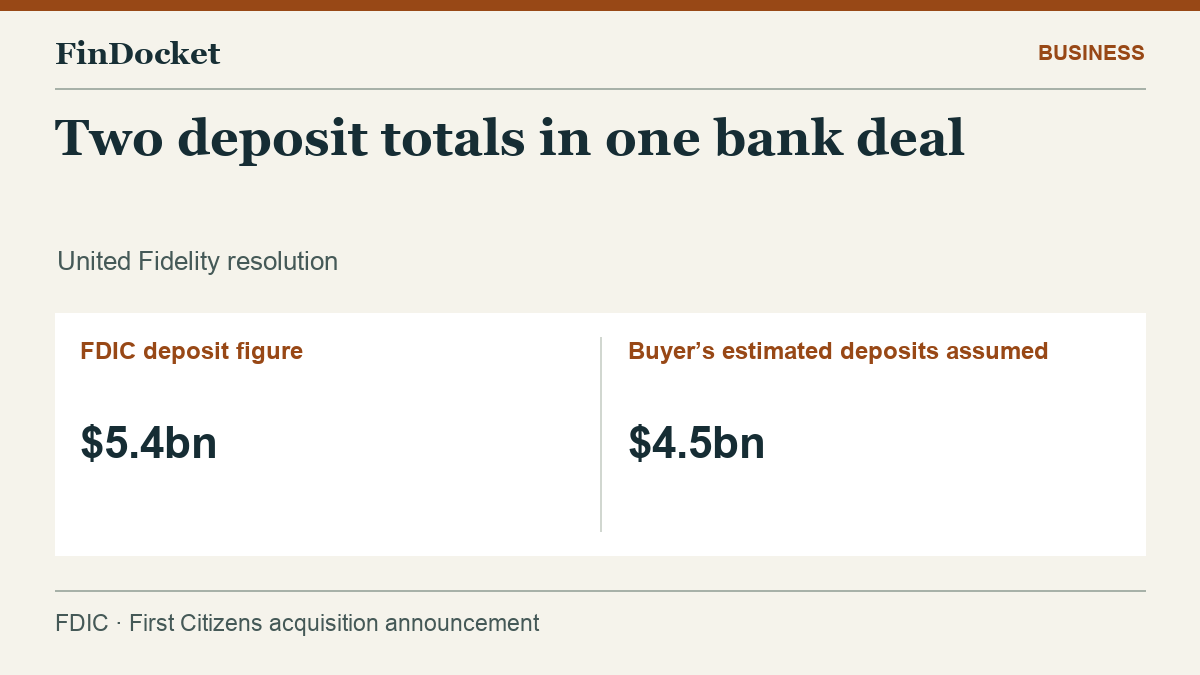
Two official announcements put different dollar figures on United Fidelity’s deposits. The FDIC put the failed institution’s September 30 total at approximately $5.4 billion. First Citizens estimated that it would assume $4.5 billion of deposits, based on that same reporting date. Subtracting gives roughly $900 million. The arithmetic is simple. Interpreting it as a loss to account holders would be wrong.
First Citizens describes its agreement as assuming customer deposits with exceptions for certain brokered deposits and other excluded accounts. The FDIC’s figure describes the failed bank before dividing up the transaction. The buyer’s figure describes the deposit balances it expects to take over. Both are rounded estimates, and the buyer expressly says the closing balance sheet and settlement with the FDIC can change the amounts.
What depositors could do over the weekend
The FDIC said customers could continue using debit cards, ATMs and checks. Loan customers were told to keep making their payments. The 22 branches were to reopen as First Citizens locations during their normal Saturday or Monday hours. The FDIC directed customers to keep using existing branches until the buyer completed the systems work needed for other First Citizens branches to handle those accounts.
Those operating instructions answer the immediate access question. The acquisition terms answer which balances transferred. The agency’s separate $1.83 billion insurance-fund estimate addresses the cost of resolving the institution. Using any one of the three as a substitute for the others would give a customer a misleading picture of the transaction.