Business · Analysis
Agree Realty Q3 2026: Forward Equity and Leverage
Agree Realty's Q3 filing shows growing AFFO and a covered dividend. Analyze pending equity, pro forma leverage, acquisition spreads and cash generation.

Agree Realty's third-quarter 2026 results show continued growth in adjusted earnings per share and a well-covered monthly dividend. Its funding position also illustrates a recurring challenge in analyzing expanding real estate companies: capital arranged for future delivery can materially change a leverage presentation before the shares are issued.
The company reports net debt to recurring EBITDA of 4.8 times and a pro forma ratio of 3.9 times. Both figures are useful, but they describe different states of the capital structure. The pending equity that lowers the second ratio also represents future participation in earnings.
What is behind Agree Realty's 3.9-times leverage ratio?
The supplemental reconciliation begins with $3.661 billion of net debt. It deducts $657.124 million of anticipated forward equity proceeds to reach $3.004 billion of pro forma net debt. Annualized recurring EBITDA is $764.692 million, producing the reported 4.8-times and 3.9-times ratios.
The adjustment removes approximately 18% of net debt from the calculation. That is substantial. It shows the financing already arranged to support the balance sheet, rather than an equivalent amount of cash already available without issuing shares.
Forward equity lets a company establish stock-sale terms ahead of taking the proceeds and delivering shares. Settlement timing can align funding with investments. Yet it does not eliminate the economic cost of equity: more owners share the income generated by the expanded property base.
Recurring EBITDA is also an adjusted denominator. The reconciliation adds a run-rate contribution from investment, disposal and leasing activity, alongside adjustments for lease intangibles. Consequently, the ratio combines a prospective funding adjustment with a measure intended to reflect current operating earning capacity. It should not be read as conventional debt divided by historical net income.
The practical question is what the company does after settlement. Applying proceeds to debt lowers leverage. Investing them creates assets and potential earnings, but changes the debt reduction implied by the pro forma presentation. The eventual use of funds determines the realized capital structure.
Is portfolio expansion increasing earnings per share?
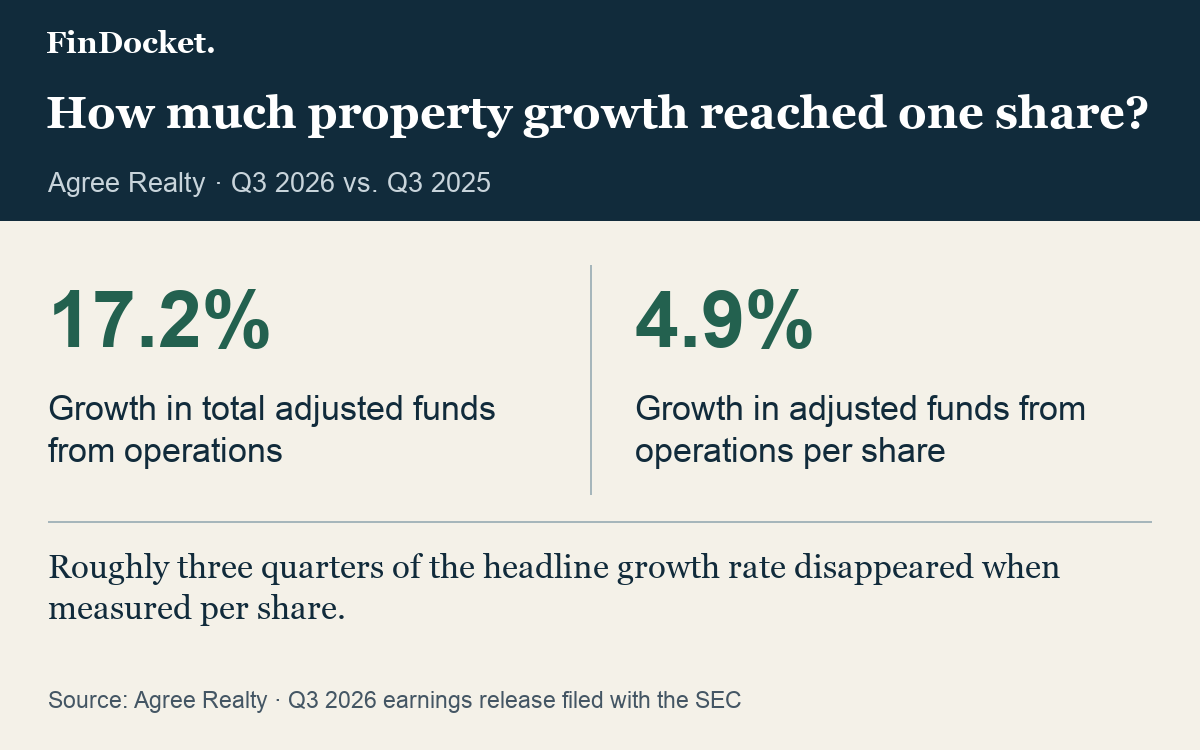
The earnings release reports quarterly AFFO of $144.2 million, up 17.2%, and AFFO per share of $1.15, up 4.9%. It raised annual AFFO guidance to $4.58–$4.59. Quarterly common-stockholder net income reached $66.5 million, or $0.53 per share. AFFO is non-GAAP.
The large gap between total and per-share growth captures the cost of financing expansion with equity. The business grew substantially faster than the earnings claim attached to an individual share. Per-share improvement remains positive, which is the more relevant outcome for an existing shareholder.
The supplemental data show weighted-average common shares and units increasing from 111.859 million to 124.951 million. Same-store rent grew 1.3%, and rent recapture on leasing activity was 105.8%.
Those figures distinguish the growth engines. Existing properties provide incremental rent improvement, while acquisitions and developments deliver a much larger addition to total income. The latter require capital. Sustained shareholder growth depends on the return earned after compensating the providers of that capital.
What spread do new property investments offer?
Quarterly acquisitions totaled $308.6 million at a 7.3% weighted-average capitalization rate, with a 14.5-year average lease term. The company also issued $400 million of 5.65% notes, with an all-in rate of 5.36% including earlier hedging activity.
The difference between the quoted acquisition rate and all-in bond rate is 1.94 percentage points. On a hypothetical $100 million funded entirely at that debt rate, the initial difference is approximately $1.94 million annually before overhead, property costs, transaction expenses and other adjustments.
This is a simple spread illustration, not the actual financing mix or an investment return forecast. Agree Realty uses equity as well as debt, and the acquisition cap rate is not a fully loaded shareholder return. The comparison nevertheless shows why acquisition pricing matters when financing costs rise.
Long leases provide visibility into contracted income, while tenant durability determines whether that visibility translates into collections. The release identifies investment-grade tenants as generating 52.1% of rent acquired during the quarter. Credit selection therefore remains part of underwriting rather than a property of every purchase.
Does operating cash support the dividend?
The 10-Q reports nine-month operating cash of $460.725 million versus $392.821 million. It includes interest-rate swap settlements of $19.384 million versus $13.551 million. Common dividends paid were $290.161 million, with another $5.578 million paid to preferred holders and $0.830 million to noncontrolling interests.
Operating cash grew 17.3%. Removing the identified swap settlement inflows from both periods leaves growth of approximately 16.4%. This analytical comparison retains working-capital effects and other cash timing, but shows that the increase was not primarily created by larger hedge receipts.
After the three specified distributions, roughly $164.2 million remained. Development spending of $131.091 million and leasing costs of $1.017 million reduce that arithmetic remainder to approximately $32.0 million before acquisitions and other flows. This is a funding bridge, not standardized free cash flow.
The dividend is supported by operating cash, while the acquisition program depends heavily on external capital. Net common-stock offering proceeds of $738.409 million supplied a major part of that funding during the nine months.
What does the dividend increase imply?
The monthly dividend rose to $0.271 for October, an annualized $3.252. Against the $4.585 annual AFFO guidance midpoint, that rate implies approximately a 70.9% payout, leaving roughly 29% of adjusted earnings before other demands on capital.
That retained portion supports growth, but cannot independently finance the scale of new investment. Agree Realty's result is therefore best judged through three connected measures: per-share AFFO, cash after distributions, and leverage after forward equity actually settles. The quarter demonstrates progress on earnings and cash; the pending funding must still translate into returns that justify the additional shareholder claims.