Business · Analysis
AIG Q3 2026: Convex Changes the Growth Equation
AIG's Q3 2026 filings show two routes into Convex: equity ownership and reinsurance. Our analysis tests the capital cost and the quality of insurance growth.

AIG's third-quarter 2026 results require a broader view of insurance growth than premium volume alone. Its Convex investment gives it two different economic exposures to the same underwriting franchise: a minority equity stake and a growing quota-share reinsurance agreement. One appears through investment income, while the other feeds the insurance operation. Both require capital and both expose AIG to the quality of the underlying risks.
The central question is whether this structure delivers an attractive combined return after the purchase premium, future claim obligations and the cost of supporting additional reinsurance. The latest SEC filing provides enough detail to make that test concrete.
What AIG bought in Convex
AIG's Form 10-Q says it acquired 35% of Convex for $2.1 billion in February 2026, alongside a 9.9% Onex stake for $642 million. The Convex purchase included $520 million of intangible assets and other basis differences and $440 million of goodwill. AIG records its share of Convex earnings, less amortization of basis differences, within General Insurance investment income.
Those two purchase-price components total $960 million, approximately 46% of the amount paid for the stake. Subtracting them from the price gives an implied residual underlying net-asset value of about $1.14 billion for AIG's interest. This arithmetic is an interpretation of the disclosed purchase allocation, not a separate appraisal of Convex.
It means a substantial part of the investment's success depends on future earning capacity beyond the acquired share of existing net assets. That can be justified by underwriting expertise, distribution access and profitable growth. It also raises the return hurdle: a minority interest in a growing insurer must generate sufficient earnings on the entire cash price, including goodwill.
For scale, a 10% return on the $2.1 billion purchase price requires $210 million of annual earnings attributable to the interest. Before acquisition-basis amortization and other differences, a 35% stake would require approximately $600 million of annual Convex earnings to produce that amount. This is a hurdle illustration, not a projection or management target.
The reinsurance exposure grows separately
The filing also discloses a whole-account quota-share agreement covering 7.5% of Convex's underwriting portfolio in 2026, rising to 10.0% in 2027 and 12.5% in 2028. AIG sold its remaining Corebridge shares in May for approximately $710 million, following a $750 million sale in February.
At an unchanged portfolio size, the quota-share percentage rises by one-third in 2027 and by two-thirds between 2026 and 2028. Actual assumed premium will also depend on Convex's own growth and contract terms. The scheduled percentages therefore create a built-in route to greater exposure even without new market share at the underlying insurer.
The equity and reinsurance positions should not be added as though they represented a simple 42.5% ownership interest in 2026. Equity participates in the residual earnings of the company after its reinsurance arrangements. The quota share participates in a defined portfolio's premiums and losses under contractual terms. Commissions, expenses, investment returns and the allocation of risk all affect how the economics interact.
The important commonality is concentration. If the underwriting assumptions behind a shared portfolio deteriorate, both channels can be affected. Conversely, sound selection can create returns through both invested ownership and directly assumed insurance. Diversifying the accounting location of earnings does not by itself diversify the underlying risk.
Why premium growth and underwriting profit diverged
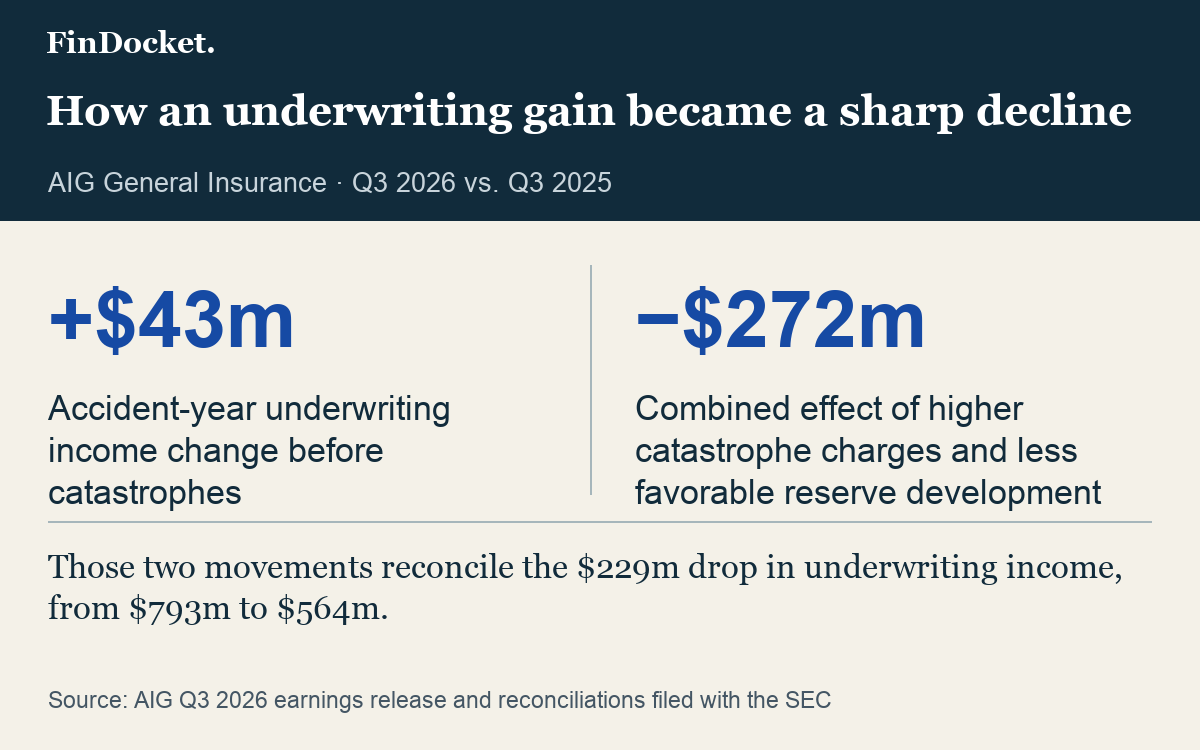
The earnings release reports General Insurance net written premiums of $6.651 billion, up 7%, while underwriting income fell to $564 million from $793 million. Catastrophe charges increased to $283 million from $100 million, and favorable prior-year development declined to $91 million from $180 million. Accident-year underwriting income excluding catastrophes increased to $756 million from $713 million.
The bridge explains the apparent contradiction. The $43 million increase in accident-year underwriting income was more than offset by $183 million of additional catastrophe charges and $89 million less favorable development. Together, those changes reconcile to the $229 million decline in reported underwriting income.
This makes the quarter more informative than either the growth rate or the profit decline alone. Current-year ordinary underwriting produced more dollars, but the complete insurance result weakened. New assumed business adds volume; it does not remove the need to reserve capital for catastrophe losses or for revisions to earlier claims.
A larger premium base can absorb fixed expenses more efficiently. It also magnifies the dollar effect of any pricing error. Evaluating the Convex quota share therefore requires watching loss development and the margin on incremental volume, rather than treating scheduled premium expansion as automatic profit growth.
GAAP earnings tell another part of the story
AIG reported common-shareholder net income of $844 million, versus $519 million, while adjusted after-tax income per diluted share declined to $2.06 from $2.20. The release attributes much of the GAAP improvement to investment fair-value changes and lower realized losses. The General Insurance adjusted accident-year combined ratio excluding catastrophes was 88.4%, versus 88.3%.
The nearly unchanged adjusted ratio implies that the extra ordinary underwriting income largely reflected a larger earnings base rather than a substantial margin expansion. That distinction matters when judging acquisition returns. Growth bought or assumed with additional capital must earn a return on that capital; a stable margin on higher premiums is only one component of the calculation.
The evidence that would validate the strategy
AIG's next phase depends on the combined economics of ownership and assumed risk. Convex earnings need to cover the investment's purchase premium, while quota-share underwriting needs to justify the reserves and capital supporting it. Cash formerly tied to Corebridge has been released, but redeploying capital changes its risk rather than eliminating its cost.
The Q3 filing shows a workable route to greater insurance earning power. It also defines the hurdle clearly: profitable volume must translate into returns on the full amount invested, through both channels, after the claims arrive.