Business · Analysis
Airbnb Q3 2026 Earnings: Faster Growth, Later Cash
Airbnb's Q3 SEC filing reveals stronger booking growth and operating leverage, while flexible payments shift cash collection and alter free cash flow comparisons.

Airbnb's third-quarter 2026 results show a marketplace accelerating while giving travelers more flexibility over when they pay. That combination strengthens the demand story and changes the cash story. More reservations do not immediately produce the same advance fee collections when payment moves closer to the stay.
The central investment question is whether improved conversion and customer retention produce enough additional lifetime profit to compensate for collecting cash later. The quarter supplies evidence of operating leverage, but its cash flow needs to be read through the changing payment cycle.
What drove Airbnb's Q3 growth?
The shareholder letter reports 155 million Nights and Seats Booked, up 16%, and gross booking value of $27.7 billion, up 21%. App nights increased 29%, reaching 66% of total nights compared with 62% a year earlier. Management said flexible payments contributed to longer booking lead times.
Volume growth matters because it makes the expansion broader than accommodation price inflation alone. More completed transactions can spread product development and corporate costs across a larger base, provided support and acquisition costs do not rise equally quickly.
The app mix offers another useful lens. A traveler returning directly to an installed app has a different potential acquisition cost from someone repeatedly reached through paid search. The reported mix does not establish the exact savings, but it identifies a mechanism through which greater engagement could improve marketplace economics.
Longer lead times need a different interpretation. They can improve visibility into future stays without producing immediate revenue. They can also change cancellation exposure and the interval between reservation and completion. Booking acceleration and earnings acceleration therefore belong on related, but distinct, timelines.
Did stronger demand produce better operating economics?
Airbnb's 10-Q reports revenue of $4.869 billion and operating income of $2.021 billion, up from $4.095 billion and $1.625 billion. Calculated operating margin increased from approximately 39.7% to 41.5%. Operating profit captured roughly 51% of incremental revenue.
That incremental conversion is meaningful. It indicates that the additional business required proportionately less additional expense than the existing revenue base. It also provides a more direct view of operating performance than a narrative focused entirely on product launches.
The calculation should not be treated as a permanent marginal profit rate. Different seasons carry different travel activity and marketing patterns. An unusually strong travel quarter can spread relatively fixed costs particularly effectively.
Management's approximately 36% full-year adjusted EBITDA margin outlook provides useful context for the quarter's 52% adjusted margin. These are company-defined non-GAAP measures. The gap reflects why extrapolating a peak quarter across an entire year would overstate the expected annual economics.
Airbnb's newsroom also reported a decline of more than 17% in customer support cost per booking, largely attributed to its AI assistant. If service quality holds, reducing effort per transaction creates a concrete route from technology spending to operating returns. The relevant outcome is fewer costly interventions for a successfully completed stay, rather than the number of AI features announced.
Why is cash growing more slowly than revenue?
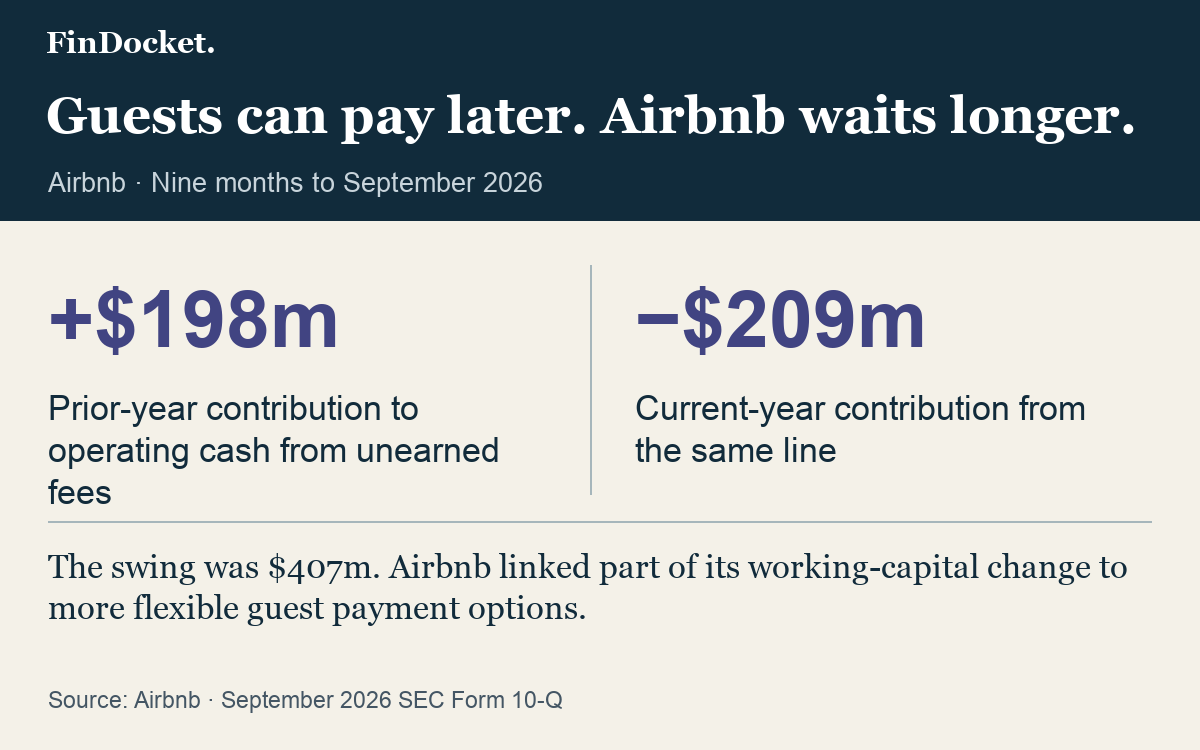
Quarterly free cash flow was $1.426 billion, compared with $1.349 billion. For nine months, operating cash flow increased from $4.120 billion to $4.486 billion, while unearned fees shifted from a $198 million inflow to a $209 million outflow. The filing attributes part of the working capital change to Reserve Now, Pay Later and other flexible payment options.
The change in unearned fees represents a $407 million unfavorable year-over-year cash comparison. It does not mean that the company lost an equivalent amount of revenue. It means that advance collections supplied less cash relative to the earlier period.
Consider a booking whose platform fee is collected several months before check-in. The platform receives financing during the intervening period even though it has not yet earned the fee. Collecting near the stay shortens that financing benefit. Both arrangements can eventually generate the same fee, but their cash timing differs.
A payment product can consequently improve conversion while weakening near-term cash conversion. Judging it requires measuring the extra completed stays, associated contribution and customer repeat behavior against the value of the financing forgone.
A crucial distinction in the filing is that customer funds and matching amounts payable do not affect free cash flow, apart from interest earned. The fee collection mechanism should not be confused with treating hosts' money as freely available corporate cash.
How much weight should investors give the buyback?
The company announced an additional $12 billion repurchase authorization. That is permission to allocate capital over time, rather than a statement that the money has already been spent or that the entire amount will reduce share count immediately.
The economic test is the price paid relative to the future cash attributable to each share. Repurchasing an expensive share can consume value even when the company is growing. Repurchasing a reasonably priced share can raise each remaining holder's ownership of the marketplace.
Stock compensation belongs in the same assessment. Equity used to pay employees transfers part of the business to those employees. A cash flow measure that adds back the expense cannot, by itself, show how much of the underlying growth reaches a continuing shareholder. Changes in diluted ownership and actual repurchase spending complete that picture.
What determines the quality of the next stage?
Airbnb's opportunity is to make discovery, booking and support work well enough that travelers return directly and hosts receive more useful demand. Better payment flexibility supports that effort when it produces completed, profitable stays that otherwise would not occur.
The strongest evidence would be sustained transaction growth alongside improving operating contribution, successful support resolution and cash conversion measured across the full booking cycle. Peak-quarter margins and early reservations are valuable signals, but neither replaces that full-cycle assessment.
Q3 demonstrated that stronger activity could generate operating leverage. Its cash figures show the price of changing when customers pay. The next stage will be judged by whether the larger, more engaged marketplace earns enough additional profit to make that trade worthwhile.