Business · Analysis
Ally Q3 2026: Auto Growth and the Treasury Profit Bridge
Ally's Q3 earnings rose while automotive finance profit fell. Analyze the SEC filing's segment bridge, deposit costs, credit reserves and capital transfers.

Ally Financial's third-quarter 2026 earnings improved even as its automotive finance segment earned less. The difference lies in funding and treasury economics, the timing of credit reserves on a growing portfolio, and the way the bank allocates financing costs between businesses.
This is a stronger consolidated earnings result than the auto segment alone suggests. It also requires a more precise investment thesis than simply assuming higher vehicle originations produced higher current profit. Shareholders own the entire funding system, including the deposits, hedges and capital supporting those loans.
How did Ally's earnings improve?
The earnings release reports GAAP earnings of $1.30 per share, versus $1.18 a year earlier, and adjusted earnings of $1.34, versus $1.15. Net income attributable to common shareholders reached $401 million. GAAP revenue increased to $2.332 billion, and pretax income reached $567 million.
The larger increase in adjusted earnings reflects a different set of excluded items and should remain distinct from GAAP growth. The common-share result also incorporates preferred dividends and the number of shares outstanding, so it is downstream of the pretax operating bridge.
That distinction matters when forecasting. Revenue growth must first pay for expected credit costs, operating expenses and taxes. The residual available to common shareholders then depends on the capital structure. A model that starts and ends with the percentage growth in EPS skips the main economic drivers.
Why did automotive finance profit decline?
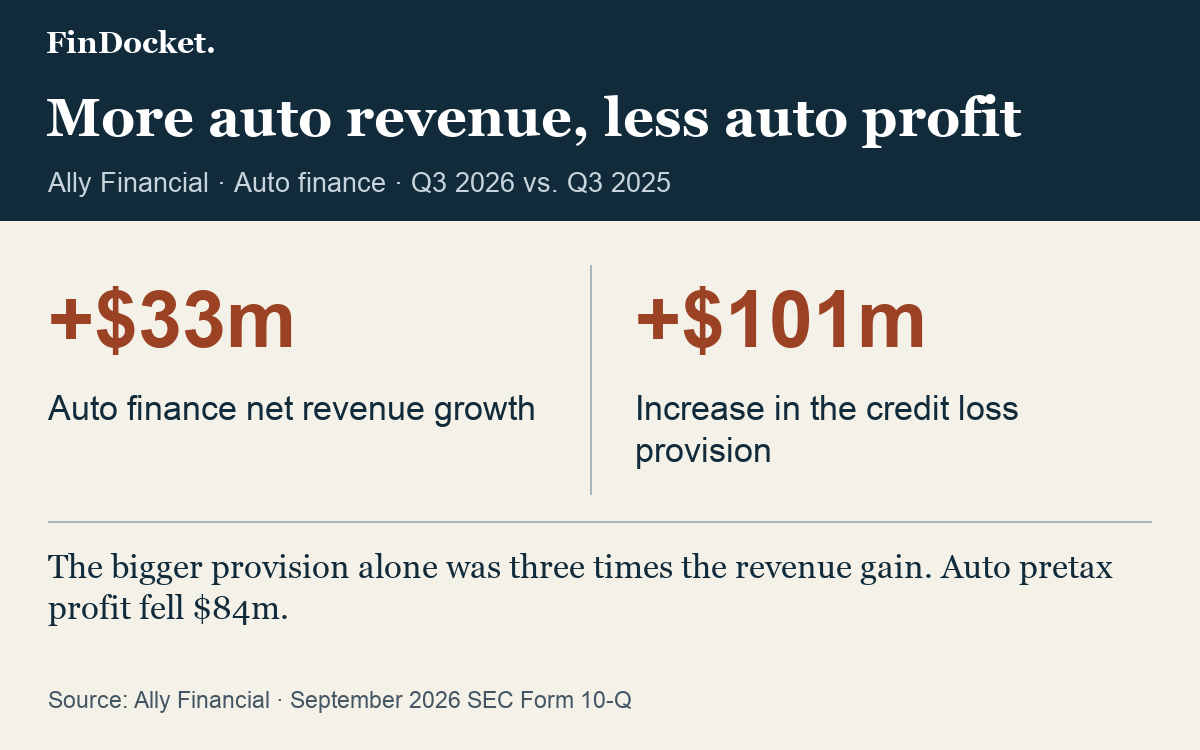
The SEC filing reports automotive finance pretax income of $337 million, down from $421 million. Segment net revenue increased $33 million, but the credit provision increased $101 million and noninterest expense rose $16 million. Management attributes the higher provision primarily to consumer auto portfolio growth.
Those figures explain the $84 million profit decline directly. Additional revenue was insufficient to cover the reserve and operating costs recognized in the quarter.
This does not mean the newly originated loans are unprofitable. Expected lifetime credit losses can be recognized before the corresponding interest income is collected. Growing a lending book can therefore depress current earnings while creating future spread income.
It also does not prove that growth creates value. That conclusion requires the eventual interest yield to cover funding costs, realized defaults, servicing and capital. The reserve build is an upfront cost of growth; the return arrives only if subsequent collections match or exceed the economics assumed when the loan was priced.
Where did the offsetting profit come from?
The filing shows Corporate and Other moving from an $82 million pretax loss to a $52 million profit. Insurance improved by $1 million and Corporate Finance by $3 million. Corporate and Other includes centralized treasury activity, external funding, deposits, derivatives and residual effects of internal funds-transfer pricing.
Calculated from these segment results, the $134 million Corporate and Other improvement more than offset the $84 million automotive decline. Together with the other two businesses, that reconciles the $54 million increase in consolidated pretax income.
This is why segment funding allocations matter. Internal transfer prices assign financing costs to business units, while the treasury function manages the external liabilities and hedges. The consolidated result captures the actual combination; an individual segment captures that combination after an allocation framework.
Investors should therefore evaluate both views. Auto underwriting determines the quality and yield of the assets. Treasury management and deposit pricing determine much of their financing economics. Treating all consolidated improvement as an acceleration in dealer lending would miss the source of this quarter's gain.
What do deposits say about funding durability?
Ally's release reports $141.9 billion of retail deposits, down $1.6 billion sequentially. Their average yield was 3.05%, down 43 basis points year over year. Deposits supplied 86% of funding. Consumer auto originations reached $12.9 billion, and the estimated retail auto originated yield was 9.44%.
The deposit repricing benefit is economically meaningful. Paying less for funding improves the spread on assets that remain outstanding, provided balances stay available at an acceptable cost.
The small sequential decline in retail balances also shows why rate reduction is a balancing act. A bank maximizes the value of its deposit franchise by retaining useful funding economically, rather than minimizing the posted rate without regard to customer behavior.
Subtracting the retail deposit yield from the estimated originated loan yield would not produce Ally's net interest margin. The figures cover different balance pools and timing conventions, and they exclude other liabilities, asset categories and hedging effects. The useful observation is directional: loan production and funding pricing must work together across the whole balance sheet.
How should investors interpret credit and lease costs?
The filing records automotive loan charge-offs of $427 million, versus $399 million, with the rounded annualized ratio unchanged at 1.9%. It also reports $16 million of off-lease vehicle remarketing losses, versus a $1 million gain. Management cites weaker resale performance, including pressures on certain recalled vehicles.
A stable charge-off ratio can coexist with higher dollar losses when the portfolio grows. That makes both measures useful: one describes loss intensity, while the other identifies the absolute earnings burden.
Lease residual performance creates another channel. The economics depend on both customer payments and the value recovered when the vehicle returns. Weaker resale proceeds can reduce returns even when the lessee pays as agreed. Forecasts should keep borrower credit losses and vehicle residual losses separate so that one does not conceal the other.
What supports further growth and shareholder distributions?
The release reports a 10.2% common equity Tier 1 ratio and a $6 billion retail auto credit risk transfer that generated approximately 25 basis points of CET1 at issuance. Ally repurchased $178 million of shares and raised the announced fourth-quarter common dividend to $0.35 from $0.30.
Risk transfer can free regulatory capacity by shifting specified exposure to outside investors. It has contractual costs and does not convert the entire reference portfolio into cash proceeds or eliminate every form of risk.
Ally's next earnings test is whether the growing loan book converts into retained spread income after credit costs, while the funding advantage holds. The current quarter demonstrates the value of the integrated bank. Sustained returns require the asset franchise and treasury franchise to keep reinforcing each other.