Business · Analysis
Amazon Q3 2026 Earnings: AWS Profits Meet a Cash Deficit
Amazon's Q3 2026 filing shows faster AWS growth and negative trailing free cash flow. Analyze AI spending, investment gains and rising debt.

Amazon’s third-quarter 2026 earnings show a stronger operating business alongside a much heavier demand for capital. AWS revenue increased 39%, consolidated operating income rose 61%, and North American profitability improved. Yet trailing twelve-month free cash flow turned negative as cash infrastructure spending increased far faster than operating cash generation.
The latest SEC quarterly filing also shows large investments in OpenAI and Anthropic and a substantial increase in debt. FinDocket’s analysis separates operating returns, private-investment accounting and financing needs to identify what the AI expansion must deliver for shareholders.
How much is AWS contributing to Amazon’s growth?
Quarterly revenue increased to $201.944 billion from $180.169 billion. AWS sales reached $45.984 billion, adding $12.978 billion, or approximately 59.6% of the consolidated revenue increase. The cloud business supplied less than a quarter of total sales but most of the incremental growth.
AWS operating income increased to $17.773 billion from $11.434 billion. Its calculated operating margin rose to 38.7% from 34.6%, despite a substantial increase in infrastructure depreciation. The segment contributed approximately 63.3% of consolidated operating income.
This is not simply growth bought through falling margins. The current-quarter income statement shows AWS generating more profit per revenue dollar while expanding rapidly. The next question is whether those margins generate adequate returns on the much larger asset base being installed.
AWS property and equipment, net, increased to $313 billion from $190.1 billion at the start of the year. Nine-month net equipment additions allocated to AWS were $147.2 billion, approximately 74.8% of consolidated additions. These additions include noncash and unpaid equipment activity and therefore differ from cash capital expenditure.
Is the retail business improving too?
North American revenue grew 6% to $112.852 billion, while operating income increased to $8.723 billion from $4.789 billion. The calculated operating margin improved to 7.7% from 4.5%. International operating income increased to $1.580 billion from $1.199 billion on 5% reported sales growth.
North American and International results include advertising, subscription services and seller fees as well as direct product sales. Their profit improvement should not be described as a pure merchandise-retailing margin expansion.
Advertising revenue increased to $19.637 billion from $17.703 billion, or 10.9%. Third-party seller services grew 9.4%, while online-store revenue increased only 1.6%. This mix shows the importance of monetizing the broader commerce platform rather than relying solely on growth in products Amazon sells directly.
Consolidated operating income reached $28.076 billion from $17.422 billion, a calculated margin of 13.9% versus 9.7%. AWS supplied approximately 59.5% of that dollar profit increase, while North America supplied another 36.9%. Both major engines contributed to the advance.
Why did net income fall when operating income rose?
Quarterly net income declined to $20.685 billion from $21.187 billion. Total nonoperating results moved from $10.748 billion of income to $1.207 billion of expense, more than offsetting the operating-profit increase before tax effects.
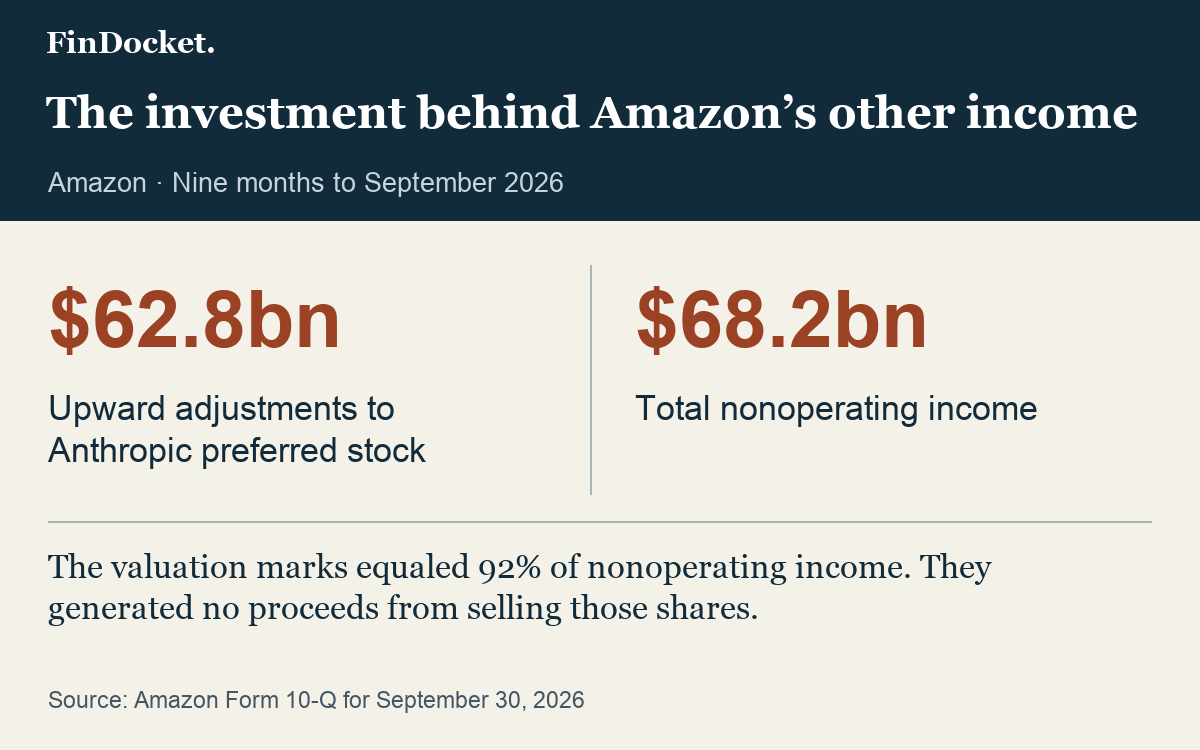
The nine-month comparison runs in the opposite direction. Net income more than doubled to $113.587 billion, with $68.171 billion of nonoperating income. The filing records $62.8 billion of upward adjustments to Anthropic preferred stock over those nine months, reflecting observable prices in funding transactions.
Those valuation adjustments are distinct from AWS sales and do not represent equivalent customer cash collections. Anthropic convertible-note gains also appear through accumulated other comprehensive income under a different accounting treatment. Adding the two categories together and calling the result operating earnings would be wrong.
At September 30, Anthropic preferred stock had a recorded value of approximately $92.5 billion, and the convertible notes had an estimated fair value of $146.2 billion. These positions create material exposure to a private company’s valuation and future liquidity events alongside Amazon’s commercial relationship with it.
Why is free cash flow negative?
Trailing twelve-month operating cash flow increased to $168.3 billion from $130.7 billion. Cash property-and-equipment purchases, net of sales and incentives, increased to $210.7 billion from $115.9 billion. Reported free cash flow consequently fell to negative $42.4 billion from positive $14.8 billion.
The problem is not declining cash collections in absolute dollars. Infrastructure spending rose about $94.8 billion, while operating cash flow increased only $37.6 billion. The investment program absorbed the entire operating cash increase and considerably more.
Free cash flow also excludes private investments and acquisitions. During the first nine months, Amazon invested $50 billion in OpenAI preferred stock and $10 billion in Anthropic preferred stock. Those are additional capital-allocation decisions beyond the equipment purchases captured in the free-cash-flow calculation.
Amazon’s cloud relationships and investment positions are connected economically, but their cash flows should remain distinct. A cloud commitment is future commercial activity subject to its terms; purchasing equity is an immediate use of capital. Neither establishes that the other automatically earns an attractive return.
The commercial arrangements also span long periods. AWS expanded its existing OpenAI commitment by $100 billion over eight years and its Anthropic collaboration by more than $100 billion over ten years. Both include obligations tied to AWS chip performance. These are not annual revenue amounts, and the required delivery performance connects the demand opportunity directly to the infrastructure investment. The capacity must work economically for customers as well as exist physically.
How is Amazon financing the expansion?
The face value of long-term debt increased to $180.9 billion from $68.8 billion over nine months. Net financing cash inflow totaled $111.8 billion, helping support infrastructure and investment spending. There were no common-stock repurchases during that period.
The filing also describes a supplier-financing facility allowing up to approximately $80 billion of borrowings beginning in 2027, subject to purchase timing and pricing. That is available future financing capacity, not an additional amount already outstanding at September 30.
Management expects approximately $220 billion of cash capital expenditure in 2026 and a meaningful further increase in 2027. Fourth-quarter operating-income guidance is $28.5 billion to $33.5 billion, against $25 billion a year earlier.
Amazon’s operating momentum is strong enough to support the expansion case. The unresolved financial test is whether the larger cloud and commerce profit base can ultimately outgrow infrastructure spending and financing costs, producing durable cash returns rather than an indefinitely expanding investment requirement.