Business · Analysis
AMD Q3 2026 Earnings: AI Growth, Cash and Customer Warrants
AMD's SEC filing shows strong data-center operating leverage alongside weaker quarterly cash conversion and customer warrant economics.

AMD's third-quarter 2026 results establish that its expanding data-center business can produce substantial operating leverage. The cash result tells a less immediate story: growth requires inventory, customer financing through receivables and advance commitments to suppliers. Customer warrants introduce another layer by sharing some of the commercial upside with buyers.
The investment question is how much of the additional operating profit becomes durable cash for existing shareholders after those funding requirements and incentives. The latest SEC filing provides enough detail to separate the strength of the product expansion from the capital and ownership economics supporting it.
How strong was AMD's operating leverage?
Revenue increased 45% to $13.377 billion and GAAP operating income increased 123% to $2.832 billion. Data Center revenue was $8.546 billion, up 97%, while Client and Gaming revenue declined 8%. Embedded revenue grew 29%. For the fourth quarter, AMD projected approximately $17 billion of revenue and a 55% non-GAAP gross margin.
FinDocket calculates that Data Center supplied more than 100% of the net increase in total revenue. Growth elsewhere could not fully offset the decline within Client and Gaming, so the consolidated acceleration depends heavily on the data-center business.
That concentration provides operating scale when the market expands. Engineering and commercial infrastructure can support a larger sales base, allowing profit to grow faster than revenue. It also concentrates the execution requirement in a product category where customers' deployment schedules and system choices have substantial financial consequences.
The quarter's incremental GAAP operating margin was approximately 37.8%: each additional sales dollar produced nearly 38 cents of additional operating profit. This calculation captures the combined benefit of greater gross profit and operating expenses growing more slowly than sales. It is strong evidence of current operating leverage.
The next question is durability. Semiconductor development requires repeated investment before the associated revenue arrives. The return depends on delivering competitive subsequent products while preserving the profit contribution of the current generation. A strong quarter earns credibility, but the economic measurement spans successive product cycles.
Why did free cash flow decline?
Quarterly operating cash flow from continuing operations was $1.202 billion, compared with $1.788 billion a year earlier. Capital spending increased to $648 million from $258 million. Free cash flow consequently fell to $554 million from $1.530 billion, despite the earnings increase.
The decline separates into two components: approximately 60% came from lower operating cash flow and 40% from higher capital spending. Both matter. Cutting investment could temporarily improve cash conversion while weakening the ability to support future growth. Conversely, strong profit with persistently weak collections would leave the company financing customers for longer.
The quarter's free cash flow was approximately 19.6% of GAAP operating income. That is a relationship between two different measures rather than a standardized conversion ratio, but it makes the gap visible. The profit expansion has arrived faster than the associated cash after investment.
Timing can explain part of that gap. Receivables record revenue before collection, and inventory is purchased before the final sale. The important question is whether those balances subsequently convert into cash at attractive margins. The financing requirement should be judged across the deployment cycle, with customer payment and supplier settlement completing the earnings story.
Supplier funding changes the growth economics
The nine-month filing describes $3.5 billion of inventory cash absorption, $2.9 billion from receivables and $2.1 billion from prepaid expenses and other assets, partly offset by $4.5 billion from payables. AMD attributes the asset expansion to data-center production, higher revenue and supply prepayments.
Using those rounded disclosures, payables funded roughly 53% of the combined cash absorption in the three identified asset categories. Supplier terms therefore provide meaningful financing for the expansion. The remaining requirement still has to be met through operating cash, available liquidity or external capital.
This structure rewards accurate scheduling. Inventory that moves quickly into profitable shipments can justify advance procurement. Components that remain idle tie up capital, and collected customer balances ultimately need to cover the supplier payments coming due.
The analysis also explains why a larger cash balance alone is incomplete evidence of stronger cash generation. Borrowing can increase liquidity at the same time that a business absorbs more capital. The relevant return is the cash produced after financing the operating cycle and the investment necessary to sustain competitive capacity.
What do customer warrants mean for shareholders?
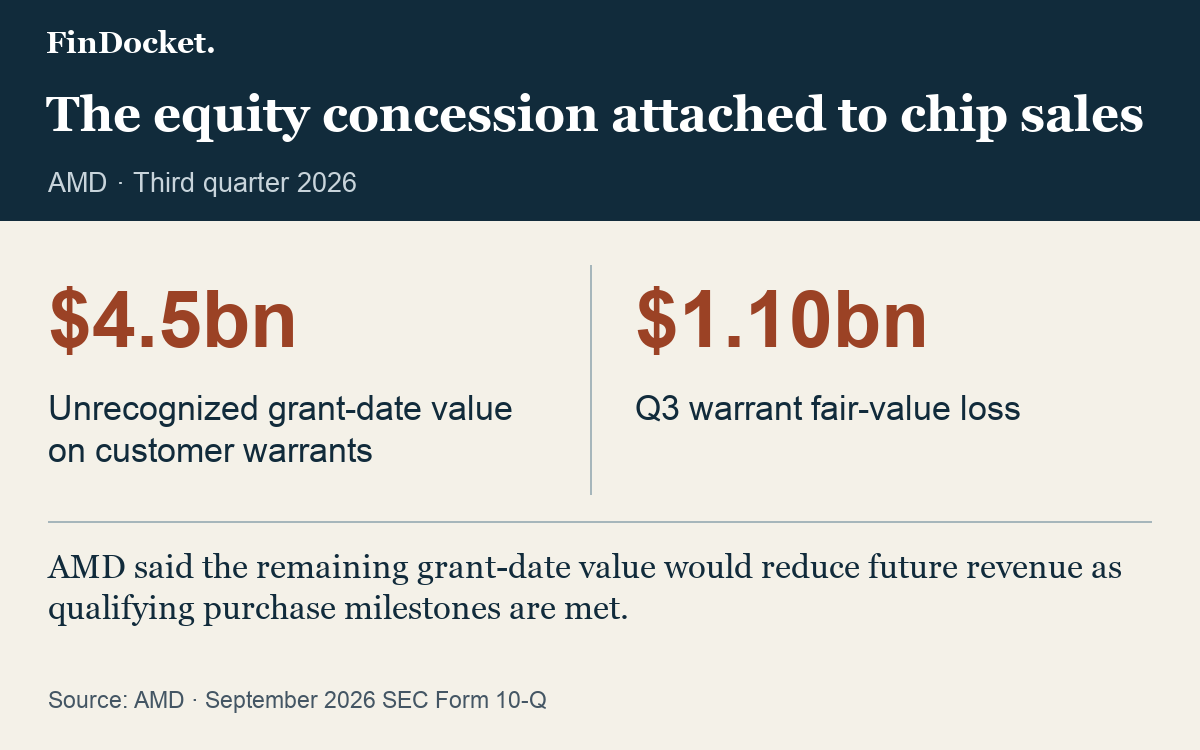
AMD's filing reports $4.5 billion of unrecognized grant-date warrant value to be recorded against qualifying future customer revenue. Subsequent fair-value changes affect other income or expense until the relevant accounting conditions are met. The quarter included a $1.097 billion warrant remeasurement loss.
There are two distinct economic effects. The original grant-date value represents consideration offered to customers as part of the commercial relationship. Later remeasurement changes reflect the evolving value of that arrangement. Combining both into a single claim about current product profitability would blur their different roles.
An incentive can create value if it secures enough profitable demand to outweigh the value transferred. The correct test is the total return retained by existing shareholders after the incentive. Customer sales volume and the customer's potential equity participation must be evaluated together.
The accounting loss also should not be treated as cash paid out during the quarter. Its significance is in the ownership and commercial terms it represents. As qualifying purchases occur, investors need to track the revenue reductions, the vesting conditions and the eventual share-count effect.
What would confirm a stronger cash outcome?
AMD's forecast implies another large step in quarterly scale. Converting that expansion into shareholder value requires more than shipment growth: the company needs timely collections, productive inventory turnover and enough gross-profit dollars after customer incentives to fund ongoing development.
The current evidence is strongest at the operating-profit level. Data Center has become the decisive growth engine, and incremental profitability is substantial. Cash conversion and customer warrant economics determine how much of that performance accrues to existing owners. The next filings should connect those three layers—commercial demand, cash generation and ownership returns—more closely as the new systems ramp.