Business · Analysis
Americold Q3 2026: The EQT Gain and Remaining Cash Claims
Americold's SEC filing separates its EQT transaction gain from recurring earnings. Analyze warehouse services, retained obligations and dividend cash coverage.

Americold's third-quarter 2026 earnings tell two different economic stories. Warehouse services improved, while a large property contribution gain transformed reported profit. The EQT joint venture released capital and reduced debt, but left Americold with ownership exposure and several obligations to support the transferred assets.
The key conclusion is that the transaction improved financing flexibility without making the remaining business self-funding. Recurring earnings and actual cash retention provide a much more useful foundation for assessing that business than the headline profit.
Why did Americold report such a large quarterly profit?
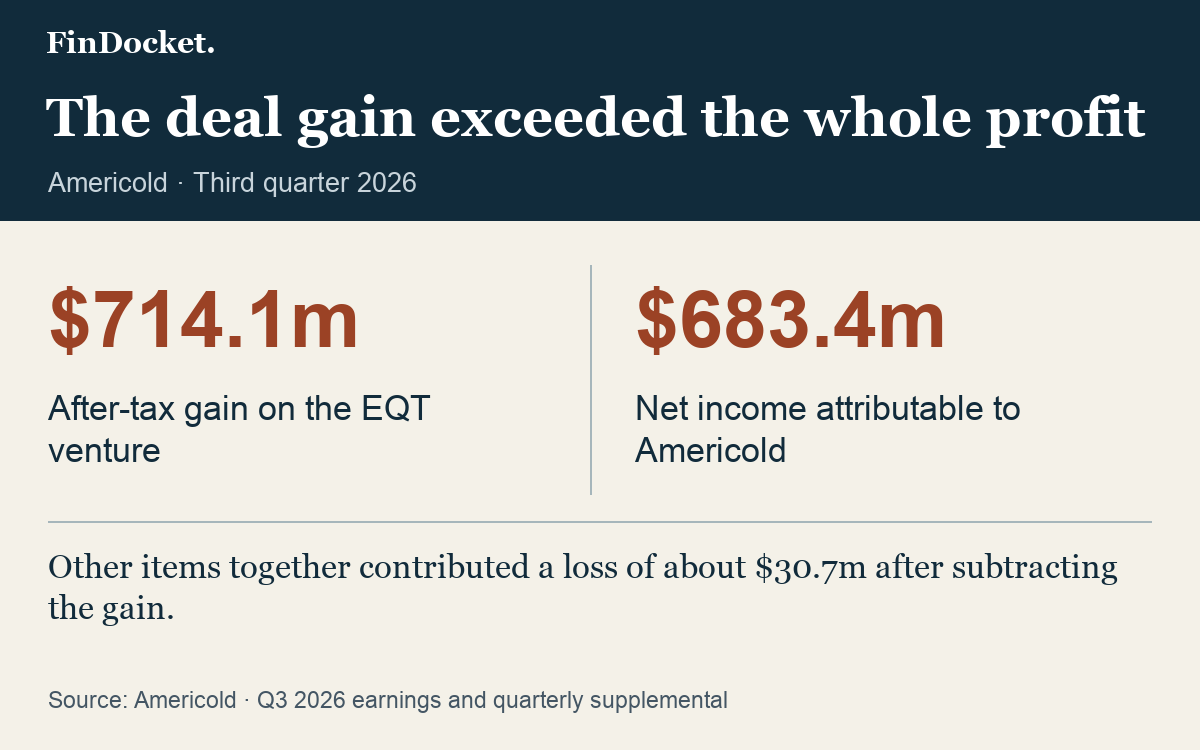
Quarterly net income attributable to Americold was $683.4 million. The earnings release identifies a $714.1 million after-tax gain associated with forming the EQT venture. Core FFO fell to $66.9 million from $81.7 million, while adjusted FFO was nearly unchanged at $101.3 million versus $100.7 million. Both FFO measures are non-GAAP.
The contribution gain exceeds the entire attributable profit. That makes the direction of the accounting effect unmistakable: the very large earnings figure does not represent a comparable surge in recurring cold-storage profitability. The difference between Core FFO and adjusted FFO also shows why selecting only the most favorable adjusted number can conceal meaningful changes in the earnings bridge.
A property transaction can create real economic value by monetizing assets at an attractive price. Its accounting gain measures something narrower: the excess over the relevant carrying amounts and other accounting adjustments. Neither concept establishes how much rent, service profit or distributable cash the retained operations will generate next quarter.
What did the EQT transaction accomplish?
The August closing announcement describes twelve facilities with more than $1.3 billion of gross asset value. EQT acquired 70% of the venture, Americold retained 30%, and Americold remains manager. The November investor presentation estimates approximately $50 million of annual interest savings following debt repayment and identifies a four-year first-look arrangement for North American development opportunities.
The interest saving is an expected financing benefit, rather than a substitute for the income given up on the sold ownership interest. Evaluating the transaction requires comparing interest avoided and net management earnings against the former property contribution, retained obligations and future capital requirements.
Retaining operational responsibility can preserve customer relationships and create fee income without funding every dollar of property equity. It also means Americold's operating performance remains relevant to assets that are no longer fully consolidated. The financial boundary changes more than the daily work at the warehouses.
The development arrangement adds a potential funding partner. Its value depends on future project economics and terms. Access to capital supports growth only when the return on completed capacity exceeds the full cost of building, operating and financing it.
Which obligations stayed with Americold?
The 10-Q records a $46.8 million income-shortfall liability for a support arrangement capped at $100 million of aggregate payments over as long as ten years. It also records $37 million for scheduled deferred capital spending through 2035 and an $8.9 million initial fair-value liability for guaranteeing 15% of the venture's closing debt. One facility remained on Americold's books, with a $72.4 million repurchase obligation.
These amounts describe different economic and accounting exposures. The guarantee's recorded fair value is not its full guaranteed principal. The support liability is a valuation of contingent future payments, rather than cash already paid. The repurchase obligation concerns a particular facility, while deferred capital spending concerns future work at venture properties.
Adding all four numbers and calling the total an immediate cash bill would misstate the arrangement. Ignoring them would overstate the completeness of the exit. The appropriate analysis follows each obligation's payment trigger, timing and interaction with the retained equity interest.
Where did warehouse improvement actually come from?
The supplemental's same-store comparison shows NOI increasing to $180.933 million from $170.704 million. Services NOI rose to $51.569 million from $41.206 million, while rent-and-storage NOI slipped to $129.364 million from $129.498 million. Physical occupancy improved to 70.0% from 65.4%; throughput increased 4.1%.
Services supplied slightly more than the entire increase in property NOI, offsetting the small storage decline. This is a more precise description of the recovery than assuming stronger occupancy automatically means higher storage profitability.
Cold storage combines a capacity business with a handling business. Keeping pallets in a temperature-controlled building earns storage revenue; moving and processing them creates service activity and associated labor costs. More throughput can improve asset utilization while also demanding additional operating effort.
The quarter's service improvement shows that additional activity translated into incremental property profit. Sustaining that outcome requires preserving productivity and pricing as volumes change. Meanwhile, the storage comparison establishes an unfinished part of the recovery: more occupied positions have yet to deliver higher rent-and-storage NOI in this pool.
How much cash remained after distributions?
Nine-month operating cash was $224.266 million, against $198.9 million of dividends and distributions. Additions to property, buildings and equipment consumed $346.5 million. Those figures come from the 10-Q and cover the period before and after the August transaction.
Distributions absorbed approximately 88.7% of operating cash, leaving about $25.4 million before property additions. Subtracting all those additions produces a roughly $321.1 million shortfall after distributions. This calculation includes growth spending and is therefore not a maintenance-only measure of dividend affordability.
It does establish that the investment program required funding beyond retained operating cash. Transaction proceeds helped reshape that funding position, but selling ownership interests cannot be treated as recurring operating generation.
Americold's next meaningful test is whether service gains spread into storage profitability and produce more cash after distributions and necessary reinvestment. The EQT transaction bought financing room. The remaining warehouse portfolio must now earn enough to justify the capital and support commitments that stayed behind.