Business · Analysis
Would an asteroid be economic to mine even if it were already on Earth?
A worked example in grams per tonne explains how grade and recovery affect economics before transport costs even enter the picture.
An asteroid-mining debate poses an unusually clean thought experiment. Put the object on Earth at zero transport cost. Would its metal distribution alone make mining impossible? A conclusion still requires a measured grade, a recovery assumption, expected costs and the price of what can be sold.
Imagine material containing one gram of a target metal per tonne and a recovery rate of 70%. At a hypothetical $100 per gram, the recovered product would generate $70 per tonne before costs. At one tenth of a gram per tonne, it would generate $7 under otherwise identical assumptions. The geometry of a deposit can affect the amount of material that must be handled, but the presence or absence of visible veins cannot settle the commercial calculation by itself. Neither illustrative grade is a measurement of an asteroid.
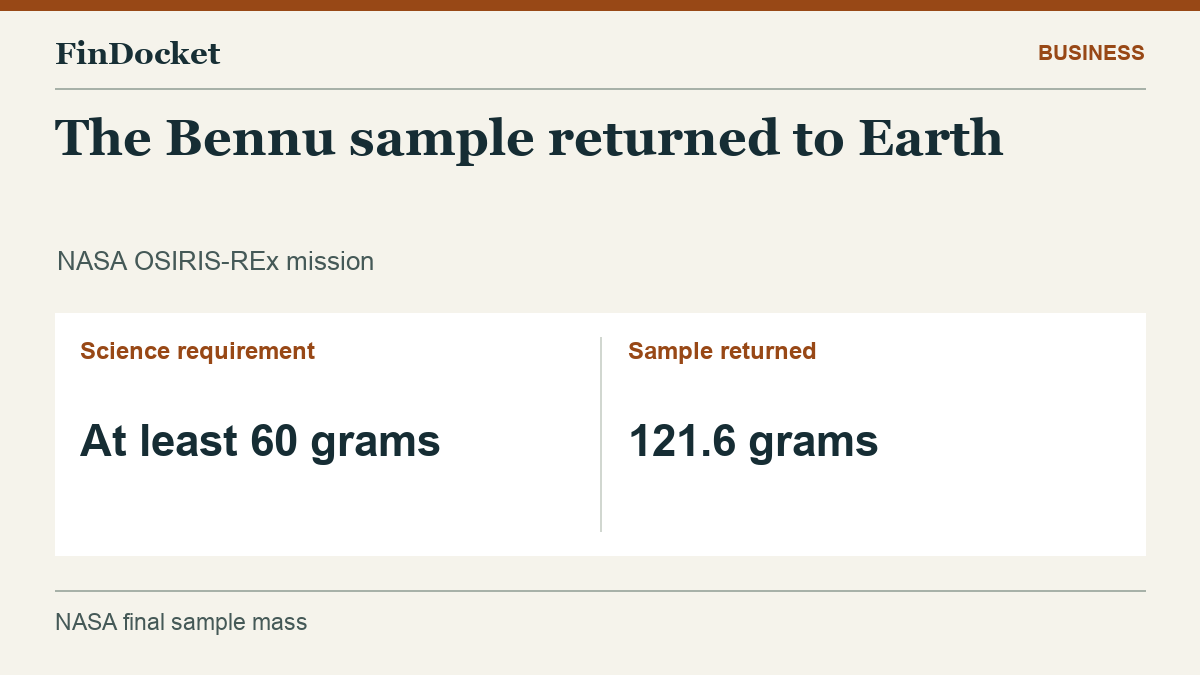
NASA’s OSIRIS-REx mission delivered 121.6 grams of Bennu material against a science requirement of at least 60 grams. A scientific sample can be worth recovering for the information it contains, even when selling its constituents would never cover the mission's cost. Nor does the sample establish an economically recoverable gold grade for Bennu or another target.
Once transport is reintroduced, the location of the buyer matters as much as the location of the material. A product valuable for use in space and a commodity delivered to Earth have different alternatives and delivery costs. An economic claim needs to name both the product and its destination.