Business · Analysis
Baxter Q3 2026: The Debt Gain Behind Reported Earnings
Baxter's Q3 SEC filings reveal a discounted debt repurchase, offsetting earnings adjustments and stronger cash flow. We examine what the recovery actually earns.

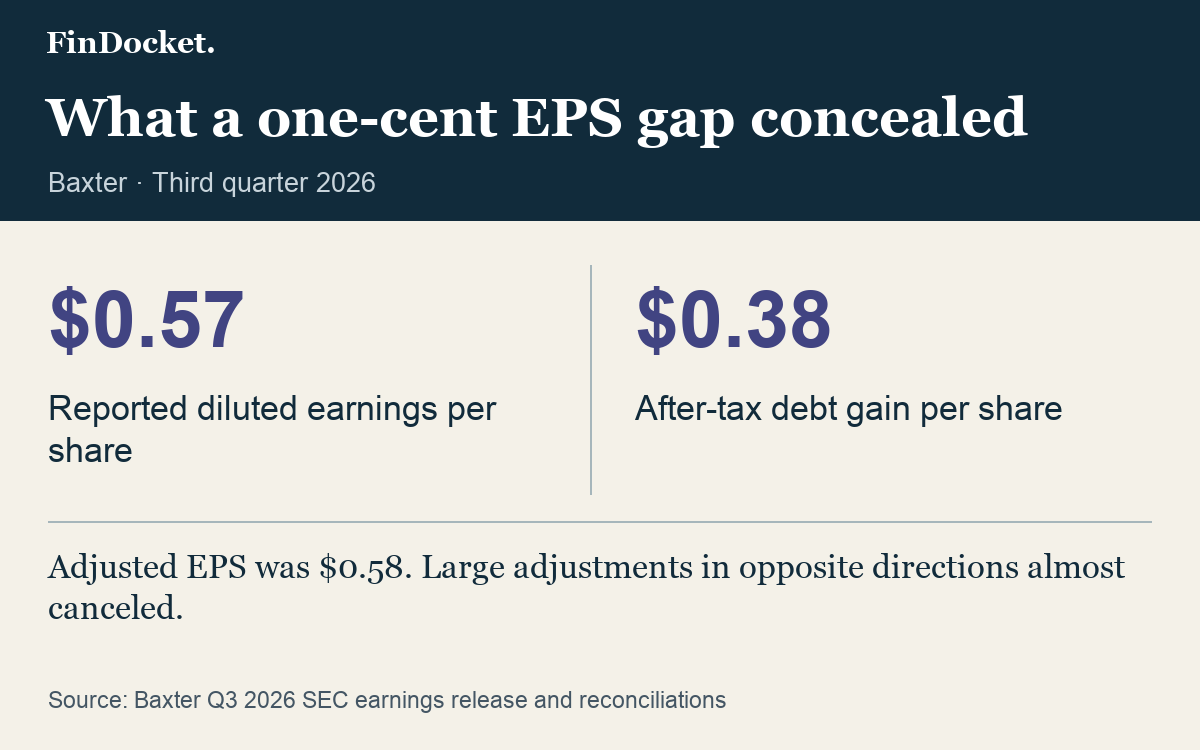
Baxter's third-quarter 2026 results show a business improving its cash generation while repairing its balance sheet. The headline earnings comparison conceals the mechanism: GAAP diluted earnings of $0.57 and adjusted earnings of $0.58 are nearly equal because large positive and negative adjustments cancel.
That agreement does not mean the quarter was free of unusual items. A discounted debt repurchase created a substantial accounting gain, while amortization, restructuring and other adjustments moved earnings in the opposite direction. Understanding those offsets gives a clearer view of the company's operating recovery.
Why are Baxter's GAAP and adjusted earnings so close?
The SEC earnings reconciliation removes a $253 million pretax debt-extinguishment gain, equivalent to $195 million after tax or $0.38 per share. It adds back $145 million of intangible amortization, worth $0.21 per share after tax, alongside business optimization and transformation costs.
The reconciliation also removes a net legal benefit and adjusts tax matters. The combined effect increases net income attributable to Baxter shareholders by only $5 million, from $294 million to $299 million.
The $5 million net adjustment therefore understates the scale of the underlying changes. The after-tax debt gain alone is 39 times that net difference. Reading only the final GAAP-to-adjusted gap would miss the economic character of the quarter.
Amortization represents the accounting consumption of acquired assets. Restructuring often involves cash payments intended to lower future costs. A debt repurchase gain arises from eliminating a liability below its carrying value. These items have different implications for future earnings and available cash, even when they offset in the current income statement.
Buying back debt created value without creating operating revenue
The Form 10-Q details four note series repurchased in August. Their principal amounts total $864 million, against aggregate purchase prices of $600 million. Baxter consequently retired approximately $1.44 of face-value debt for every dollar deployed.
The $264 million difference between principal retired and purchase consideration is a face-value discount; the recorded accounting gain was $253 million. Those figures measure different things and should not be substituted for one another.
Discounted debt retirement can improve the balance sheet efficiently. It reduces contractual principal due and eliminates the interest attached to the retired notes. However, the gain is not revenue from hospital customers, and repurchasing the debt consumes cash rather than supplying operating cash.
The maturity mix also matters. Three series mature in the 2040s or 2051, with another due in 2032. The transaction reduces future obligations, but it is not equivalent to eliminating $864 million of debt that would otherwise have required repayment next quarter.
Baxter also amended its revolving-credit agreement to increase the permitted maximum net leverage ratio for five fiscal quarters through September 2027. The company reported compliance and no revolver borrowing at quarter-end. Covenant flexibility supports financial room; it does not itself reduce outstanding obligations or replace operating execution.
Tax explains much of the adjusted EPS decline
Adjusted operating income increased from $423 million to $432 million, yet adjusted pretax income edged down from $372 million to $371 million. Adjusted tax expense rose from $19 million to $68 million, lifting the effective rate from 5.1% to 18.3%.
That $49 million tax increase explains almost all the $50 million decline in adjusted income from continuing operations. Operating improvement and weaker adjusted per-share earnings can therefore coexist without contradiction.
The relevant conclusion is narrower than either headline suggests. Baxter did not suffer a comparable collapse in adjusted operating profit, but modest operating growth also failed to deliver higher pretax earnings. Interest and the rest of the earnings bridge absorbed the improvement before a less favorable tax comparison reached shareholders.
Forecasts should therefore build the operating margin, financing expense and tax rate separately. Applying the reported percentage decline in adjusted EPS directly to future operating performance would confuse those drivers.
Stronger cash flow gives the recovery practical substance
Baxter reported $705 million of free cash flow through September, including $448 million in the third quarter. The latter represents approximately 64% of the nine-month total, indicating a heavily weighted cash contribution late in the period.
Cash generation gives management resources to fund remediation, invest in products and reduce obligations. Its quarterly concentration also makes the next working-capital movements important. A strong collection period can materially improve reported cash without establishing an identical quarterly run rate.
The debt transaction illustrates the distinction. Cash generated by operations can finance repurchases of discounted liabilities, but the associated accounting gain must not be counted again as an additional operating funding source. Otherwise the same capital allocation decision would inflate both perceived earnings capacity and perceived cash generation.
What must improve next?
Baxter raised its full-year organic sales-growth outlook to 3%–4% and adjusted EPS guidance to $2.05–$2.15. The EPS midpoint increased to $2.10 from $2.05, approximately 2.4%, as the lower bound rose and the upper bound held steady.
The updated range signals a stronger expected floor rather than a dramatically higher ceiling. Management still needs to translate growth into greater recurring profit while completing the operational changes associated with its smaller portfolio.
Segment comparisons require the recast reporting structure introduced during 2026. Pharmaceuticals is now included in Medical Products & Therapies. Comparing the new segment with an unrecast historical figure would manufacture a growth signal from an organizational change.
The decisive evidence will be recurring operating earnings after corporate costs, sustained cash conversion and fewer demands from restructuring and product remediation. Baxter's debt repurchase strengthened its financial position. Its longer-term earnings case depends on hospital products and technology generating enough incremental cash to continue that repair after the one-time gain disappears.