Business · Analysis
Toronto’s reported $115 million relief deal carries a $23 million annual price
A reported five-year relief deal averages $23 million a season. The club’s full payroll determines the tax consequences.
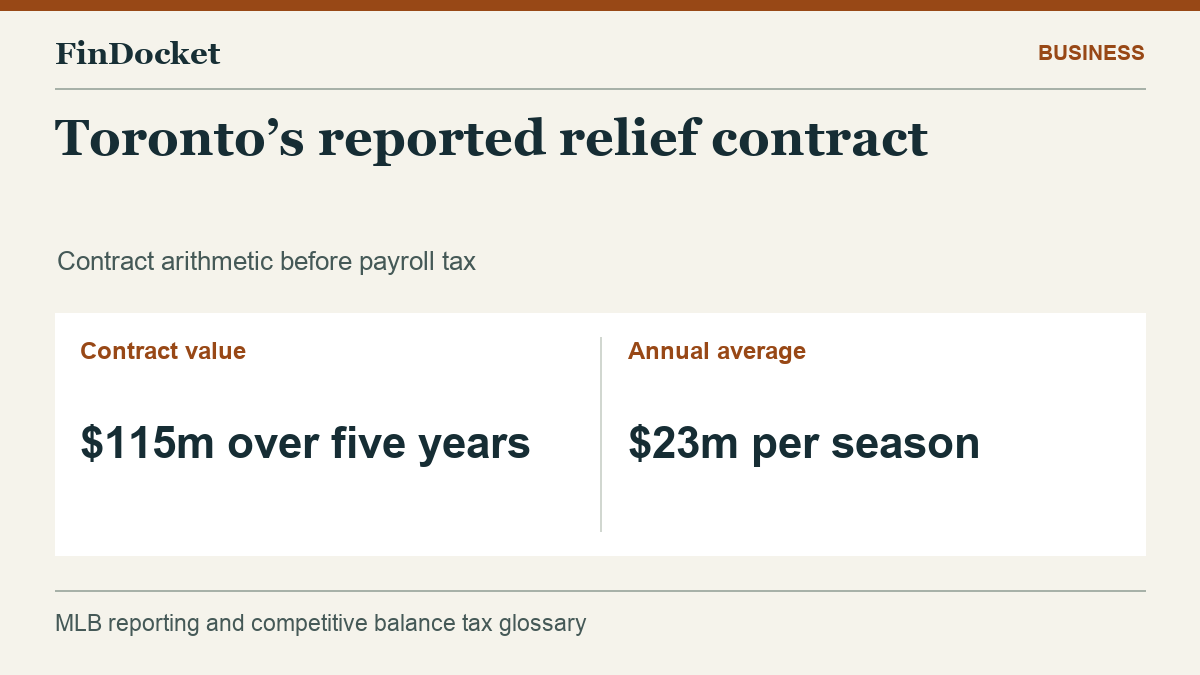
The Blue Jays’ reported agreement with relief pitcher Adrian Morejon puts a price on a scarce service. Five years and $115 million implies a simple average of $23 million per season. That is the right starting point for comparing contracts of different lengths. It is insufficient for estimating payroll tax or even the cash leaving Toronto’s account next year.
Major League Baseball’s competitive-balance tax looks at a club’s aggregate payroll for tax purposes, including average annual contract values and specified benefits. The tax applies above a threshold. Under the rules MLB describes, the tax rate also depends on how many consecutive years a club has exceeded the threshold, with additional surcharges at higher levels. An individual signing therefore has no universal tax rate attached to it.
How much room was left?
Imagine a simplified payroll system in which a club has $10 million of headroom before a threshold. Adding $23 million of charge would put $13 million above it. Another club already sitting on the threshold would put the whole $23 million above it. Those are different marginal costs for the same player. They are examples, not estimates of Toronto’s payroll.
The remaining questions concern the actual contract’s payment schedule and terms, Toronto’s other commitments and the rules governing each season covered. For the business of building a roster, compare annual commitments first. Then ask how the next dollar changes the team’s overall payroll position.