Business · Analysis
Boeing Q3 2026: Customer Advances Fund the Inventory Build
Boeing's Q3 SEC filing shows customer advances supporting cash generation while commercial aircraft remain loss-making and inventory absorbs capital.

Boeing's third-quarter 2026 results show positive cash generation alongside continuing losses in commercial aircraft. The apparent contradiction is explained partly by the funding cycle: customers pay advances before delivery, while aircraft inventory consumes cash before the sale is completed.
The nine-month SEC cash-flow statement makes that relationship visible. Customer funding has helped support the production system, but the resulting cash cannot be interpreted as an equivalent amount of completed manufacturing profit. Boeing still needs to turn the inventory and commitments into profitable deliveries.
What did Boeing report in Q3 2026?
Quarterly revenue was $24.188 billion and operating income was $354 million. Operating cash flow was approximately $1.5 billion, with free cash flow of approximately $0.5 billion. Commercial Airplanes reported $10.720 billion of revenue and a $697 million operating loss. Global Services earned $1.019 billion on $5.574 billion of revenue.
The service business therefore supplied substantial profit while commercial manufacturing remained below breakeven. The difference illustrates why a consolidated cash headline is insufficient to assess the state of the aircraft recovery.
Commercial Airplanes' loss is approximately 6.5% of revenue. Global Services' operating margin is approximately 18.3%. The profitable aftermarket and support operation provides an important earnings contribution, but it does not eliminate the need to improve the economics of building and delivering aircraft.
The commercial division must ultimately generate a return on the capital tied up in production. Customer financing can support that process; it cannot permanently substitute for an adequate manufacturing margin.
Advances offset a large inventory cash requirement
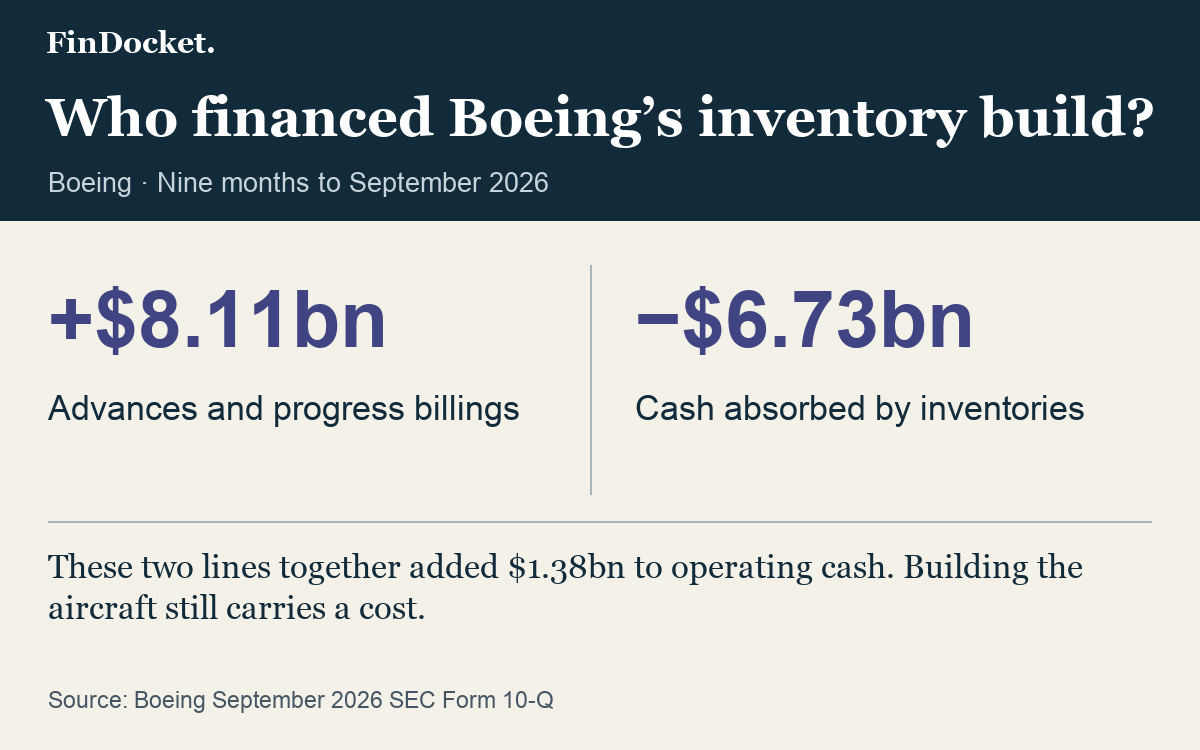
The nine-month filing reports $8.113 billion of cash provided by changes in advances and progress billings, against $6.733 billion used by inventory changes. Operating cash flow totaled $2.681 billion, while capital expenditures were $3.040 billion.
The advance contribution exceeded the inventory use by approximately $1.380 billion. Operating cash less capital expenditures was approximately negative $359 million across the nine-month period, despite the positive latest quarter.
These calculations show both progress and the remaining funding challenge. The company generated cash in the third quarter, but cumulative capital spending still exceeded operating cash through September.
Removing only the advance contribution from reported nine-month operating cash would produce an illustrative negative $5.432 billion. That is not a forecast or a normalized cash-flow measure: customer advances are a legitimate part of aircraft financing. It shows how important that financing source was to the reported result.
The key economic question is whether Boeing can deliver the aircraft at a cost that leaves sufficient profit after the advance is applied to the purchase price. The cash arrives earlier, but the production obligation remains.
Why inventory is more than a balance-sheet number
Aircraft manufacturing requires significant work before a customer accepts delivery. Components, labor and production costs can accumulate while the sale remains incomplete. That timing makes the cash cycle longer than in many ordinary manufacturing businesses.
The inventory balance can represent future earning capacity if the aircraft are completed and delivered profitably. It can also represent capital waiting on production progress, certification, rework or customer acceptance. The financial value depends on what is required to convert the recorded asset into final cash.
Higher inventory is therefore not automatically evidence of stronger demand or deteriorating execution. The relevant analysis asks why it increased, how close the underlying aircraft are to delivery and what costs remain.
A successful recovery would turn that capital into deliveries without repeatedly adding more cost than the sales economics can support. Strong order demand helps establish the customer opportunity; production execution determines the return.
The prior-year charge dominates the operating comparison
The SEC filing identifies a $4.9 billion reach-forward loss recognized in Commercial Airplanes in the prior-year period. The release notes that the earlier quarter's commercial margin was affected by the 777X charge.
The absence of such a large charge creates a dramatic reported improvement even before evaluating the current manufacturing result. That is why the current $697 million commercial operating loss is more informative about remaining work than the size of the year-over-year earnings swing alone.
A reach-forward loss recognizes an expected program shortfall before all the related costs are paid. Its later absence does not create a new cash profit; it means the earlier estimate is not repeated in the same form.
Program-accounting comparisons therefore need to distinguish current execution, changes in estimated lifetime economics and the timing of cash expenditures. Otherwise, a large improvement in reported earnings can be mistaken for a fully restored production margin.
Backlog provides opportunity over a long horizon
Boeing's filing reports approximately $745.4 billion of backlog, with about 17% expected to convert to revenue through 2027 and 57% through 2030. Those percentages describe cumulative conversion horizons, rather than standalone annual growth forecasts.
Applying them implies roughly $126.7 billion through 2027 and $424.9 billion through 2030. The later cumulative amount includes the earlier period; adding the two would double-count part of the same work.
The commercial opportunity is substantial, but backlog is revenue before fulfillment cost. Its value to shareholders depends on delivery timing, contractual terms and the margin left after completing the aircraft and support commitments.
The backlog consequently supports the need for production investment while making the execution burden equally clear. A longer queue does not make a loss-making delivery profitable by itself.
What would demonstrate a stronger recovery?
The most convincing progress would combine commercial margin improvement with inventory conversion and cash generation that remains positive after capital expenditure across multiple periods. Advances should be evaluated as part of the financing cycle, alongside the obligations they fund.
Global Services continues to provide a valuable profit contribution. The next step is for commercial manufacturing to add sustainable earnings rather than absorb part of that contribution.
Boeing's latest quarter improves the cash picture. The larger test remains converting customer-funded production into profitable deliveries, while reducing the amount of capital waiting inside the manufacturing system.