Business · Analysis
Booking Q3 2026 Earnings: FTC Charge and Buyback Math
Booking Holdings' Q3 SEC filing separates a large FTC accrual from travel growth, while buybacks, merchant bookings and cash flow reshape the shareholder story.

Booking Holdings' third-quarter 2026 earnings combine growing travel activity, a large regulatory accrual and a shrinking share base. Those three forces explain why bookings increased, reported revenue declined and earnings per share still rose.
The financial story is more demanding than simply removing a charge and declaring the business healthy. The operating comparison benefits from identifying the discrete item. Shareholder value still depends on the associated obligation, the cash retained from travel activity and the price paid to repurchase shares.
Why did revenue fall when travel bookings grew?
The earnings release reports 345 million room nights, up 7%, and approximately $54.5 billion of gross bookings, up 10%. Reported revenue declined 1%, while company-defined adjusted revenue increased 9% to approximately $9.8 billion.
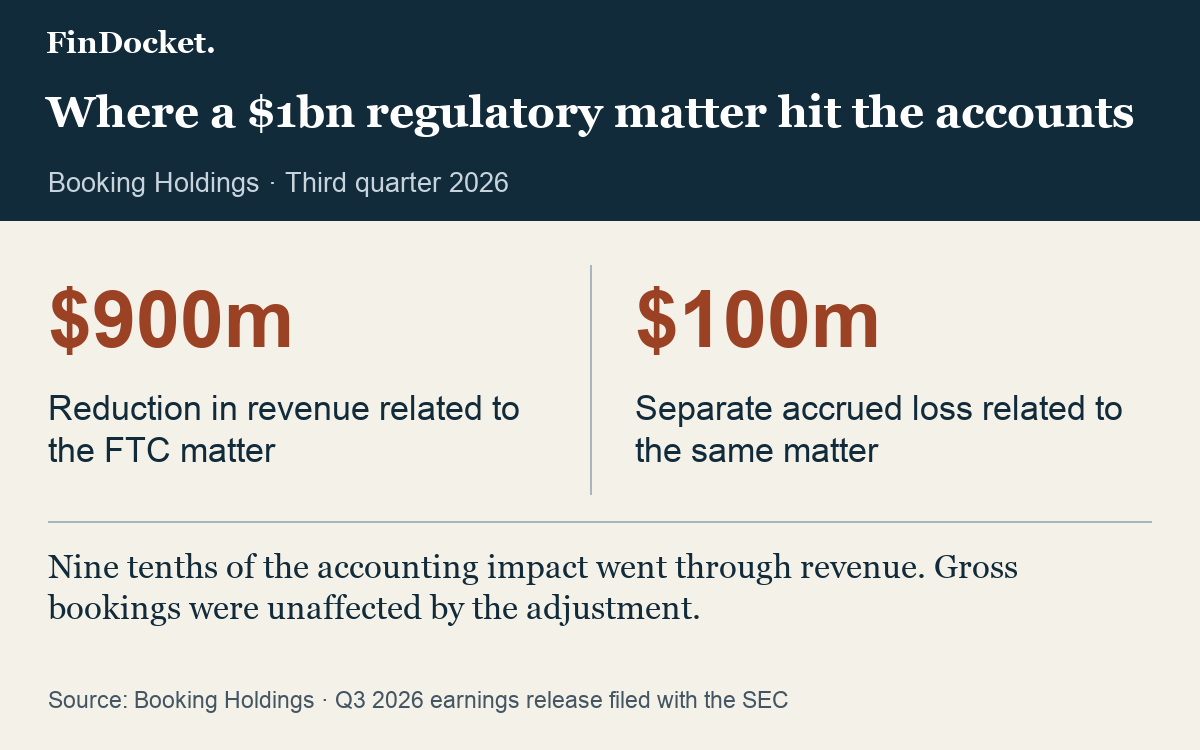
The difference reflects a $900 million revenue reduction related to an FTC matter. The 10-Q also records a $100 million expense accrual. It says Priceline was discussing a resolution after FTC staff recommended a complaint concerning alleged business practices; no settlement had been agreed.
The accounting treatment matters. A reduction to revenue lowers both reported sales and profit. An expense lowers profit without lowering sales. Together, the two entries create a much larger difference between transaction activity and reported operating results than would be visible from room-night growth alone.
Removing the revenue reduction helps compare the current reservation business with the earlier period. It does not mean the underlying obligation is economically irrelevant. A cost connected with earlier customer activity remains a claim on resources even when it is excluded from an adjusted growth measure.
Nor should the recorded accrual be described as a final agreed settlement amount. The filing's distinction between an accounting estimate and a completed resolution is essential to understanding what has actually happened.
What does the operating growth establish?
Room nights measure transaction volume, while gross bookings also reflect accommodation prices, mix and other travel services. Growth in both supports a stronger demand interpretation than booking value alone.
A reservation platform creates value by helping travelers find suitable inventory and helping suppliers reach customers efficiently. It captures part of that value through fees and related services. The number of reservations matters because the platform must spread technology, customer service and corporate costs across those transactions.
Higher booking value does not automatically mean proportionately more profit. A more expensive hotel room can require little extra platform work, which is favorable. A change in geography or product can also change marketing requirements, payment costs and the share of value retained.
The useful operating test is therefore contribution after acquiring and serving the reservation. Gross booking growth identifies the activity available to monetize; the margin earned on that activity determines how much reaches shareholders.
Why are merchant and agency trends diverging?
The filing reports merchant revenue of $6.998 billion, up from $6.131 billion, while agency revenue fell from $2.569 billion to $2.463 billion. Booking.com's continuing shift toward merchant transactions contributed to that divergence.
In a merchant arrangement, the platform takes a more active role in the payment relationship. That can make booking and payment easier for customers and suppliers, while also introducing processing costs and timing differences between collecting money and settling obligations.
The financial assessment should compare the additional service value with its incremental costs. A larger merchant share is not inherently better merely because it is growing faster. It creates value when improved conversion, retention and payment economics exceed the resources required to provide them.
It also affects cash analysis. Collecting before a stay can provide temporary financing, but money associated with an unsettled reservation cannot be treated as though every obligation has already been discharged. Revenue, collections and available surplus are related concepts with different timing.
How much did repurchases contribute to EPS growth?
GAAP net income fell approximately 1% to $2.7 billion, while GAAP diluted EPS increased 7% to $3.61. Adjusted net income increased 8%, while adjusted EPS increased 17%. The release says Booking repurchased $2.1 billion of shares during the quarter.
The difference between profit growth and per-share growth is economically significant. Earnings divided among fewer shares can grow for each remaining owner even when total earnings are flat. This is an ownership effect, distinct from selling more reservations or earning a higher operating margin.
It can be attractive capital allocation when the repurchase price is favorable relative to future cash generation. It can also make headline EPS growth look stronger than the operating improvement. The two observations should be kept separate rather than treating buybacks as either automatically good or automatically cosmetic.
A share repurchase consumes cash today in exchange for a larger claim on future cash per remaining share. The price of that exchange is the central variable.
Are distributions supported by current cash generation?
For nine months, operating cash flow was $8.071 billion and capital expenditures were $251 million. Share repurchase payments were $9.900 billion and dividends were $978 million. Subtracting capital spending leaves approximately $7.820 billion, versus $10.878 billion of those shareholder payments.
The calculated gap is approximately $3.058 billion. It means the period's distributions exceeded operating cash after capital expenditures. A company can bridge such a gap with existing liquidity and financing, but the distribution pace should not be mistaken for the cash produced by current operations alone.
The release's Q4 outlook called for room-night growth of 1%–3% and approximately flat adjusted EBITDA. That makes disciplined capital allocation particularly relevant as growth moderates.
Booking's quarter demonstrates continued demand and a meaningful per-share benefit from repurchases. Its regulatory accrual and cash distribution gap make the next test clear: preserve attractive reservation economics while meeting obligations and buying ownership at a price that improves future cash per share.