Economy · Analysis
The arithmetic inside Lula’s next spending decision
Brazil links spending-limit growth to revenue and past performance against fiscal targets. A worked example shows where the constraints bind.
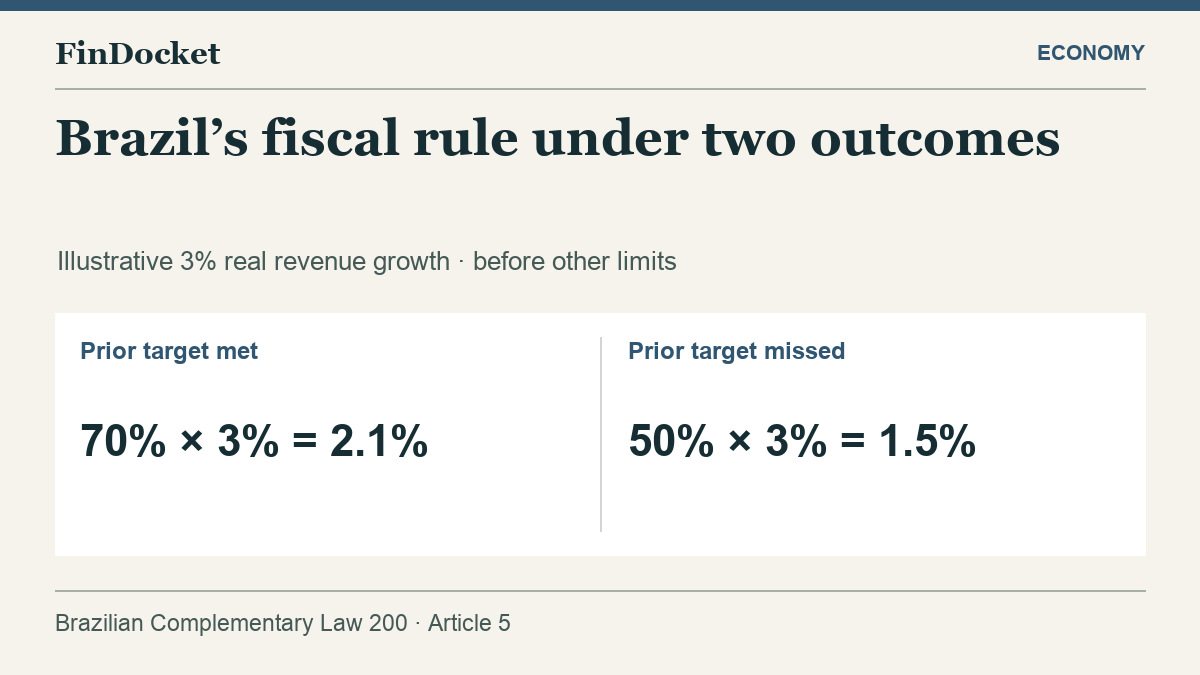
A useful starting point for interpreting Luiz Inácio Lula da Silva’s next spending decision is an equation already written into Brazilian law. Article 5 of Complementary Law 200 links growth in the relevant primary spending limits to real revenue growth. The permitted fraction changes with the government’s prior performance against its primary balance target, allowing for the statutory tolerance interval.
Take a simplified example with 3% real growth in the revenue measure used by the framework. If the applicable target was met, the 70% factor gives 2.1% growth. If it was missed, the 50% factor gives 1.5%. That 0.6-percentage-point difference changes how much additional real spending can fit under the limit, even with identical revenue performance and political preferences.
Where the simple calculation runs out
The statute normally imposes a floor of 0.6% and a ceiling of 2.5% on annual real growth of the spending limits. A November 24 amendment also provides for a 2% ceiling from 2027 in a year when the specified measures apply. The tax base, timing and binding limit therefore matter before translating a campaign commitment into a budget number.
The rule governs covered primary spending limits. It does not forecast interest expense, guarantee that the government will collect its projected revenue or decide which program gets priority. A budget can protect a favored program while squeezing another. For investors, the test is whether the proposed budget’s revenue base, target outcome and statutory spending limit fit together.