Business · Analysis
Broadcom Q3 FY2026 Earnings: AI Cash and Financing Exposure
Broadcom's SEC filing pairs powerful AI earnings and cash generation with customer-financing exposure and changing software contract economics.

Broadcom's third-quarter fiscal 2026 earnings show exceptional growth in AI infrastructure revenue, operating profit and cash. The filing also reveals a broader commercial role: Broadcom is helping customers access financed computing capacity while retaining exposure to their lease performance. Software contract changes add another dimension to the interpretation of growth.
The company is therefore generating cash today while building commercial relationships whose economics extend well beyond the initial shipment. The investment case depends on the profit retained from that expansion, the cash collected and the obligations assumed to enable customers to buy.
How much AI growth reached operating earnings?
Revenue increased 86% to $29.591 billion, GAAP operating income reached $15.955 billion and quarterly free cash flow was $13.665 billion. AI semiconductor revenue was $16.7 billion, up 221%. Management projected fourth-quarter revenue of approximately $34.8 billion, including $21.7 billion of AI semiconductor revenue.
FinDocket calculates that AI represented approximately 56.4% of the quarter's total sales. The forecast implies that proportion increasing to about 62.4%. The company is becoming more concentrated in the economics of AI infrastructure even as its absolute software and other semiconductor businesses remain substantial.
The incremental GAAP operating margin was approximately 73.8%: the $13.639 billion sales increase produced $10.068 billion of additional operating income. This is powerful evidence that a larger revenue base is scaling through the cost structure effectively.
The result also shows why investors should evaluate profit dollars alongside percentage margins. A hardware-heavy sales mix can carry different gross margins from software while still delivering attractive incremental operating earnings. The value depends on the contribution retained after engineering, customer support and commercial obligations, rather than on a single consolidated percentage.
What does the $29 billion backstop cover?
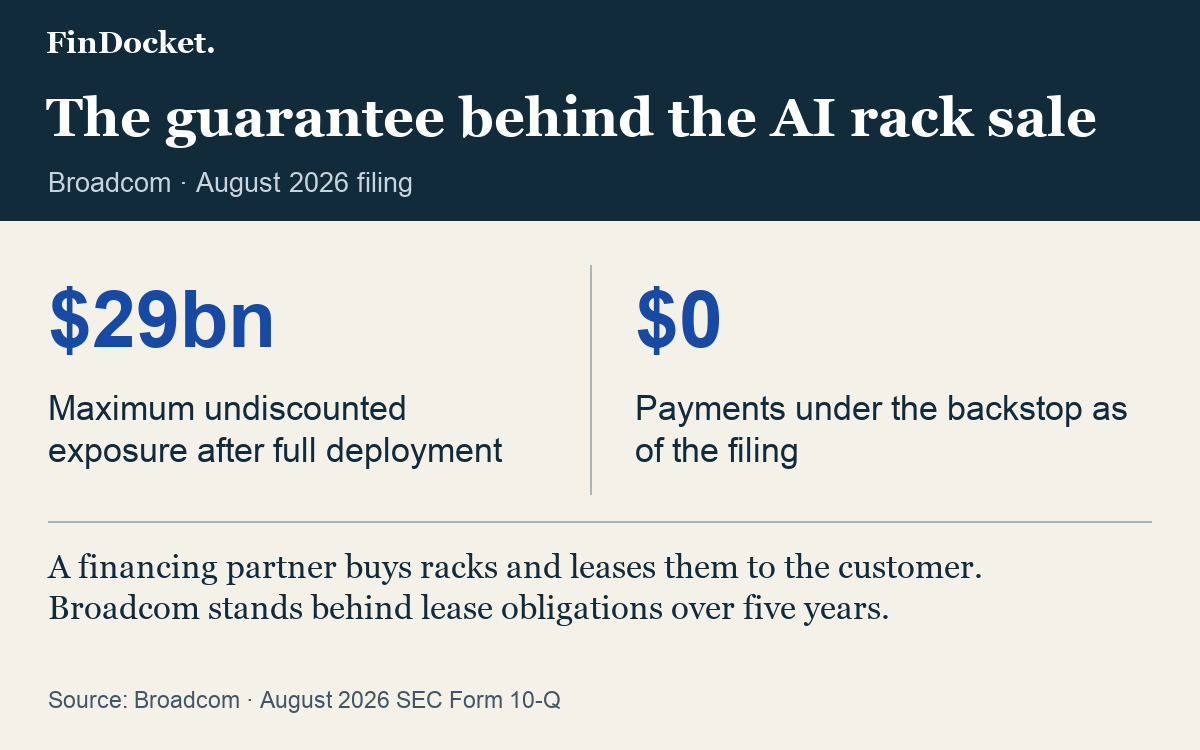
Broadcom arranged for a financial partner to purchase AI racks and lease them to a customer. Its backstop grows as racks are deployed and declines as lease payments arrive. The filing disclosed approximately $29 billion of maximum potential liability after full deployment, with immaterial fair value and no payments made under the arrangement.
That maximum is a contingent exposure rather than cash already spent. The distinction is fundamental: a financial guarantee can have a modest current accounting value while creating a large potential obligation under a particular adverse outcome.
The contract's default mechanics also matter. Broadcom's liability is linked to 85% of outstanding backstopped amounts less the value recovered from selling the racks, with specified remedies available to limit exposure. The resulting economics depend on both the customer's payments and the assets' recoverable value.
This links credit performance to technology resale value. If financed systems retain utility and a liquid secondary market, recoveries can offset an unpaid balance. If architecture changes quickly or equipment demand weakens at the same time that a customer defaults, both protections can deteriorate together.
A simple scale comparison puts the maximum potential exposure at approximately 2.1 times current quarterly free cash flow. That comparison measures size only; it supplies no probability of default or expected loss. The investment question is whether the incremental commercial return adequately compensates Broadcom for assuming that exposure.
Software growth includes a change in contract economics
The filing reports $3.465 billion of quarterly upfront license revenue versus $1.916 billion a year earlier. Most new software contracts no longer include termination-for-convenience rights. Infrastructure Software segment operating income increased $2.087 billion to $7.325 billion.
Removing termination rights strengthens the contractual commitment and changes when qualifying license revenue is recognized. The customer relationship may span years, while a portion of revenue is recognized upon transfer of the license. That timing can make current growth stronger than a simple subscription-style interpretation would suggest.
FinDocket calculates that upfront license revenue increased approximately 80.8%. The related $1.549 billion increase was equivalent to about 74.2% of the software segment's operating-income increase. This is a scale comparison rather than a causal profit bridge, because other revenue and expense changes also affect the segment.
The appropriate test connects commitments, revenue recognition and collection. Stronger contractual terms can improve commercial value, but a larger recognized license amount is different from cash received immediately. Investors need to follow contract assets and future billing as well as reported software profit.
Is cash generation keeping pace with the enlarged business?
For the first three fiscal quarters, operating cash was $32.950 billion and capital expenditures $1.013 billion. Receivables absorbed $6.544 billion and inventory $2.253 billion, partly offset by $2.313 billion from payables. Dividends and program repurchases totaled $17.731 billion, and net debt payments were $6.054 billion.
Cash after capital spending was therefore $31.937 billion. After the two main shareholder distributions, approximately $14.206 billion remained. Subtracting net debt payments leaves $8.152 billion before the other investing and financing movements.
That is substantial internal funding capacity. It distinguishes Broadcom's current cash result from a business whose growth requires shareholder returns to be financed primarily through new borrowing. The company is funding distributions, debt reduction and a cash balance increase while supporting a larger operating footprint.
Working capital still deserves attention. Receivables and inventory together absorbed $8.797 billion, and payables funded about 26.3% of that amount. Growth in profitable shipments must continue through customer collections for the earnings expansion to remain self-financing.
What should the next filing demonstrate?
The next test is the connection between three expanding activities: AI product deliveries, software commitments recognized upfront and computing capacity supported by financing arrangements. Each can create value, but each has a different cash and obligation profile.
Broadcom's latest quarter provides strong evidence of current profitability and cash generation. The financing backstop increases the importance of customer credit and asset recovery, while software contract changes increase the importance of billing and collection timing.
The strongest continuation would combine profitable shipment growth with cash collection, controlled procurement and a clear return on the commercial exposure assumed. That would demonstrate that the enlarged AI business is improving the earnings claim of existing shareholders after the full cost of enabling customer demand.