Business · Analysis
Carrier Q3 2026: Tariff Refunds Change the Margin Story
Carrier's Q3 SEC filing reveals how tariff refunds support adjusted margins, while a European goodwill charge raises a separate capital-allocation question.

Carrier's third-quarter 2026 results contain a real operating recovery, a significant refund benefit and a large reassessment of acquisition value. Those three developments answer different questions. Combining them into a single adjusted growth rate obscures what the business earned from selling equipment and services during the quarter.
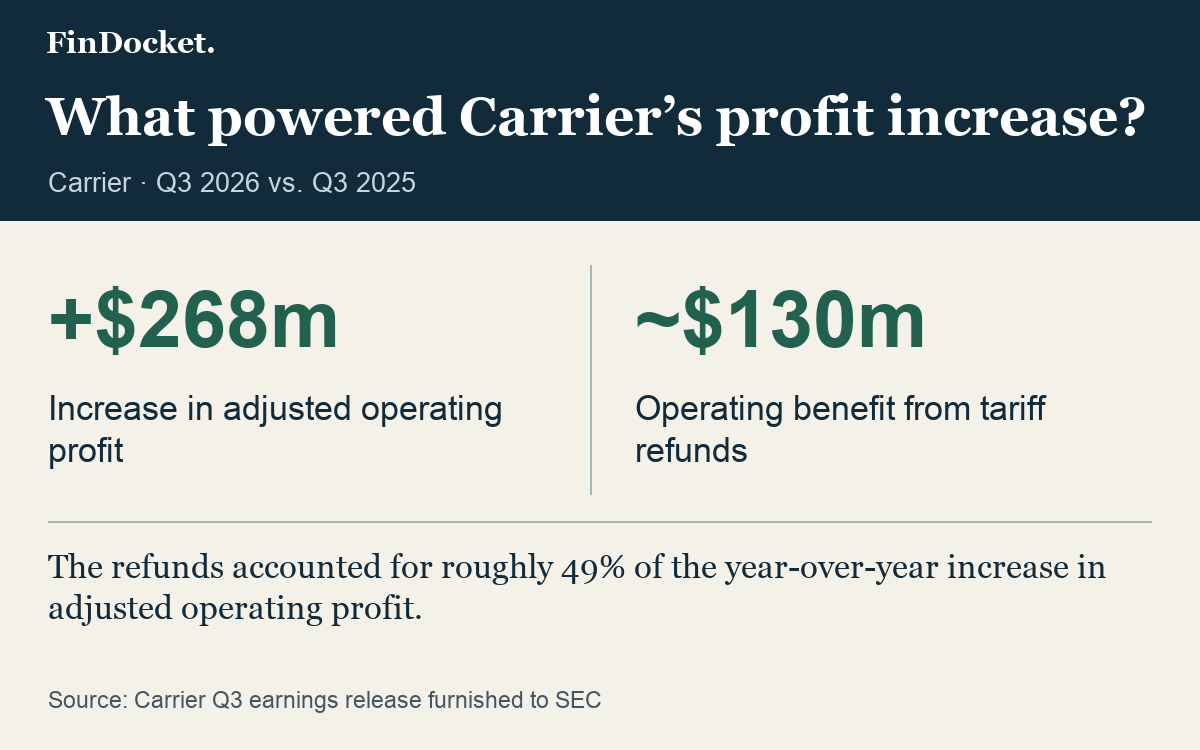
The clearest finding is that tariff refunds account for almost half the increase in adjusted operating profit. Sales growth still produced additional earnings after removing that benefit, but the underlying margin expansion was considerably smaller than the reported adjusted improvement.
What did Carrier report in Q3 2026?
Sales reached $6.263 billion, compared with $5.579 billion. Adjusted operating profit rose to $1.091 billion from $823 million, with adjusted margin increasing to 17.4% from 14.8%. Adjusted EPS rose to $0.87 from $0.67. Approximately $130 million of operating profit came from IEEPA refunds; the adjusted EPS benefit was approximately $0.10 after the noncontrolling-interest effect.
Subtracting the refund produces illustrative operating profit of $961 million. That is approximately 16.8% above the prior-year adjusted result, compared with reported growth of approximately 32.6%. On current sales, the resulting margin is approximately 15.3%.
This calculation is FinDocket's analytical adjustment, rather than another company earnings measure. It isolates the size of the identified benefit while retaining the other adjustments in Carrier's reported non-GAAP result.
Approximately $138 million of the $268 million adjusted profit increase remains after the subtraction. That supports the case for improved operations. It also establishes that the headline 260-basis-point margin expansion is an unsuitable recurring baseline without a comparable refund contribution.
The Americas margin tells the same story more sharply
Carrier's presentation reports Americas sales of $3.354 billion and segment operating profit of $745 million, versus $2.711 billion and $533 million. The segment received approximately $120 million of refund benefits. Its published margin rose to 22.2% from 19.7%.
Removing that benefit leaves approximately $625 million of segment profit, or an illustrative 18.6% margin. Under this calculation, earnings still increase approximately 17%, while sales increase approximately 24%. The normalized incremental profit on additional sales is about 14.3%.
That is below the previous year's average segment margin. The arithmetic indicates that the reported margin increase cannot be attributed entirely to better production economics or stronger mix. The refund is large enough to change the direction of the margin comparison.
The implication is practical. A forecast that applies the published quarterly margin to a larger future revenue base would capitalize a benefit that may not recur at the same scale. A forecast anchored to the lower illustrative margin gives greater weight to operating execution, pricing and cost recovery.
Neither exercise assumes that refunds are worthless. They increase economic resources available to shareholders. The issue is the period over which those resources should be treated as repeatable earnings.
Goodwill impairment concerns the purchase price already paid
The SEC filing records a $3.1 billion goodwill impairment in Climate Solutions Europe. Carrier links the reassessment to reduced projected operating results, weaker demand, a changed pace of conversion from boilers to heat pumps, higher interest rates and challenging macroeconomic conditions. The charge was largely responsible for the quarter's GAAP loss and was not deductible for income-tax purposes.
An impairment does not require Carrier to pay another $3.1 billion at the moment the expense is recognized. The money associated with an acquisition was committed earlier. The accounting charge recognizes that the expected value supporting part of the recorded asset has fallen.
That distinction prevents two analytical errors. Treating the charge as a fresh operating cash outflow overstates the quarter's financing requirement. Ignoring it entirely because it is excluded from adjusted earnings understates the consequences of earlier capital allocation.
A business can improve its current operating performance while the expected return on its historical acquisition price declines. These outcomes are compatible. The operating question concerns the profit earned on today's sales; the acquisition question concerns the value of future cash flows relative to the amount invested.
Carrier therefore needs two scorecards. One should measure current equipment demand, pricing and service economics. The other should assess whether the European operation can produce a satisfactory return on the capital already committed, including the original purchase premium.
Backlog and long-term commitments require separate treatment
Management's presentation identifies backlog above $8.5 billion and long-term agreements with minimum-volume commitments that are additional to backlog. Those agreements strengthen the demand picture, but adding an unspecified multiyear commitment value directly to a near-term revenue forecast would mix different measures.
Backlog is a stock of future work. Revenue is the portion delivered and recognized during a period. Long-term commitments may provide further visibility, but their timing, pricing mechanisms and execution requirements determine their value to current shareholders.
For cooling systems, a strong order book can also create production demands before cash from final delivery arrives. Capacity, purchased components, engineering and installation coordination all sit between an order announcement and realized earnings.
The useful question is how effectively Carrier converts that visibility into profit after funding the equipment and absorbing input costs. A faster-growing order book supports the opportunity; a sustainable margin and disciplined working-capital cycle determine the economic result.
What should define the next earnings comparison?
The most informative comparison will start with operating profit excluding the identified refund contribution, then evaluate changes in volume, pricing, productivity and input costs. That approach establishes whether expansion is becoming more profitable on its own terms.
Europe requires an additional test: evidence that current demand and future returns support a stable asset valuation after the write-down. A short recovery in sales would be helpful, but the return on invested capital depends on the durability and profitability of that recovery.
Carrier's quarter supports an improving demand thesis. It does not support treating every dollar of adjusted profit growth as recurring operating progress. The distinction between refund income, current trading performance and acquisition value is the central issue for the next stage of the company's earnings story.