Business · Analysis
Charter Q3 2026 Earnings: Cox Savings and Cash Pressure
Charter's Q3 SEC filings separate Cox-driven growth from comparable declines, a franchise impairment and the cash demands behind its new savings program.

Charter's third-quarter 2026 earnings show a larger company confronting a smaller comparable revenue base. The Cox acquisition lifted reported sales, but the combined businesses declined on a pro forma basis. A substantial franchise impairment and weaker cash generation make the newly announced cost program financially important.
The recovery case depends on two outcomes occurring together: stopping customer erosion and removing enough cost to improve cash after network investment. The acquisition expands the platform on which Charter can execute. It does not independently reverse the underlying customer trend.
Why reported growth overstates the operating improvement
Actual quarterly revenue increased 9.1% to $14.922 billion. Pro forma revenue declined 1.5% to $16.505 billion, while pro forma adjusted EBITDA, a non-GAAP measure, fell 4%. The presentation explains that actual results include Cox only after the August 19 closing, whereas pro forma results treat the combination as present throughout the comparison periods.
These figures answer different questions. Actual results show the activity consolidated during the period. The pro forma comparison is more useful for assessing whether the enlarged portfolio is growing on a comparable basis.
An acquisition can increase the first measure without improving the second. That is the situation here. Charter now has more operations, but the existing revenue pool represented by the combined businesses contracted during the quarter.
The difference also matters when comparing debt with earnings. A balance sheet at quarter-end can include liabilities associated with the entire acquisition even when reported quarterly earnings include only a partial contribution. A consistent analysis needs a full-period earnings basis and careful attention to how management defines the resulting ratios.
What does the franchise impairment actually mean?
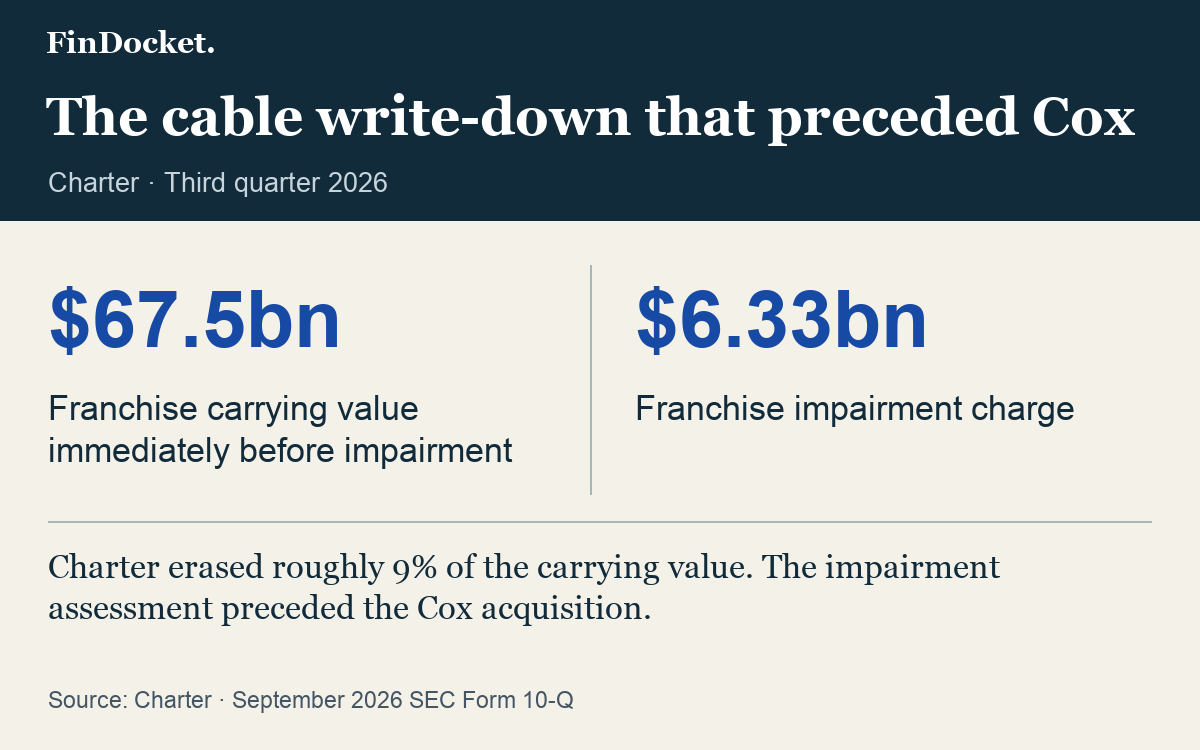
Charter recorded a $6.326 billion noncash franchise impairment. Its 10-Q says the analysis followed a sustained share-price decline and reflected lower projected future customer and revenue growth, alongside higher replacement values for certain fixed assets. The impairment testing preceded the Cox acquisition and excluded the acquired assets.
A noncash charge does not represent a payment of that amount during the quarter. It does represent a reduction in the value supported by the assumptions used to assess the recorded asset.
For Charter, the relevant economic question is the cash attributable to its ability to reach and serve potential customers after allowing returns to other assets. If growth expectations weaken or the required contribution to network assets rises, less value remains attributable to the franchise itself.
The charge therefore should not be dismissed simply because it lacks an immediate cash payment. Its informational value lies in the revised expectations supporting it. Equally, subtracting the entire impairment from quarterly cash generation would confuse an asset valuation adjustment with current expenditure.
The filing also reports that the unimpaired franchise unit's estimated fair value exceeded carrying value by approximately 8%. That limited cushion makes the valuation sensitive to future operating assumptions. The operating turnaround needs to strengthen those assumptions through results.
Can mobile growth offset Internet pressure?
Pro forma Internet revenue declined 3.7% to approximately $7.1 billion, while mobile service revenue increased 17.3% to approximately $1.2 billion. Pro forma residential revenue declined 4.1%; excluding costs allocated to programmer streaming applications and netted against video revenue, the decline was 2.6%.
The difference between those residential measures shows that presentation affects the headline growth rate. It does not eliminate the comparable decline after adjustment.
Mobile can deepen a household relationship and create a reason to retain Internet service. The financial benefit is strongest when those additional services increase contribution after wholesale connectivity, devices, marketing and support costs.
Percentage growth alone does not establish the offset. The mobile business starts from a much smaller revenue base than Internet, so rapid expansion can coexist with a weaker combined household result. Customer retention and contribution per household remain essential to judging whether bundling is improving the economics.
How large is the savings opportunity?
The results presentation targets $2 billion of annualized operating expense savings over 18 months, additional to more than $1 billion of anticipated Cox synergies. It reports $27.3 billion of pro forma last-twelve-month adjusted EBITDA.
A combined savings ambition exceeding $3 billion is equivalent to more than 11% of that EBITDA base. This is a scale comparison, not an earnings forecast. It illustrates why execution can materially affect the financial outcome.
Annualized savings describe an eventual rate, rather than cash delivered immediately or evenly over the implementation period. Transition costs, reinvestment and continuing revenue declines can absorb part of the benefit before shareholders see it.
The quality of the savings matters too. Eliminating duplicated work can improve service and lower cost together. Reducing resources needed to retain customers can worsen the revenue problem. Charter's stated emphasis on customer service and Internet growth needs to be evaluated alongside the expense reduction.
What does current cash generation support?
Actual quarterly free cash flow fell to $674 million from $1.621 billion. The presentation's bridge includes $378 million more cash taxes, $125 million more cash interest and $612 million of unfavorable working capital movements across its device and non-device categories. Actual adjusted EBITDA increased $382 million.
The bridge demonstrates why higher reported EBITDA did not produce higher residual cash. Cash taxes, financing and payment timing can overwhelm the operating increase. Those cash claims cannot be ignored merely because EBITDA excludes them.
Some movements can reverse as timing normalizes. A lasting recovery requires an improvement in recurring cash generation after necessary investment, with transition spending separately visible.
Charter has a meaningful cost opportunity and a larger network platform after Cox. The financial case becomes stronger when comparable customer revenue stabilizes and realized savings survive the cash demands of integration, investment and financing. The latest quarter establishes the need for that improvement more clearly than it demonstrates its arrival.