Economy · Analysis
What changed hands in China’s 6.2 billion kWh green-power trade?
China’s new green-power trade transferred electricity and a claim on its environmental attributes. A corporate buyer needs documentation of both.
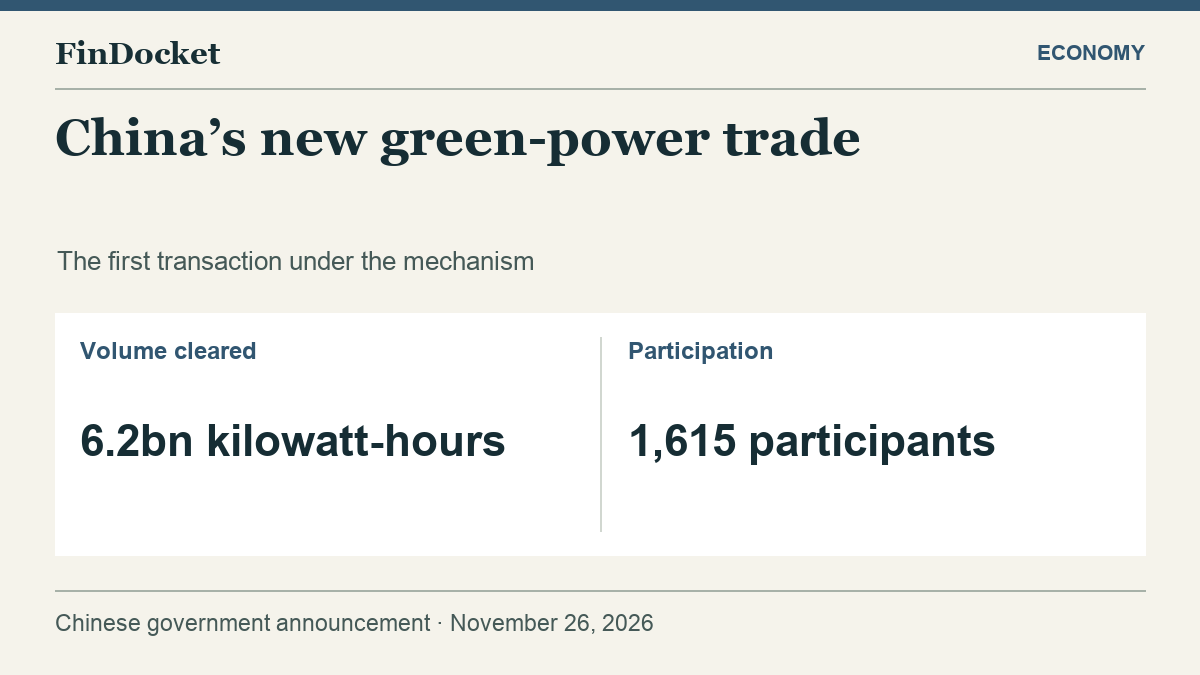
A manufacturer that pays for renewable electricity needs to establish more than the amount on its power bill. It needs the right to claim the environmental benefit of that purchase. China’s November announcement describes a trading mechanism that transfers electricity together with its environmental value and a corresponding green certificate.
The first trade under the mechanism involved 1,615 participants in northwest and east China and cleared 6.2 billion kilowatt-hours, according to the government’s account of State Grid’s figures. That is 6.2 terawatt-hours. It measures the volume cleared in the trade. It cannot establish how much new generating capacity was built as a consequence or the exact mix of electrons reaching any one buyer’s factory.
Why a certificate has financial value
Suppose a supplier sells a factory renewable electricity at a premium. If the environmental claim remained with the supplier, the factory would have paid for an attribute it could struggle to substantiate to a customer. Transferring the supporting certificate makes that claim identifiable. A procurement team can compare the premium with the value of meeting a customer's sourcing requirement and ask who will retain the documentation.
The government also cites a 2030 goal for market-based trading to reach about 70% of total electricity consumption. That is a broader market-design target. Treating it as a promise that renewables will supply 70% of all power would mix up the trading mechanism with the generation mix it serves.