Business · Analysis
Circle Q3 2026: ARC Token Sales Change the Growth Story
Circle's SEC filings reveal how ARC token presale revenue drove quarterly growth while reserve yields pressured USDC income and distribution economics.

Circle's third-quarter 2026 growth came from a new source: recognized revenue from an ARC token presale. The contribution exceeded the company's entire year-over-year increase in revenue and reserve income. That changes how the quarter should be modeled.
The underlying USDC business faced a familiar financial constraint. More average circulation expanded the base earning reserve income, but lower yields reduced the income earned on that base. Circle is building a broader network; this quarter's reported growth does not yet establish that recurring network monetization has replaced interest-rate sensitivity.
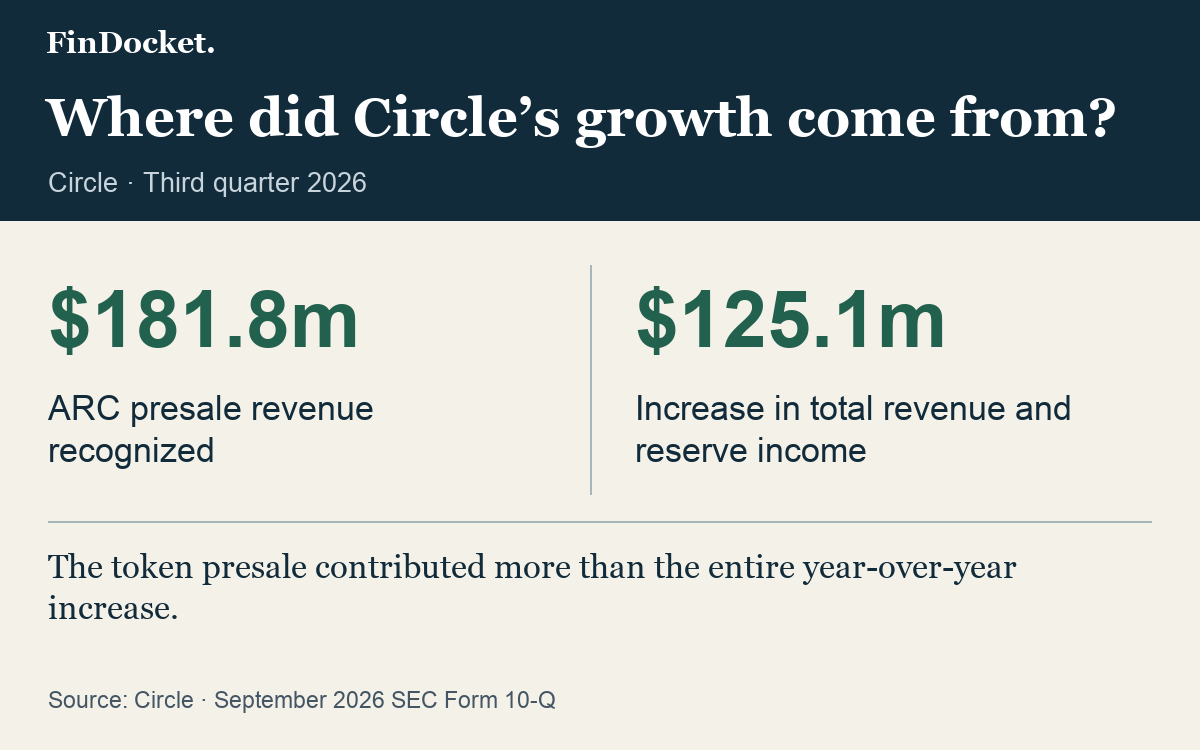
How much of Circle's growth came from ARC?
The SEC earnings release reports total revenue and reserve income of $864.9 million, versus $739.8 million a year earlier. Other revenue reached $207.3 million, including approximately $181.8 million from the ARC token presale. Reserve income declined to $657.6 million from $711.2 million.
Subtracting the disclosed token contribution leaves approximately $683.1 million of revenue and reserve income, about 7.7% below the prior-year total. This calculation isolates the contribution to the revenue comparison; it is not an adjusted earnings figure and makes no assumption about associated costs.
The same exercise within other revenue leaves roughly $25.5 million, compared with $28.5 million previously. The new token activity therefore explains more than the entire increase in that category as well.
Token commercialization is an actual business development. The analytical error would be to extrapolate a milestone-based contribution at the same pace as continuously earned reserve income or recurring service fees. Those streams have different drivers, delivery requirements and recognition patterns.
Why are token proceeds different from current-quarter cash generation?
The quarterly filing says the presale generated approximately $242.2 million of gross proceeds in the second quarter. Revenue was initially deferred. Recognition reflects progress on obligations including token minting and distribution and enhancing functionality through a transition to proof of stake. Approximately $60.4 million of the proceeds remained deferred after the third-quarter recognition.
This creates an important timing distinction. Cash can arrive before revenue appears. Recognizing previously collected consideration improves the current income statement without requiring a matching new inflow during that quarter.
Deferred revenue then represents an outstanding delivery obligation rather than a second pool of earnings waiting to be counted immediately. Converting it into reported revenue requires the applicable performance conditions to be satisfied.
For valuation, the relevant questions are the commercial substance of what customers bought, the resources needed to complete delivery and the repeatability of future sales. A successful initial sale demonstrates demand for that offering. It does not determine how much subsequent network usage will generate for common shareholders.
A forecast should therefore model token-sale recognition and operating network fees separately. Combining them into a single run rate would hide the difference between delivering an earlier sale and monetizing ongoing activity.
Why did higher USDC circulation fail to lift reserve income?
The release reports average USDC circulation of $73.3 billion, up 8%, and a reserve return rate of 3.5%, down 61 basis points. The filing attributes a $106.5 million income reduction to lower yields, partly offset by $52.8 million from higher average circulation.
The mechanism is straightforward: reserve income depends on both the amount invested and the return earned. Growth in one factor does not guarantee growth in their product. Here the disclosed yield effect was about twice the favorable circulation effect.
An illustrative sensitivity makes the scale clear. Holding average balances constant, a one-percentage-point annual yield change on $73.3 billion represents roughly $733 million of annual gross reserve income before distribution economics, timing differences and other factors. This is a mechanical illustration, not company guidance or a forecast of rates.
Lower rates can also influence customer demand for stablecoins, so holding balances fixed is only a way to isolate the income sensitivity. Actual results require modeling both variables. The network's commercial growth must be assessed alongside the yield it can earn on the associated reserves.
Does the higher retained-revenue margin prove better USDC economics?
Circle's release reports a 52% revenue-less-distribution-cost margin, compared with 39%, while the narrower net reserve margin moved to 38% from 37%. The measures use different revenue bases.
The large improvement in the broader margin therefore cannot be read as an equally large improvement in the reserve business. Adding a different revenue stream can raise a blended margin even when the underlying reserve margin moves only modestly.
This is a standard mix effect with a company-specific consequence: extrapolating the blended result assumes that the new composition persists. A reserve-income model and a token-commercialization model should each have their own costs and margins before consolidation.
Distribution remains central because the value of an issued stablecoin depends on where it can be used. Partners can expand access and circulation, while sharing in the economics generated. Gross reserve income alone consequently overstates the amount available to fund Circle's workforce, infrastructure and shareholder returns.
What would establish durable earnings diversification?
The strongest evidence would be recurring fee growth linked to continued network usage, accompanied by retained economics after distribution and operating costs. Adoption announcements and transaction activity establish reach. They need a separate monetization bridge to establish earnings power.
For ARC, that bridge should distinguish existing contractual delivery, additional token sales and ongoing services used after delivery. For USDC, it should distinguish balance growth, reserve yield and distribution arrangements. For consolidated earnings, it should show how the two businesses contribute after their respective costs.
Circle's quarter demonstrates a meaningful new commercial contribution. It also shows why a headline growth rate is insufficient: token-sale recognition more than supplied the reported increase, while reserve income contracted. The next phase of the investment case depends on turning the expanded platform into repeatable, retained earnings.