Business · Analysis
Coinbase Q3 2026: Crypto Gains Mask the Revenue Reset
Coinbase's SEC filings explain why net income rose as operating profit fell, and why a larger services mix does not establish recurring revenue growth.

Coinbase's third-quarter 2026 earnings contain two different outcomes: a recovery in the value of investments and a contraction in the operating business. Net income captures both. Treating that headline as a measure of trading-platform momentum would miss the central economic development.
The same distinction applies to diversification. Subscription and services supplied a larger share of revenue, but the category itself contracted. A stronger percentage mix can reflect a weaker denominator rather than expansion in the supposedly stabilizing business.
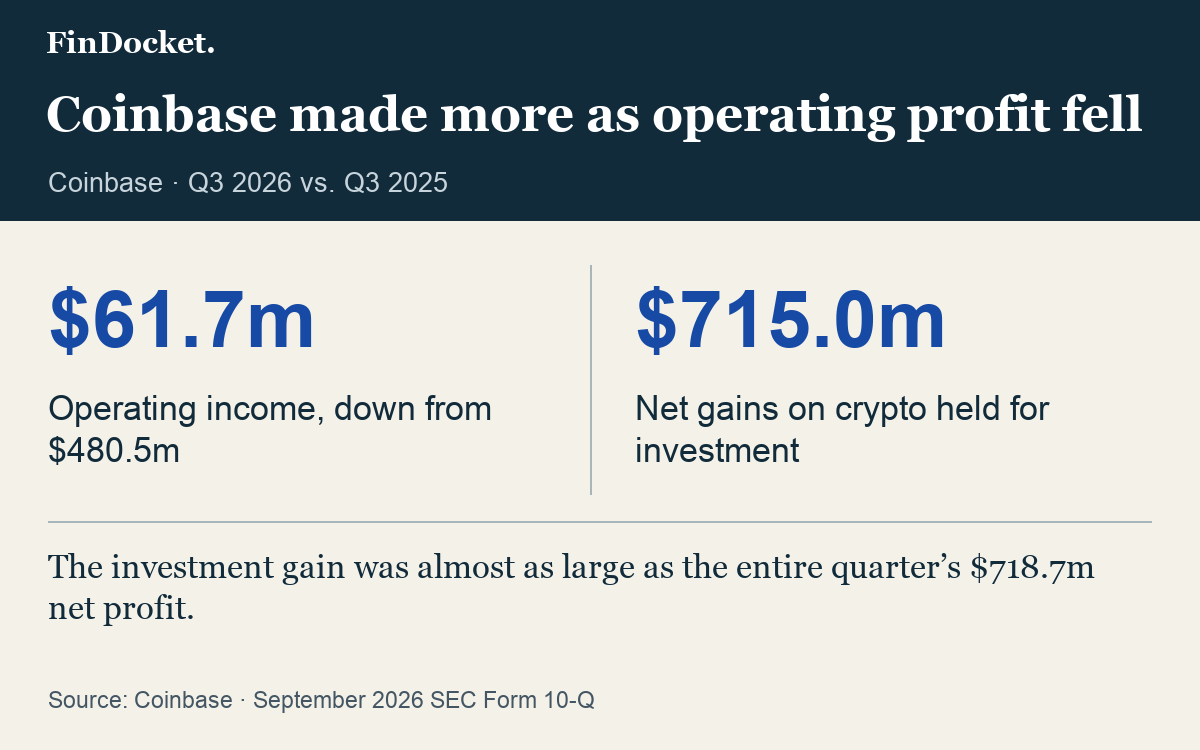
Why did Coinbase's net income rise while operating profit fell?
The SEC quarterly report shows net income of $718.7 million versus $432.6 million a year earlier. Operating income fell to $61.7 million from $480.5 million. Crypto-investment gains reached $715.0 million, while other income replaced a prior-year expense.
The arithmetic explains the apparent contradiction. Operating earnings deteriorated by roughly $419 million, yet gains and the change in non-operating income more than absorbed that reduction before taxes. The resulting net income is valid GAAP profit. Its sources simply have different implications for future operating earning power.
Investment appreciation increases the value available to shareholders, but it does not demonstrate that customers generated more fees. Capitalizing that appreciation as though it were a repeatable platform margin would count a market movement as an operating improvement.
Conversely, removing every market-sensitive item from the investment case would also miss part of Coinbase's economic exposure. The company owns assets whose values change. The useful approach is to value the operating franchise and investment holdings separately, then reconcile their contributions to consolidated results.
Does a 49% services mix mean recurring revenue is growing?
The filing reports subscription and services revenue of $570.2 million, down from $716.6 million, while its share of net revenue increased to 49% from 41%. Stablecoin revenue declined 5% and blockchain rewards fell 54%.
This is diversification measured by composition, not growth measured in dollars. A category can become more important inside a shrinking business without adding any incremental revenue. Forecasts that interpret the higher percentage as proof of a growing recurring base would start from the wrong premise.
The category also combines economically different activities. Stablecoin income depends on balances and the return generated by reserve assets. Staking economics depend on token quantities, token prices and reward rates. Neither behaves like a fixed subscription contract simply because the accounting presentation groups it with services.
A stronger assessment would separate customer adoption from monetization. More balances or more staked units can indicate expanding usage even when revenue falls. The next question is whether that adoption can overcome lower revenue per unit, and whether the company retains enough of the resulting income after distribution and customer incentives.
What do market-share gains actually establish?
Coinbase's earnings presentation reports crypto trading market share of 10.7%, versus 5.6% a year earlier, and average USDC held in its products of $22 billion. It also identifies annualized prediction-market revenue above $200 million and says the Deribit platform integration was completed in October.
Those indicators support a broader product footprint. They do not, on their own, establish higher consolidated monetization. Market share measures activity relative to a defined market. Revenue additionally depends on which products customers use, the applicable fee schedules and the size of the total market.
The distinction becomes particularly important when derivatives, spot trades and stablecoin conversions all contribute to a platform's activity metrics. Equal dollar volumes need not produce equal fee dollars. A changing activity mix can improve competitive position while reducing average revenue earned per dollar transacted.
Prediction markets introduce another potential fee engine. However, an annualized quarterly revenue measure describes a recent pace; it is not a contracted annual amount. The durability test is repeat activity across different event calendars, together with the cost of obtaining and retaining customers.
Integration creates a separate test. A combined platform can concentrate liquidity and simplify access. It must still show that those advantages translate into incremental customer economics after implementation costs, acquired assets and the capital invested in the transaction.
How much of adjusted EBITDA belongs to shareholders?
The quarterly filing reports adjusted EBITDA of $332.9 million versus $800.7 million. Its reconciliation adds back $233.0 million of stock compensation and excludes crypto-investment gains.
The decline indicates that the net-income improvement was not matched by this operating measure. The compensation adjustment then creates another distinction: EBITDA before equity compensation is not the same as earnings available per existing share.
Employees paid in shares receive an ownership claim. That claim has an economic cost even when the current-period cash expense is absent. Buybacks can offset the resulting dilution, but doing so consumes capital that otherwise could remain invested or be returned to owners.
That makes adjusted EBITDA useful for understanding aspects of operating capacity, while leaving work to do on shareholder returns. A complete model connects operating results to compensation, cash requirements and the eventual share count. It does not stop at the largest positive earnings measure.
What would establish a stronger Coinbase earnings trajectory?
The next operating improvement needs to appear in fee dollars and retained profit. Product adoption, balances and market share provide leading evidence, but the final test is revenue earned after customer economics and operating costs.
For services, the relevant evidence is absolute growth across distinct sources, with balance growth separated from interest-rate effects and staking activity separated from token-price effects. For trading, it is the relationship between activity, mix and realized monetization. For shareholders, it is profit after the resources required to maintain the platform and compensate its workforce.
Coinbase's quarter therefore supports a precise conclusion: the platform's reach expanded in several disclosed measures, while its operating earnings weakened. Investment gains explain the stronger net-income headline. A durable earnings recovery requires the commercial expansion to produce a better operating result.