Business · Analysis
Constellation Q3 2026: Calpine Changes the Comparison
Constellation's Q3 SEC filing supplies a pro forma comparison that separates acquisition scale from earnings improvement as nuclear power contracts expand.

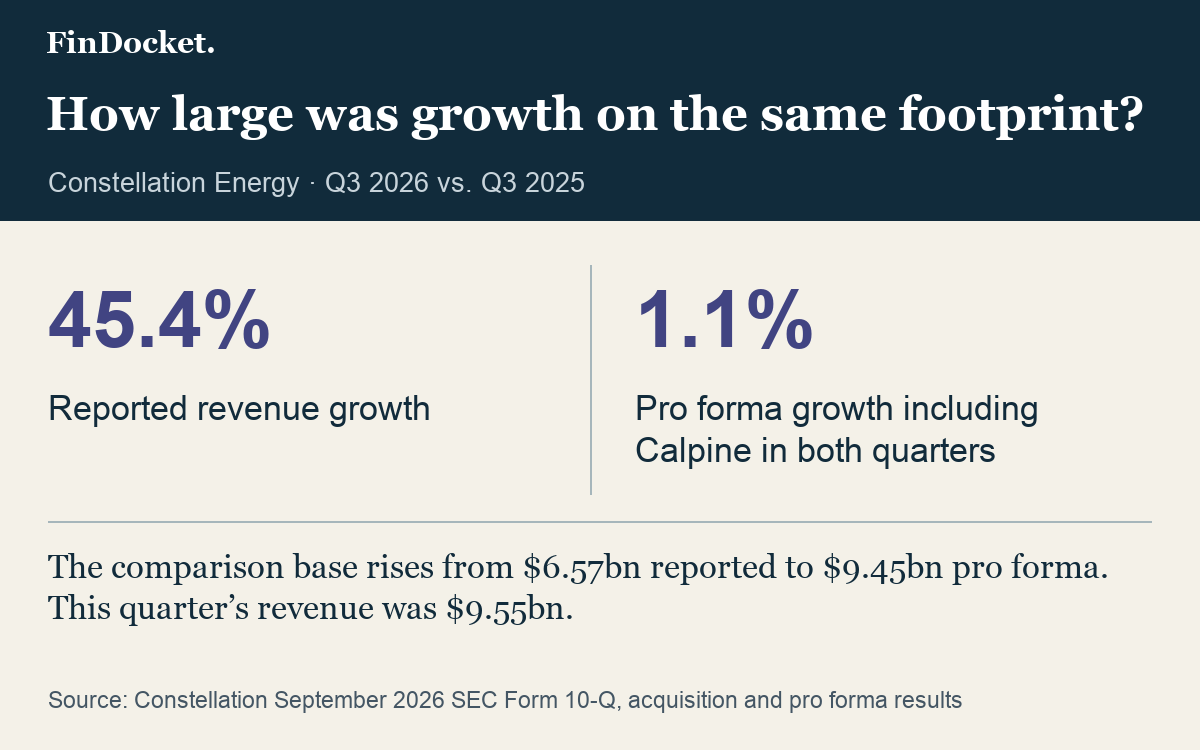
Constellation Energy's third-quarter 2026 results are stronger, but the Calpine acquisition makes the headline growth rate a poor standalone measure of operating progress. The current company contains a substantial business that the prior-year reported company did not contain.
The SEC filing offers a more informative comparison: unaudited pro forma figures that place Calpine in both periods. Those figures show modest revenue growth alongside a substantially larger improvement in net income. The story is therefore about the profitability of a broader portfolio, rather than simply a larger sales base.
What did Constellation report in Q3 2026?
Constellation reported GAAP EPS of $5.19 and adjusted operating EPS of $5.06, compared with prior-year adjusted EPS of $3.04. It raised the midpoint and narrowed full-year adjusted operating guidance to $12.50–$12.80 per share.
Adjusted EPS increased approximately 66%. The new full-year midpoint is $12.65. These are strong figures, but the annual comparison includes the addition of Calpine following its January acquisition.
Calling the entire increase organic would imply that the same collection of assets produced both periods' results. That is not the comparison presented by reported financial statements after a major acquisition. The acquisition can be strategically successful while still requiring a different baseline for analysis.
The pro forma figures change the growth picture
The 10-Q presents quarterly pro forma revenue of $9.550 billion for 2026 and $9.446 billion for 2025, assuming the acquisition occurred at the start of 2025. Pro forma net income was $1.835 billion versus $1.550 billion. The filing says integration and consolidated financing make Calpine's standalone post-acquisition earnings impracticable to determine.
On this basis, revenue increased approximately $104 million, or 1.1%. Net income increased approximately $285 million, or 18.4%.
The ratio of net income to revenue improved from approximately 16.4% to 19.2%, a change of approximately 2.8 percentage points. This is a broad accounting ratio based on the pro forma table, not a segment operating margin or a cash-return measure.
The calculation reveals something that the headline acquisition comparison obscures: a nearly unchanged pro forma revenue base generated meaningfully higher income. Evaluating that outcome requires attention to margins, financing, tax effects and contract accounting, rather than assuming the increase came mainly from higher electricity sales.
Pro forma is a better baseline, but not a clean organic bridge
The filing's pro forma figures include acquisition-accounting adjustments involving depreciation, amortization, taxes and other items. They therefore answer a specific question: what the combined presentation would look like under the stated acquisition assumptions.
They do not isolate every operational improvement or provide a historical cash-flow statement for a company that actually operated in that form throughout both periods.
That limitation is particularly relevant when trying to calculate Calpine's standalone contribution. Subtracting legacy Constellation earnings from combined earnings would not automatically reconstruct the acquired company's economic profit after financing and integration. Shared costs, financing decisions and purchase accounting can alter both sides of that subtraction.
A credible acquisition assessment instead follows the combined business's earning power, debt service, integration spending and capital requirements over time. It should preserve the distinction between accounting accretion and cash available after maintaining the enlarged fleet.
Nuclear contracts create investment obligations as well as demand
Constellation's Google agreement includes a 20-year power purchase agreement supporting more than $4.3 billion of investment across 11 nuclear units and approximately 890 megawatts of incremental capacity. The company also describes a separate 15-year, 2,700-megawatt financial energy load-following agreement.
Those are different contractual products. Adding the two capacity figures and describing the result as new nuclear generation would misstate the transaction. One figure describes additional generating capability; the other describes the scale of a separate financial supply arrangement.
Dividing the announced investment by the incremental generating capacity gives more than approximately $4.8 million per added megawatt. This is a rough program-intensity calculation. It is not a quoted construction cost for an identical standalone reactor, and it does not measure the contract's profitability.
The program uses existing units, so its economics need to incorporate the improvements, the associated operating life and the contracted revenue together. The shareholder return depends on what the investment earns after operating expenses, maintenance and financing, not merely on the existence of a long-duration customer commitment.
Contract duration cannot substitute for a return calculation
A long power contract can establish revenue visibility and support investment decisions. Its value still depends on pricing, escalation provisions, output obligations and the cost of delivering the promised product.
For a nuclear uprate, the relevant increment is the additional cash produced by the improvement relative to the capital and outage work required. Existing plant output and incremental output should not be conflated when estimating the return on the new investment.
The same discipline applies to the financing announcement. Constellation describes a conditional federal loan commitment of up to $5 billion for nuclear uprates, subject to a loan agreement. A conditional commitment is a potential financing source; it is not current operating revenue or cash already drawn.
Borrowing can improve funding access and influence the cost of capital. It also creates repayment obligations. The analytical benefit arises when financing terms support positive project economics, not when a loan amount is counted as additional company value without the matching liability.
What would confirm the investment case?
Constellation now needs to demonstrate the earning power of its enlarged fleet while executing another investment cycle in nuclear capacity. The strongest evidence will combine comparable portfolio results, controlled financing costs and projects entering service under attractive contracts.
The third-quarter pro forma comparison is encouraging because income improved substantially faster than revenue. It does not establish the standalone return on Calpine or the future return on every announced nuclear project. Those conclusions require subsequent cash generation and capital execution.
For investors, the useful distinction is between scale acquired and value earned. Calpine supplied a larger platform. The quarterly income progression and the economics of new contracted investment will determine how much that platform is worth to each share.