Business · Analysis
Credit Acceptance Q3 2026: The Collection Forecast Reset
Credit Acceptance's GAAP loss and adjusted profit tell different timing stories. Analyze the collection reset, rapid assignments and new $800 million financing.

Credit Acceptance's third-quarter 2026 results put the reliability of expected loan collections at the center of its investment case. New assignments accelerated, but the company reduced its forecast of cash to be collected from existing loans. The resulting accounting charge produced a GAAP loss while management's adjusted measure remained profitable.
The disagreement between those measures is largely about timing. The deterioration in expected cash collections is an economic event under either presentation. Investors need to understand when each measure recognizes that deterioration and whether new lending is priced to earn adequate returns on the revised assumptions.
Why did Credit Acceptance report a loss and an adjusted profit?
The earnings release reports a $56.6 million GAAP net loss, or $5.43 per diluted share, versus $108.2 million of profit a year earlier. Non-GAAP adjusted income increased to $135.5 million from $117.9 million. Its floating-yield method spreads changes in expected net cash flows over the remaining forecast period, while GAAP recognizes forecast changes immediately through provision.
The difference is fundamental to interpreting the quarter. Adjusted profitability indicates earnings under management's alternative recognition pattern. It does not reverse the change in what borrowers are expected to pay.
A discounted cash-flow valuation ultimately depends on those expected payments, their timing and the capital required to finance the loans. Moving a charge between periods changes the earnings path but cannot restore a dollar of cash that is no longer expected to arrive.
That makes the collection forecast a more useful starting point than choosing whichever EPS figure looks more representative. Both earnings presentations should be reconciled to the same underlying cash economics.
How large was the collection reset?
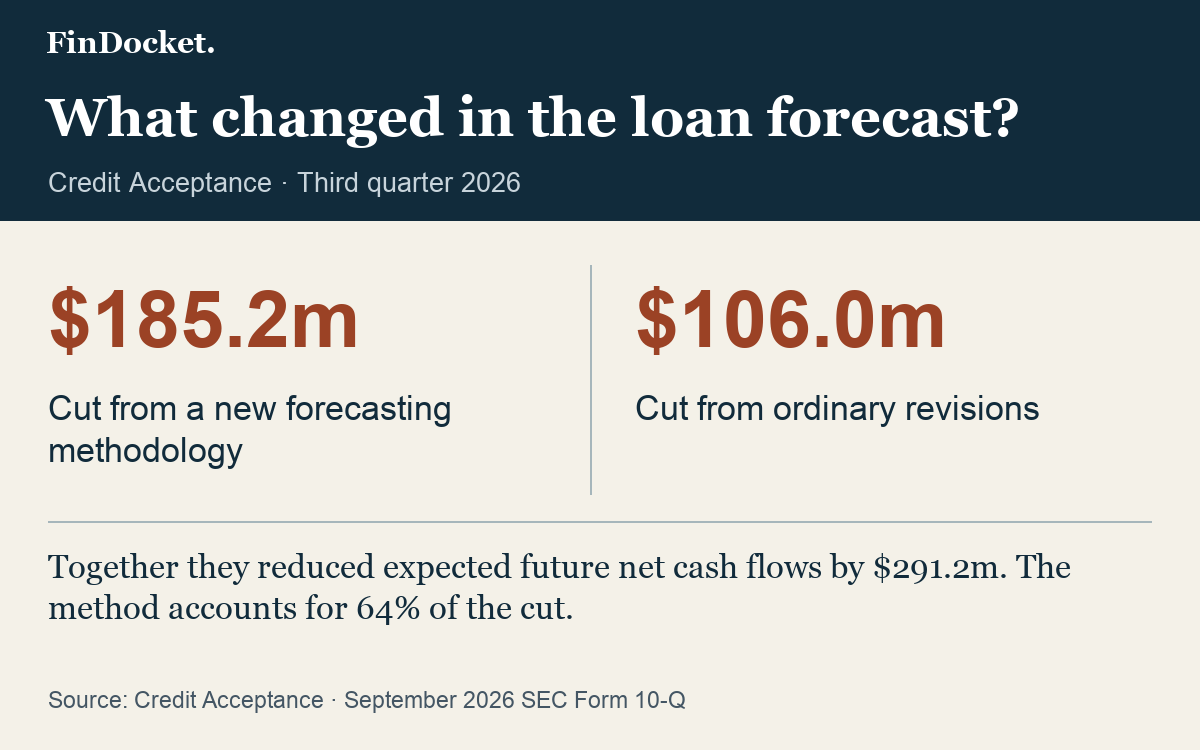
The quarterly filing reports a $291.2 million reduction in forecasted net cash flows. Ordinary forecast changes accounted for $106.0 million; a methodology adjustment accounted for $185.2 million and increased provision by $143.7 million. The adjustment reduced expected collection rates for 2022–2026 assignments, following persistent underperformance concentrated in lower scorecard bands.
Calculated from the disclosed amounts, the methodology change represented approximately 64% of the total forecast reduction. The remaining 36% came from ordinary revisions. Calling the entire reduction a model change would therefore miss a substantial part of the deterioration.
The provision effect is smaller than the associated reduction in forecast cash flows because the accounting measurement also reflects how and when those collections enter the loan balances. The two numbers address related but different quantities and should remain separate.
The breadth of affected vintages matters. This was not confined to the newest quarter's production. It changed expectations for several years of loans, which means the earning power assigned to the existing portfolio needed revision alongside assumptions for future originations.
What does rapid assignment growth imply?
The release reports 110,010 consumer-loan assignments totaling approximately $1.4 billion, up 37.7% in units and 51.0% in dollars. Average portfolio balance increased only 1.1% to $8.1 billion. Unit volume per active dealer rose 15.2%.
Dollar volume growing faster than units implies a higher average amount assigned. Using the reported growth rates, the average dollar amount per unit increased approximately 9.7%. That affects the capital needed for each transaction and the absolute dollars exposed to collection performance.
Production growth and average portfolio growth also describe different periods. New assignments can accelerate late in a quarter without immediately creating an equivalent increase in the average earning balance. The future earnings contribution depends on how those loans season and how quickly existing loans repay.
The underwriting test is therefore incremental: are the new assignments priced and selected using assumptions that reflect the revised collection experience? More dealer activity creates opportunity, but its economic value depends on the return on each additional dollar advanced.
Does the latest scorecard change resolve the issue?
The filing says most of the forecast-adjustment impact related to loans assigned before the scorecard change introduced in the second quarter of 2026. It also describes small but consistent earlier underperformance and quarterly forecast revisions before the larger adjustment.
That provides a reason to examine recent production separately from older cohorts. It does not yet establish the ultimate performance of loans originated under the newer scorecard; those loans have had less time to mature.
The evidence needed is straightforward: actual collections relative to initial forecasts across successive months and vintages. Better selection should eventually appear in cash receipts, collection stability and returns after funding and servicing expenses.
A valuation model can credit improved underwriting when the results support it. Until the newer loans season, the strongest analytical approach is to show their assumed performance explicitly and measure the return under a range of collection outcomes, using the company's disclosed reset as relevant operating evidence.
What does the November financing add?
On November 24, Credit Acceptance completed $800 million of asset-backed non-recourse financing against approximately $1.0 billion of conveyed loans. Expected annualized cost is about 6.2%, including fees. The financing revolves for 24 months, with proceeds intended to repay higher-cost debt and support corporate uses.
The transaction demonstrates access to secured funding and can reduce financing expense where it replaces more expensive obligations. Its approximately 80% debt-to-conveyed-loan-value relationship also shows that gross collateral value and cash raised are different amounts.
The announcement says dealers retain their holdback rights, and 4% of underlying consumer-loan cash flows is allocated to servicing expenses. Borrower collections must therefore support the contractual distribution of cash, including financing and dealer claims, before the residual benefits shareholders.
Cheaper debt improves that distribution, but it cannot fully compensate for any scale of credit deterioration. The spread earned on the assets remains the essential source of value.
Credit Acceptance's quarter combined stronger production with a significant reassessment of existing loans. The new financing supports flexibility. The decisive shareholder test is whether the revised collection forecasts prove reliable and the expanding assignment book earns enough above funding and operating costs to rebuild durable economic returns.