Business · Analysis
Cummins Q3 2026: Power Growth Needs a Cleaner Comparison
Cummins' Q3 SEC filing shows strong power-generation economics, but last year's impairment and current tax benefits exaggerate headline EPS growth.

Cummins' third-quarter 2026 results show a profitable expansion in power-generation equipment alongside a recovering truck business. The quarter also illustrates why an earnings growth rate needs a comparable starting point: last year's impairment depressed the base, while discrete tax benefits lifted this year's result.
After adjusting only for those identified per-share items, the growth remains substantial. It is much smaller than the more-than-doubling suggested by the reported EPS comparison. The operating case rests on what power equipment and truck-related businesses can earn repeatedly, rather than on the absence of an old write-down.
How much did Cummins' earnings improve?
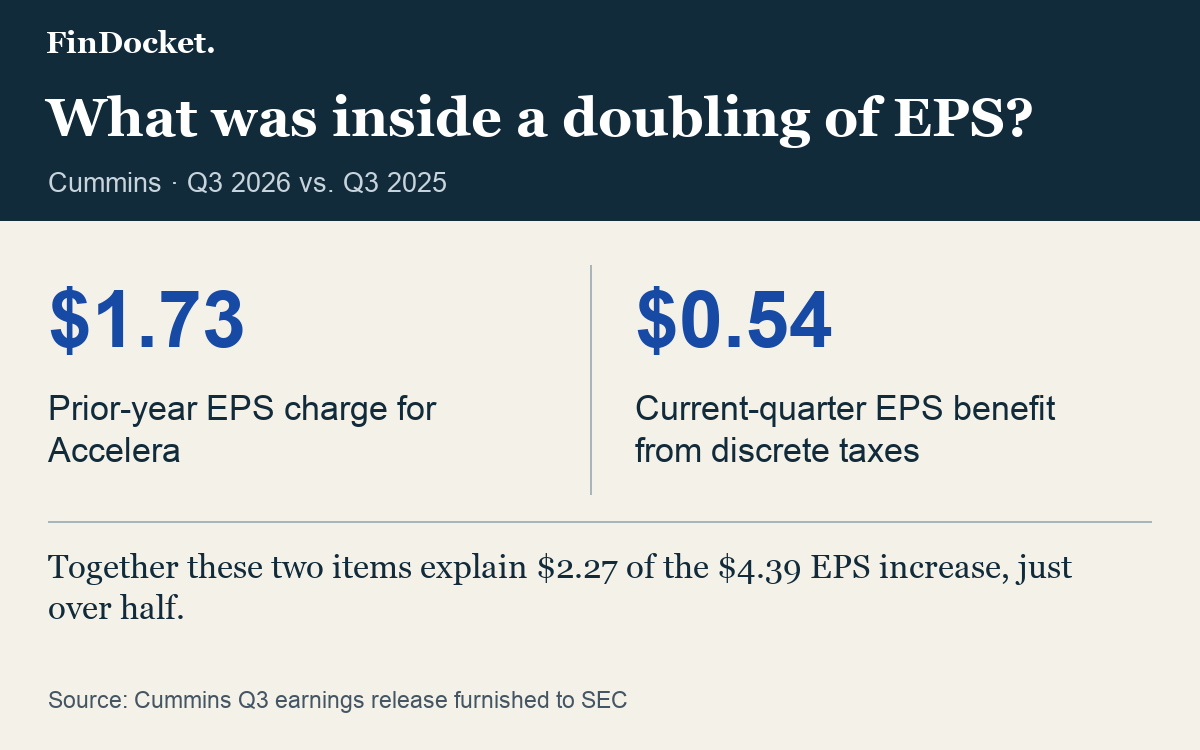
Cummins reported quarterly revenue of $9.438 billion and net income attributable to the company of $1.140 billion. Diluted EPS reached $8.25 versus $3.86. The release identifies $1.73 per share of Accelera noncash charges in the previous-year quarter and a $0.54 favorable discrete-tax contribution in the current quarter.
Adding the earlier charge back to the prior EPS produces an illustrative $5.59 base. Removing the current tax benefit produces $7.71. The resulting increase is approximately 37.9%, compared with approximately 113.7% on the reported figures.
This is a targeted analytical comparison, not a complete reconciliation of every possible nonrecurring item. Its purpose is to show the effect of two explicitly disclosed factors on the headline growth rate.
Approximately $2.12 of the $4.39 reported per-share increase remains under this calculation. That represents meaningful earnings progress. It also shows that the growth narrative becomes more credible when the operating improvement is distinguished from differences in accounting charges and tax timing.
Power Systems earns an attractive incremental return on sales
The release reports Power Systems sales of approximately $2.3 billion, up 15%, and segment EBITDA of $582 million versus $457 million. The EBITDA margin increased to 25.4% from 22.9%. Demand for generation equipment, particularly data-center applications, supported growth.
The SEC filing identifies a $293 million quarterly sales increase in this segment. Dividing the $125 million EBITDA increase by that revenue change produces an incremental EBITDA margin of approximately 42.7%.
That is considerably above the segment's average margin. It indicates that the additional revenue supported strong profit absorption within the existing operating structure. The result is consistent with a business benefiting from higher throughput and an attractive sales mix.
The figure does not measure cash return on the investment required to expand manufacturing capacity. EBITDA excludes depreciation, interest and taxes, while the incremental ratio compares two quarterly income-statement changes. A capital-return assessment also needs the cost and useful life of the assets supporting those sales.
For forecasting, the useful conclusion is that Power Systems is currently converting additional revenue into profit efficiently. Repeating that relationship depends on pricing, capacity utilization, product mix and the cost of adding resources as demand grows.
Distribution shows that higher sales do not guarantee higher profit
The filing reports Distribution sales of $3.310 billion versus $3.172 billion. Segment EBITDA fell to $461 million from $492 million, with higher compensation costs outweighing the benefit of increased volume.
The arithmetic is a useful counterweight to the Power Systems result. Distribution added $138 million of revenue while losing $31 million of EBITDA. The implied incremental margin is negative, and the average margin declined by roughly 1.6 percentage points.
These segments occupy different positions in the commercial chain. Strong demand for generation equipment can benefit manufacturing and distribution while producing different profit outcomes in each. Technician capacity, sales support and compensation can affect the downstream operation differently from the factory.
Segment revenue also includes internal transactions. Cummins eliminates those transactions when preparing consolidated results. Adding reported segment sales without those eliminations would overstate the amount sold to outside customers.
The appropriate question is how much profit the combined customer relationship generates after the internal supply chain and service network have been funded. Manufacturing strength is valuable, but it does not remove the need to control the cost of delivery and support.
A portfolio with different demand cycles
Power-generation demand and truck purchases do not follow identical schedules. The release describes strong generation and North American heavy-duty truck demand alongside weaker pickup-truck orders. Management consequently places full-year revenue growth at approximately 10%, at the bottom of its prior 10% to 13% range.
This mix makes a single end-market label inadequate. Cummins can earn strong power-equipment margins while another part of its engine portfolio faces pressure. The consolidated result depends on the relative scale and profitability of each business.
Diversification creates resilience when demand cycles offset one another. It can also conceal weakness if a rapidly expanding operation dominates the headline. Separate tracking of segment revenue and incremental profit provides a more informative view of whether the portfolio is improving broadly.
A stronger truck cycle would add another source of operating leverage. A weaker one would increase the importance of maintaining generation margins and controlling spending in less profitable activities. Neither scenario can be inferred from data-center demand alone.
What would make the earnings improvement durable?
The next stage of the Cummins story requires three outcomes. Power Systems needs to preserve attractive economics as capacity and deliveries increase. Distribution needs to translate higher activity into profit after labor costs. Truck-related businesses need sufficient volume and pricing to support their fixed resources.
Tax benefits and the absence of impairments help explain the reported comparison, but they cannot carry a recurring operating thesis. The stronger evidence is the profit earned on incremental sales, measured alongside the capital and support infrastructure required to produce them.
Cummins' quarter demonstrates a substantial underlying earnings improvement even after cleaning up the most obvious comparison effects. The variation between Power Systems and Distribution shows where further execution matters: converting the full customer relationship into profit, rather than counting every additional equipment dollar as equally valuable.