Business · Analysis
Deere Q4 2026 Earnings Test the Recovery Outlook
Deere Q4 2026 earnings reveal uneven segment profits. Explore our SEC-based analysis of the 2027 outlook, pension charge and machinery recovery.
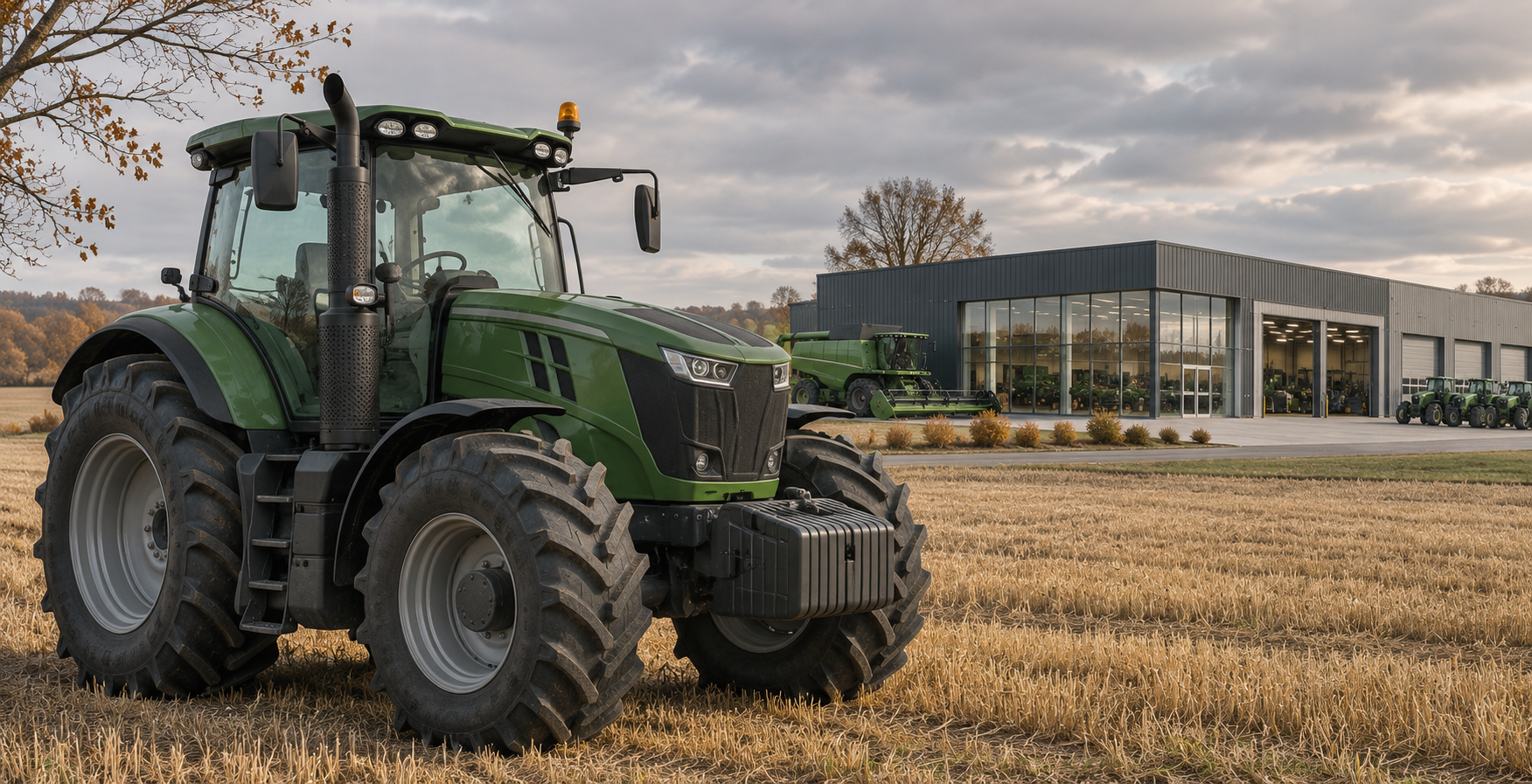
Deere’s fiscal 2026 fourth-quarter earnings show an uneven machinery cycle. Smaller agricultural equipment recovered sharply, large agriculture remained under pressure, and construction sales growth delivered lower operating profit. The resulting investment question is how much of an anticipated sales recovery Deere can retain as earnings after production costs, financing conditions and investment.
The November 25 earnings exhibit furnished with Deere’s Form 8-K provides a useful starting point. FinDocket’s calculations show the three equipment segments generating combined quarterly operating profit of $978 million, almost unchanged from $977 million a year earlier. The stability conceals a substantial redistribution of earnings between businesses, making segment margins essential to understanding the outlook.
What did Deere report for Q4 2026?
Deere reported quarterly net income attributable to the company of $1.051 billion, or $3.89 per diluted share. Equipment net sales were $10.514 billion, while total net sales and revenues, including financing and other revenue, were $12.115 billion. Those revenue measures describe different economic activities and need consistent use when calculating margins.
For the full year, attributable net income reached $4.860 billion on total net sales and revenues of $47.704 billion. Our calculation puts net margin on that consolidated revenue measure at approximately 10.2%. The comparable prior-year calculation is about 11.0%, indicating that higher annual revenue coincided with lower overall profit retention.
The company’s operating structure explains why a consolidated headline supplies only part of the picture. Equipment manufacturing earns income from machinery and associated products, while Financial Services earns income from financing activity. Both depend on customer economics, but their earnings respond to different combinations of shipment volumes, production costs, financing spreads and credit performance.
Why large agriculture remains central
Production & Precision Agriculture recorded fourth-quarter sales of $4.018 billion and operating profit of $406 million. The comparable prior-year figures were $4.740 billion and $604 million. FinDocket calculates a $198 million profit decline against a $722 million sales decline, equivalent to a decremental margin of approximately 27.4%.
That calculation measures how much operating profit disappeared with each dollar of lost segment sales between the two periods. It illustrates the sensitivity created by factory capacity, product mix and other costs that do not move proportionately with shipments. Deere attributed the segment’s weaker profit primarily to shipment volumes and sales mix, partly offset by lower production costs and currency effects.
A recovery in demand can improve factory economics when additional units spread costs over a larger sales base. The reverse also applies when production is reduced. Investors therefore need to follow shipments and operating margin together to judge the earnings power of the next stage of the cycle.
How smaller equipment stabilized group profit
Small Agriculture & Turf generated $233 million of quarterly operating profit, compared with $25 million a year earlier. The $208 million increase slightly exceeded the $198 million decline in large agriculture. This arithmetic explains why combined equipment profit remained broadly stable despite the weakness in Deere’s largest agricultural segment.
The smaller-equipment result also shows why percentage growth requires context. An increase from a depressed comparison produces a very large growth rate. The more useful operating evidence is the segment’s recovery to an 8.6% margin, alongside the disclosed effects of volumes, pricing, warranty expense and production costs.
The next stage requires holding that improved profitability as the comparison becomes more demanding. Sustained profit depends on shipment quality and cost execution. A single quarter’s rebound establishes progress, while subsequent results establish the level of earnings the segment can support through the cycle.
Why construction revenue growth needs scrutiny
Construction & Forestry sales increased from $3.382 billion to $3.793 billion, while operating profit fell from $348 million to $339 million. Our calculations show a $411 million sales increase accompanied by a $9 million profit decline. Operating margin moved from approximately 10.3% to 8.9%.
This is a direct example of sales growth failing to improve earnings. Deere identified higher production costs and higher selling, administrative and research expenses, with favorable pricing providing a partial offset. The quarter demonstrates that recovering demand must be accompanied by sufficient cost absorption and price realization to improve returns.
At the latest sales level, restoring one percentage point of operating margin would represent about $38 million of quarterly operating profit, holding sales constant. That sensitivity gives investors a concrete way to assess the financial significance of future cost and productivity improvements.
How to interpret the 2027 profit outlook
Deere forecasts fiscal 2027 attributable net income between $4.50 billion and $5.25 billion. The $4.875 billion midpoint is approximately level with fiscal 2026 net income. Management’s range includes an estimated $250 million to $400 million noncash pension settlement charge associated with a voluntary lump-sum option for certain retirees.
The bottom of the profit outlook represents a decline of approximately 7.4% from fiscal 2026, while the top represents growth of approximately 8.0%. That spread describes a substantial range of potential earnings outcomes around a broadly flat midpoint. Modeling the pension settlement separately requires its actual amount and tax treatment so that a pretax expense is translated consistently into attributable net income.
The pension item affects the comparability of reported profit, while the machinery cycle determines the operating foundation. Both belong in the earnings model. Keeping the settlement assumption explicit allows an analyst to test how much expected improvement comes from the equipment businesses and how much reflects an accounting adjustment.
What should investors watch next?
The strongest evidence for recovery would combine better large-agriculture shipments, sustained smaller-equipment margins and improved conversion of construction sales into profit. Financial Services also deserves attention after quarterly net income fell to $231 million from $293 million, with management citing financing spreads, portfolio size and credit-loss provisions.
Deere’s latest quarter shows the stabilizing value of its business mix and the work still required to lift consolidated profitability. The next meaningful improvement must appear in margin and cash generation as well as sales. Segment execution will determine the earnings value of the expected recovery.