Business · Analysis
Diamondback Q3 2026: Cash Timing and Viper's Debt
Diamondback's Q3 SEC filing shows strong production economics but a working-capital drag. We separate parent debt reduction from Viper's consolidated borrowing.

Diamondback Energy's third-quarter 2026 results show a productive Permian business with substantial cash-generating capacity. The financial picture becomes more precise when two distinctions are maintained: cash before working-capital changes differs from cash collected, and Diamondback's own debt differs from the consolidated debt that includes Viper Energy.
Those distinctions explain why a quarter with strong free-cash-flow headlines can also show a rise in consolidated net debt, even while the parent reduces its own obligations.
The free-cash-flow calculation excludes working capital
Diamondback reported operating cash of $2.599 billion, cash capital expenditure of $1.026 billion, and free cash flow of $2.148 billion. Its definition starts with operating cash before working-capital changes, which was $3.174 billion.
Subtracting capital spending directly from reported operating cash instead produces $1.573 billion. The $575 million difference is exactly the working-capital adjustment. It represents approximately 26.8% of the company's reported free-cash-flow measure.
The distinction is material to current liquidity. Excluding working capital can help compare operating performance across periods when payment dates vary. It does not mean the cash tied up in those balances is available immediately for debt repayment or distributions.
Accounts receivable used $476 million during the quarter, and income taxes payable used another $138 million. Other movements partly offset those uses. Receivables therefore accounted for approximately 82.8% of the net working-capital outflow, though that percentage does not imply they were the only moving balance.
Higher selling prices can expand receivables even when customers pay on schedule. The correct next test is collection and turnover, rather than assuming that a receivables increase proves either deteriorating credit quality or permanent cash growth.
The same distinction changes the reinvestment ratio
Management's shareholder letter describes a 32% corporate reinvestment ratio, calculated as cash capital expenditure divided by operating cash before working-capital changes. Using actual reported operating cash as the denominator produces approximately 39.5%.
Both describe the same investment program. One measures spending against cash generation before timing changes; the other measures it against the cash that reached the operating statement during the quarter.
The difference affects how much financial flexibility appears to remain. Roughly two-thirds of cash before working capital remained after the specified capital spending. On actual operating cash, approximately three-fifths remained. Neither calculation includes every acquisition, subsidiary financing flow or claim on cash.
A disciplined assessment should use the first ratio to examine the production model and the second to understand the current funding position. The gap between them is then tracked through the working-capital bridge.
Parent deleveraging and consolidated borrowing occurred together
The filing consolidates Viper, although Diamondback owned approximately 40% of its combined outstanding shares on a fully diluted basis. Consolidation brings the subsidiary's financial statements into the group totals and separately recognizes outside ownership.
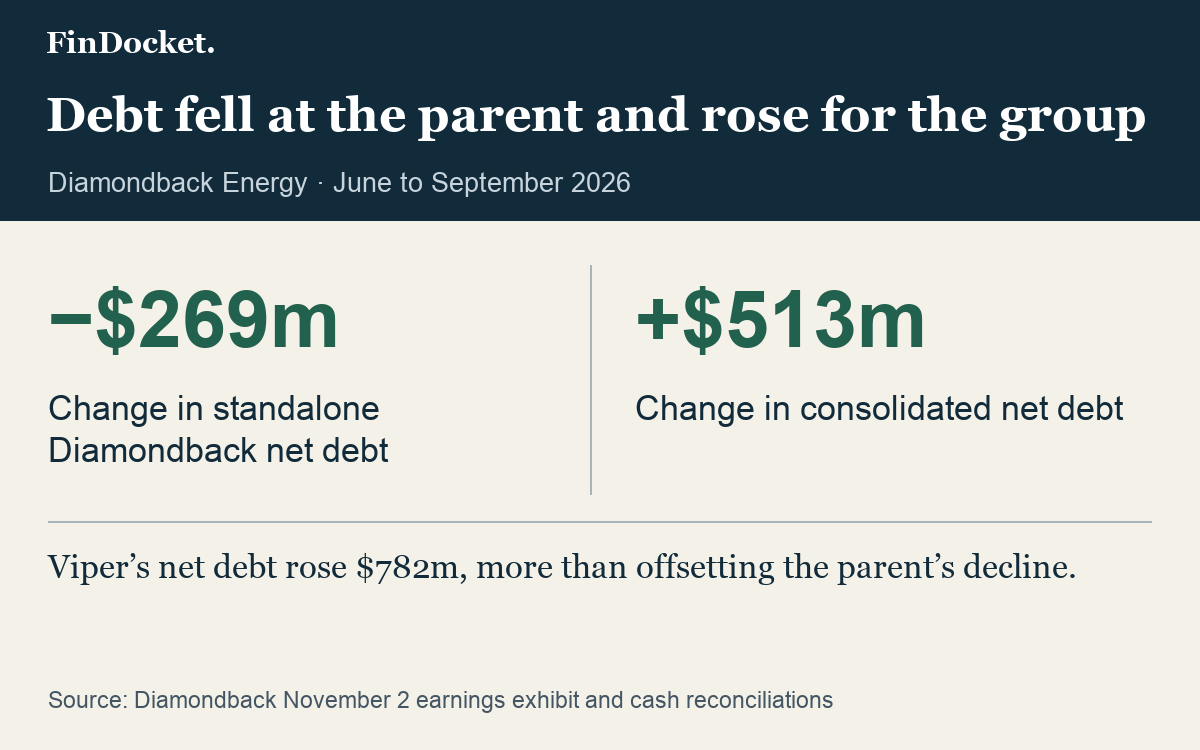
The earnings release shows Diamondback's standalone net debt declining to $10.417 billion from $10.686 billion at June-end. Viper's net debt increased to $2.400 billion from $1.618 billion. Consolidated net debt consequently increased to $12.817 billion from $12.304 billion.
The parent improved its net-debt position by $269 million. The subsidiary's $782 million increase more than offset that improvement, producing a $513 million rise for the consolidated group.
This is the central balance-sheet reconciliation. Saying simply that Diamondback reduced debt would omit the consolidated increase. Saying simply that the group borrowed more would omit the parent's progress. Both statements need a defined perimeter.
The same care applies to cash and profit. Consolidated earnings and cash generation include activities partly attributable to outside Viper owners. They are not automatically available in full to Diamondback common shareholders. Subsidiary debt, minority distributions and parent receipts need to be considered before calculating shareholder-level coverage.
Capital allocation now has greater discretion
Management's letter says Diamondback removed its quarterly minimum free-cash-flow return commitment earlier in 2026. It describes discounted bond purchases, smaller acreage transactions and opportunistic equity repurchases as competing uses of capital.
That change alters the interpretation of a quarter with relatively modest stock buybacks. A lower payout ratio is no longer sufficient evidence that management missed its former quarterly framework. The relevant assessment is whether the selected use earns an attractive return relative to alternatives.
Buying debt below face value retires a larger contractual claim than the purchase price paid, before fees and other effects. Buying acreage can extend drilling inventory or support longer laterals, but the return requires development spending and successful production. Repurchasing stock changes ownership per share without adding new operating assets.
These alternatives have different timing and return characteristics. Comparing them requires consistent mid-cycle commodity assumptions and a clear view of the capital already committed to each option.
Production efficiency must be judged by formation
Management reports flat sequential oil production of approximately 525,000 barrels daily and total production growth of about 2%. The letter also explains that blended drilling costs per lateral foot increased as deeper Barnett and Wolfcamp D targets became a larger part of the program, while like-for-like costs remained flat to lower.
A blended cost increase can therefore reflect a different geological target rather than a deterioration in execution. Conversely, lower cost per foot alone does not establish superior returns if production per foot or recovery changes unfavorably.
The useful economic measure combines drilling and completion cost with expected recoveries, decline rates and realized netbacks. Longer laterals and deeper targets are valuable when the additional production exceeds the full incremental cost of development.
Diamondback's quarter supports strong underlying production economics, but the cash and financing story requires more than the headline free-cash-flow figure. The next assessment should follow receivables conversion, parent versus Viper leverage, and the returns earned on discretionary capital deployment. Those measures reveal whether operating strength is translating into greater value for Diamondback's common shareholders.