Business · Analysis
Edwards Q3 2026: Valve Growth and a Research Write-Off
Edwards Lifesciences' Q3 SEC filings show strong valve growth and a major abandoned research asset. We analyze operating leverage, adjusted profit and capital returns.

Edwards Lifesciences delivered strong third-quarter 2026 sales growth and higher adjusted earnings, but its SEC filing also records a substantial development failure. The company wrote off an in-process research asset after abandoning the project for which it was originally intended.
The financial picture consequently has two parts. Existing valve franchises are producing greater revenue and operating leverage. Previously committed development capital has also lost value. Adjusted earnings help evaluate the first part; the impairment is essential to evaluating the second.
How fast is Edwards growing?
The earnings release reports revenue of $1.7155 billion, increasing 10.5%, or 11.2% on its constant-currency measure. Transcatheter aortic valve replacement, or TAVR, generated approximately $1.24 billion, up 8.0% as reported and 8.8% at constant currency.
Transcatheter mitral and tricuspid therapies, or TMTT, produced approximately $207 million of adjusted sales, with reported adjusted growth of 44.0% and constant-currency growth of 45.6%. That figure excludes $2.9 million of acquired Implantable Heart Failure Management revenue.
The faster-growing franchise is strategically significant, but the larger franchise still determines most consolidated revenue. TAVR represents roughly 72% of total sales, compared with approximately 12% for the adjusted TMTT figure. These are approximate mix calculations using the company's rounded product totals.
A high percentage growth rate from a smaller base does not immediately replace dependence on the larger business. Edwards benefits when both expand: TAVR supplies scale while newer therapies add a second source of demand. Sustaining that combination is more valuable than relying on one product group to compensate indefinitely for weakness elsewhere.
What did the research impairment mean?
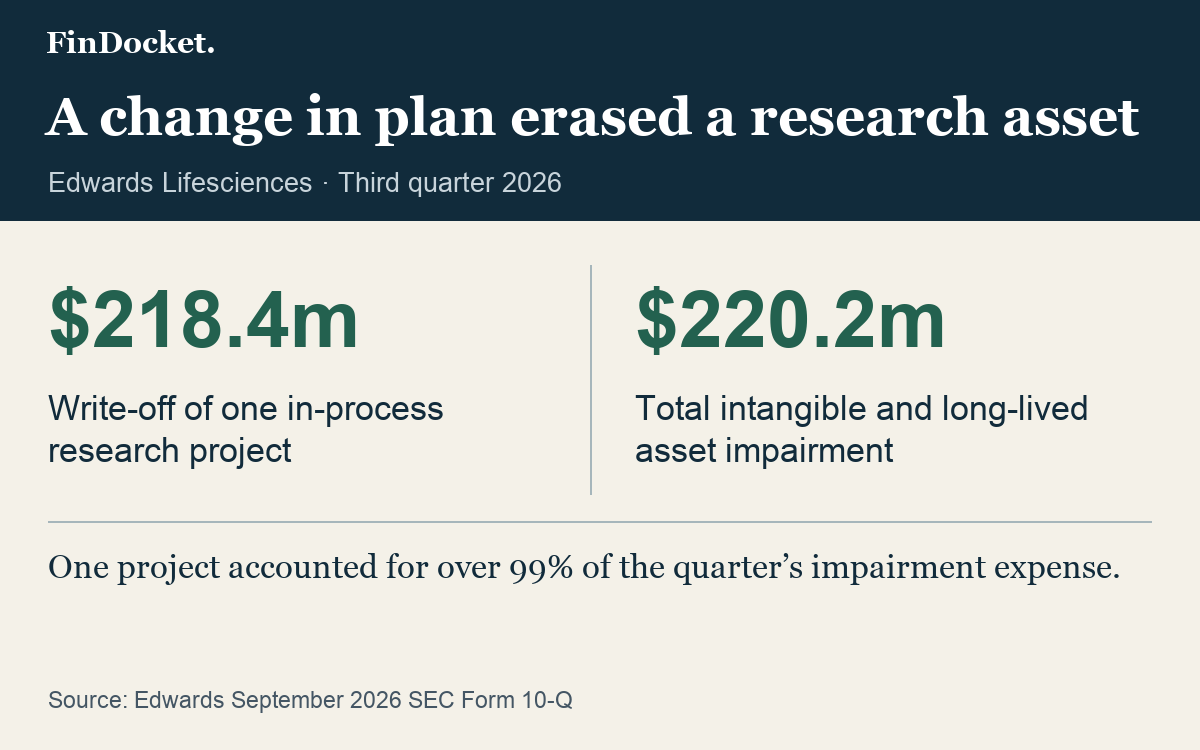
The Form 10-Q says Edwards revised a development plan in September and ceased pursuing the original project. It fully impaired the associated in-process research and development asset by $218.4 million. Total quarterly intangible and long-lived asset impairment expense was $220.2 million.
Edwards says aspects of the underlying technology may inform future research, but specific plans remain under development. That possibility does not reverse the filing's conclusion that the original asset is no longer expected to generate future economic benefit.
The distinction is concrete. Knowledge retained from a failed project can have scientific utility without preserving the recognized asset's economic value. An investor should not assume that an unspecified future application restores the return originally expected from the abandoned development program.
The charge is noncash in the current quarter. That describes when cash moves, rather than whether value was lost. Capital committed in an earlier period can fail to earn its expected return even when the resulting accounting recognition requires no new payment today.
Operating leverage survives beneath the charge
Reported operating income was $299.1 million, versus $307.1 million a year earlier. Adjusted operating income was $520.5 million, with an adjusted margin of 30.3%. The reconciliation adds back the impairment and other costs while removing an insurance recovery benefit.
The research write-off therefore explains much of the distance between reported and adjusted operating profitability. It is reasonable to separate that event when assessing current product economics. It is equally necessary to retain it when assessing management's longer-term investment record.
The income statement offers evidence of operating leverage independent of the impairment. Revenue increased $162.4 million and gross profit increased $138.4 million, giving an incremental gross-profit conversion of approximately 85%. Selling, general and administrative expense rose $46.3 million, while research and development expense increased just $0.7 million.
Those movements indicate that current revenue growth outpaced major recurring expense categories. They do not establish that research spending can remain nearly flat indefinitely. Clinical programs, trial enrollment, regulatory work and commercialization can produce uneven expense patterns across quarters.
Edwards' operating model is most attractive when an expanding installed clinical base generates additional procedures without requiring equivalent increases in selling infrastructure. The observed quarter supports that mechanism. Future development and launch spending will determine how much of it reaches recurring profit.
Procedure growth becomes the next test
Management raised its full-year sales-growth guidance to approximately 11.5% and TAVR guidance to 9.0%–9.5%. It expects growth in the fourth quarter and beyond to rely more on procedure volumes and less on market-share gains.
That changes the analytical emphasis. Share gains can help an individual supplier outperform an unchanged market. Procedure growth requires more patients to reach treatment, making referral pathways, diagnosis, hospital capacity and clinical adoption increasingly relevant to the revenue outlook.
The company increased adjusted EPS guidance to $2.97–$3.05 from $2.95–$3.05. The midpoint rose only one cent, despite the improved revenue outlook. The revised forecast therefore supports stronger demand without implying that every additional sales dollar will translate directly into a proportionate earnings upgrade.
Capital allocation needs two scorecards
Edwards reported approximately $3.1 billion of cash, approximately $600 million of debt and roughly $700 million of share repurchases through September. That liquidity provides resources for research, acquisitions and shareholder returns.
The correct assessment separates operating productivity from investment outcomes. Expanding valve demand and improving expense absorption strengthen the recurring business. The abandoned research asset demonstrates that innovation spending also produces losses that adjusted profit can exclude.
The next filings should be judged on sustained procedure growth, conversion of newer therapies into profitable scale and evidence that replacement development programs earn adequate returns. Edwards' current franchises are performing well. Its capital allocation record must still include the projects that failed alongside the products that succeeded.