Business · Analysis
Equinix Q3 2026: The atNorth Fee and Construction Cash
Equinix's SEC filing shows strong demand, a transaction fee in AFFO and a large construction program. Analyze recurring growth, joint ventures and funding needs.

Equinix's third-quarter 2026 earnings show strong demand for interconnected data center capacity and improving operating earnings. They also contain a transaction-related benefit that makes reported AFFO growth stronger than the underlying comparison presented by management.
The more substantial capital allocation issue sits in the cash flow statement. New construction and joint venture investment require resources well beyond the quarter's earnings adjustments. The shareholder outcome depends on converting those investments into productive capacity at returns that exceed financing and ownership costs.
How strong was Equinix's underlying growth?
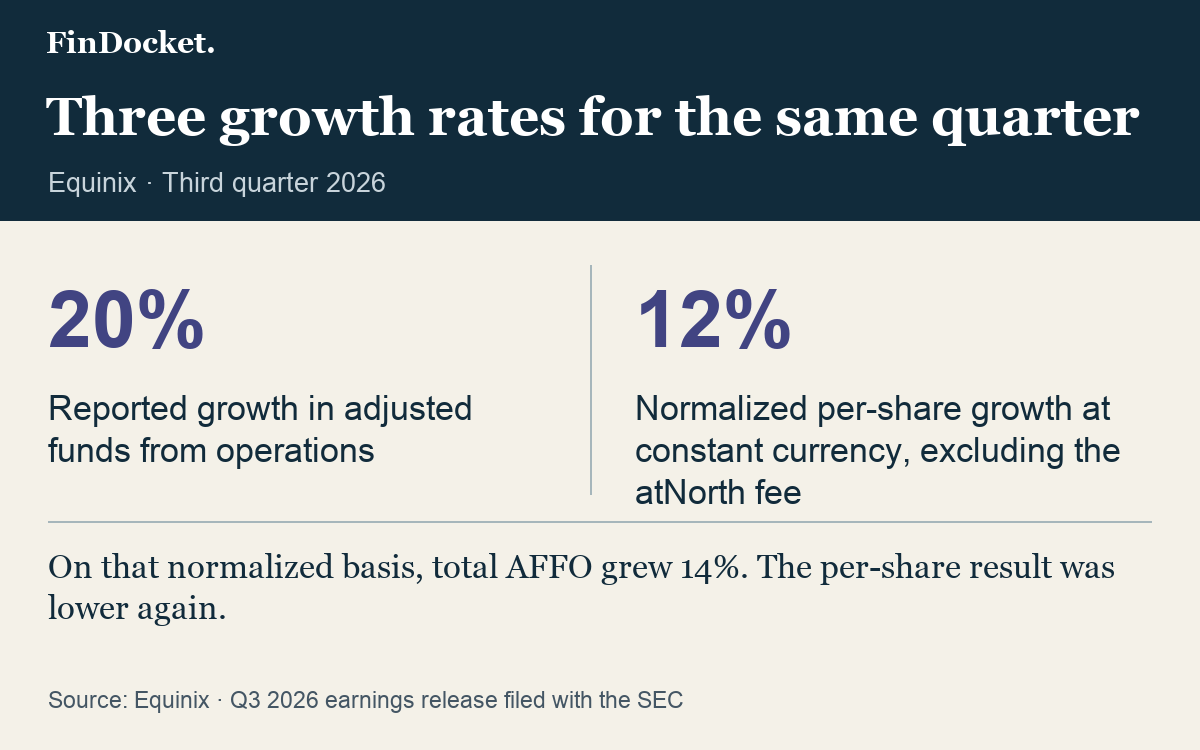
The earnings release reports revenue of $2.571 billion, up 11%, and adjusted EBITDA of $1.321 billion, up 15%. AFFO increased 20% to $1.156 billion. Excluding the atNorth fee on a normalized and constant currency basis, AFFO growth was 14%; the corresponding per-share growth was 12%. Both adjusted EBITDA and AFFO are non-GAAP measures.
The normalized comparison still indicates substantial expansion. It also makes clear that the headline AFFO increase should not be interpreted as entirely recurring growth in customer economics. Transaction benefits and currency effects account for part of the difference.
Calculated adjusted EBITDA margin was approximately 51.4%. Earnings growth exceeding revenue growth suggests improved operating conversion at this measure of profit. To assess the return to shareholders, that improvement then needs to be connected with construction spending, financing costs and the incremental shares participating in earnings.
The per-share growth rate is especially relevant. Enterprise growth can look stronger than shareholder progress when capital issuance or compensation increases the share count. A durable increase in cash earned per share is the more useful end point than an expanded revenue base alone.
Why does the atNorth transaction fee matter?
The release identifies a non-recurring fee associated with the atNorth joint venture as a contributor to net income growth. The 10-Q reports quarterly net other income of $54 million, primarily related to transaction compensation. It also discloses a minimum capacity leasing commitment to atNorth by the end of 2030 whose amount is not yet determinable.
The fee is real income, but its source differs from recurring colocation and interconnection revenue. A transaction can generate compensation when arranged without establishing an equivalent annual stream of operating profit. It belongs in the assessment of the deal's economics, rather than being extrapolated as recurring customer growth.
The capacity commitment adds another relationship between Equinix and the investee. Equinix is providing capital while also agreeing to become a customer for a minimum level of capacity. The ultimate return needs to consider both sides: investment income and the cost and utilization of leased capacity.
Because the commitment has not been quantified, the published balance sheet does not provide a complete numerical measure of that future requirement. The appropriate analysis follows the eventual lease terms and capacity deployment as they become available, rather than assuming no further economic obligation exists.
What does Equinix own in atNorth?
The completed acquisition announcement describes a $4 billion transaction with CPP Investments holding approximately 51%, Equinix approximately 34% and Partners Group approximately 10%. Equinix's announced commitment was $895 million. atNorth remains independently operated and includes operational facilities and a Nordic development pipeline.
A minority investment provides access to growth without requiring Equinix to supply the entire acquisition price or consolidate every project expenditure. It also means that the gross scale of the platform is not identical to Equinix's own economic interest.
An investor should distinguish the total transaction value, committed capital and the cash Equinix has actually contributed. Those amounts measure different things. Comparing the full platform's capacity with only Equinix's equity contribution can overstate the return attributable to its shareholders.
Joint ventures also separate operating influence from unilateral control. The contribution to Equinix's results depends on contractual ownership rights, fees, distributions and further funding requirements. The value is determined by those claims and cash flows, rather than by an undifferentiated share of the venture's headline size.
How large is the construction cash requirement?
The SEC filing reports nine-month operating cash flow of $3.027 billion versus $2.767 billion. Purchases of other property, plant and equipment were $4.392 billion, real estate acquisitions $234 million and equity investment purchases $1.153 billion. Common dividends used $1.547 billion. Senior note proceeds were $5.399 billion before specified repayments.
The calculated gap between operating cash flow and other property and equipment purchases was $1.365 billion. Adding dividends increases that gap to $2.912 billion before real estate purchases, joint venture investments, asset-sale proceeds and other cash movements.
These calculations are not Equinix's AFFO or a measure of its stabilized recurring cash margin. They show the scale of the development program relative to current operating cash generation. Growth assets require funding before their full earnings contribution arrives.
Operating cash grew approximately 9.4%, while other property and equipment purchases increased approximately 52.8%. That difference explains why rising profits coexist with a significant need for external capital. The pace of spending must eventually be justified by the income and cash created by completed projects.
What should investors examine as capacity opens?
The 10-Q reports $6.4 billion of unaccrued contractual capital expenditure commitments, mostly payable within twelve months. Nine-month interest expense was $462 million, while another $120 million of interest was capitalized into construction, versus $385 million and $51 million respectively a year earlier.
Capitalized interest remains part of the economic cost of development even though it is not currently expensed in the same way. Combining the disclosed expense and capitalized amounts gives approximately $582 million versus $436 million, illustrating the increasing financing burden associated with the investment program.
Equinix has evidence of strong recurring demand and improved adjusted operating conversion. The next test is how quickly new capacity generates billable revenue, what customers pay to use it and how much cash remains after sustaining the facilities. Those outcomes will determine whether the larger construction and joint venture commitments translate into durable gains for each shareholder.