Business · Analysis
Why an oil producer’s free cash flow differs from a royalty check
The gap between operating and free cash flow shows why a producer’s distributions depend on investment and disposal decisions.
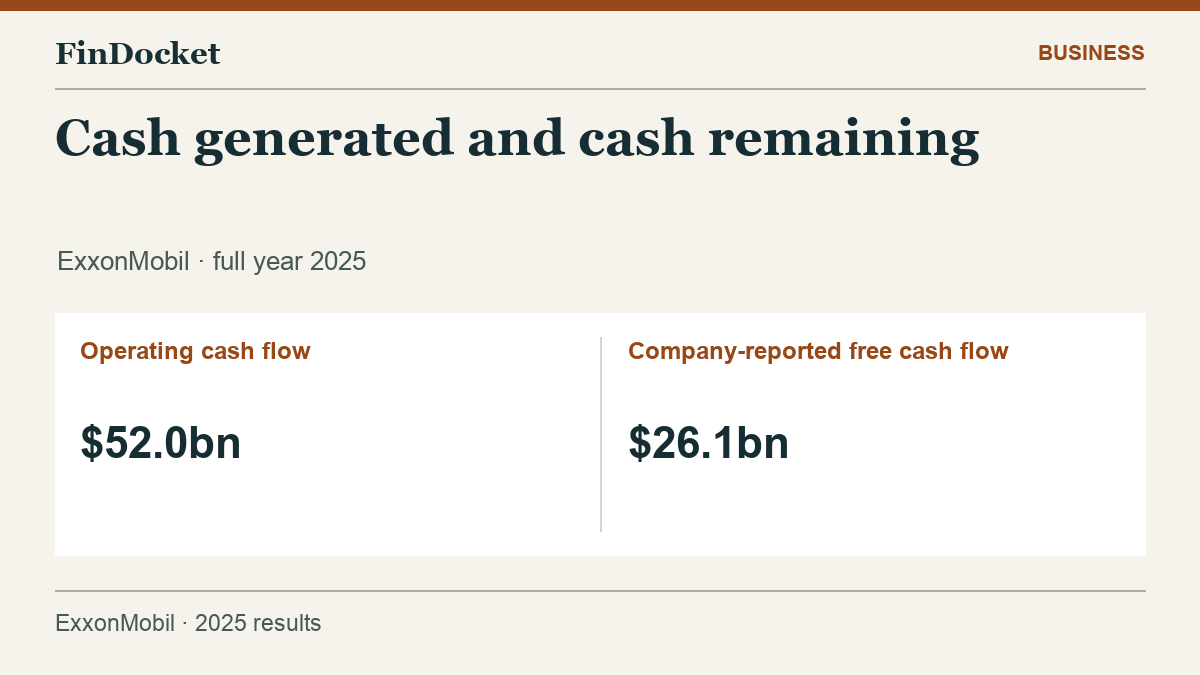
ExxonMobil reported $52.0 billion of cash flow from operations and $26.1 billion of free cash flow for 2025. That $25.9 billion difference is a useful starting point for a debate about whether oil companies now resemble royalty businesses. The operating cash is real. So is the expense of keeping a producing and refining business capable of generating it.
Free cash flow is a company-defined measure. Read ExxonMobil's reconciliation to see what it deducts and adds, including its treatment of asset sales. The gap between the two headline numbers should not automatically be labeled maintenance spending. A company funds projects intended to offset decline, projects intended to grow, and facilities with different economic lives. Proceeds from selling an asset can lift cash even though the asset will no longer earn income for the seller.
A royalty interest generally entitles its owner to a defined share under a contract. A producer typically bears more direct operating and capital obligations. Two companies could each report $1 billion of free cash flow this year, yet one may have deferred necessary investment while the other has already financed years of future output. Their ability to repeat the distribution can be very different.
A sharper valuation test uses several years of cash flows across commodity prices, reconciles disposals and looks at production after investment. That connects a strong cash year to the question investors care about most. How much can the business distribute repeatedly without running down its earning capacity?