Business · Analysis
FedEx Q3 2026: Part of the Cash Balance Belongs to Customers
FedEx's latest SEC filing separates customer tariff-refund obligations from cash resources and explains the unusual bridge from GAAP to adjusted earnings.

FedEx's September-quarter 2026 results show improving adjusted operating earnings, but the balance sheet and EPS bridge need careful interpretation. Approximately one-third of reported cash is associated with tariff refunds held for customers. Meanwhile, the quarter's earnings adjustments include both a large investment loss and offsetting gains and tax benefits.
The central distinction is between financial resources held by the company and resources economically available to its shareholders. A customer-related cash balance can increase liquidity temporarily without becoming permanent capital for buybacks, debt repayment or network investment.
Which quarter is FedEx reporting?
FedEx changed its fiscal year-end from May 31 to December 31 effective June 1, 2026. It will report a seven-month transition period ending December 31, followed by calendar-year reporting beginning in 2027. The company also completed its FedEx Freight spin-off on June 1.
The latest release therefore covers the three months ended September 30, rather than the old fiscal quarter ending in August. The continuing-operations comparison also reflects the separation of the freight business.
This prevents a common modeling error. An analyst cannot compare the new September quarter mechanically with an old August-quarter total and attribute the difference entirely to operating growth. Both the dates and the scope of the business need to match.
The company's recast information supplies the relevant historical framework. Keeping that framework consistent is the first step before evaluating margins or forecasting seasonal performance.
Why the cash headline needs a liability adjustment
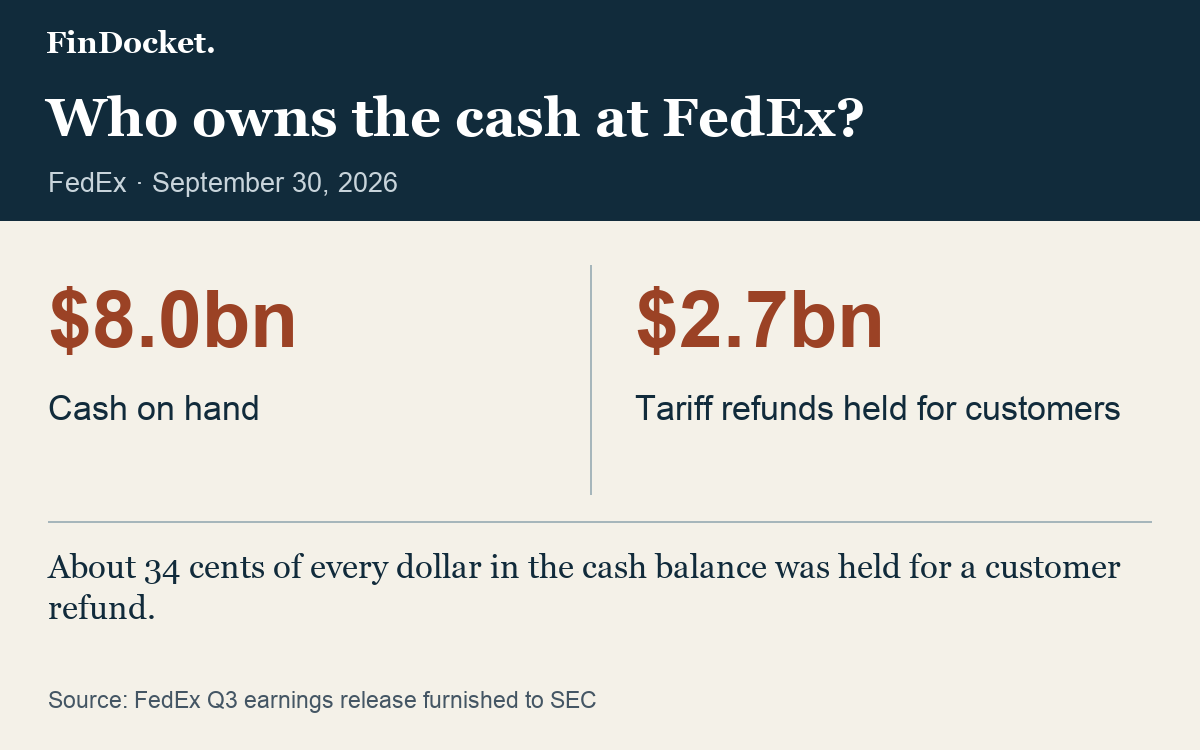
The earnings release identifies $8 billion of cash at September 30, including approximately $2.7 billion of IEEPA tariff refunds held for customers. Subtracting that amount leaves approximately $5.3 billion before considering debt, other obligations or operating needs.
The customer-related portion is approximately 33.8% of the cash headline. It is held on the balance sheet, but its purpose is to satisfy an associated obligation. Treating the full $8 billion as unrestricted shareholder surplus would materially overstate the available resources.
This is an economic adjustment rather than a claim that all customer-related cash is legally classified as restricted cash. Balance-sheet classification and the ultimate obligation to pay another party are separate questions.
The principle is the same for other forms of pass-through cash. A company may receive money before transmitting it to the party entitled to it. Holding the balance can support short-term liquidity, but repayment reduces both the cash and the associated liability.
The appropriate capital-allocation analysis starts after recognizing that obligation. It then evaluates the remaining cash alongside working-capital requirements, capital spending and debt.
Adjusted operating profit shows a smaller but useful improvement
The release reports approximately $22.9 billion of revenue, $1.067 billion of GAAP operating income and $1.197 billion of adjusted operating income. The comparable adjusted operating result was approximately $1.03 billion. Adjusted margin increased to 5.3% from 5.1%.
The roughly $167 million adjusted profit increase indicates progress in the delivery business, with a modest expansion in the proportion of sales retained as operating earnings. The larger revenue base requires considerable purchased transportation, labor and network resources, so revenue growth alone is an inadequate measure of value creation.
At a 5.3% operating margin, a one-percentage-point change in margin represents a substantial movement relative to profit. This makes cost discipline and mix particularly important. Small percentage changes in operating expense can materially affect what reaches shareholders.
The operating result is therefore a more direct view of current network performance than the headline net-income decline, which includes financial items outside ordinary package operations.
The EPS reconciliation runs in both directions
The quarterly reconciliation starts with GAAP EPS of $1.21 and reaches adjusted EPS of $3.74. The disclosed per-share items are a $5.18 investment-loss add-back, subtraction of a $1.97 debt-extinguishment gain, and subtraction of a $0.68 benefit associated with restructuring, exit and other costs.
The arithmetic is $1.21 plus $5.18 minus $1.97 minus $0.68, producing $3.74. Looking only at the investment-loss adjustment would substantially overstate the resulting adjusted EPS.
The final category is especially unusual. Operating charges can coexist with a larger tax benefit, leaving a net earnings benefit in the combined reconciliation. Removing that net benefit lowers adjusted earnings even though the category includes costs.
A consistent adjusted comparison removes favorable and unfavorable items under the same framework. Excluding losses while retaining related gains would create a biased picture of the quarter's earnings power.
The reported EPS decline and adjusted EPS increase therefore describe different layers of the result. One includes the period's investment, financing and tax effects; the other seeks to isolate a more comparable earnings base after specified adjustments.
Buybacks should be evaluated after the obligations
The company reports completing $2 billion of share repurchases from June through September, with approximately 6.3 million shares purchased. It identifies a $0.02 benefit to the September quarter's EPS from the lower share count.
Repurchase spending and immediate EPS contribution are different measures. Timing determines how much a buyback affects weighted-average shares during a quarter. The long-term economic return also depends on the purchase price relative to the value of the business.
Customer refund cash should not be treated as a permanent funding source for those distributions. The relevant resources are recurring operating cash generation and capital available after obligations and network investment.
What should define the next comparison?
FedEx's next earnings assessment should preserve the new calendar reporting basis, use continuing operations consistently and reconcile customer-related cash before evaluating financial flexibility.
The operating test is whether revenue growth and structural cost reductions produce a larger profit margin after the network resources needed to serve customers. The capital test is whether that profit becomes cash available after investment and obligations.
FedEx's quarter shows operating progress. Its most consequential accounting lesson is that neither a large cash balance nor a large earnings adjustment can be interpreted in isolation from the liability or offsetting item beside it.