Economy · Analysis
A one-point rate premium can erase a 50-year mortgage’s payment saving
On a $400,000 balance, a one-point interest-rate difference can undo the monthly saving from an extra 20 years of repayment.
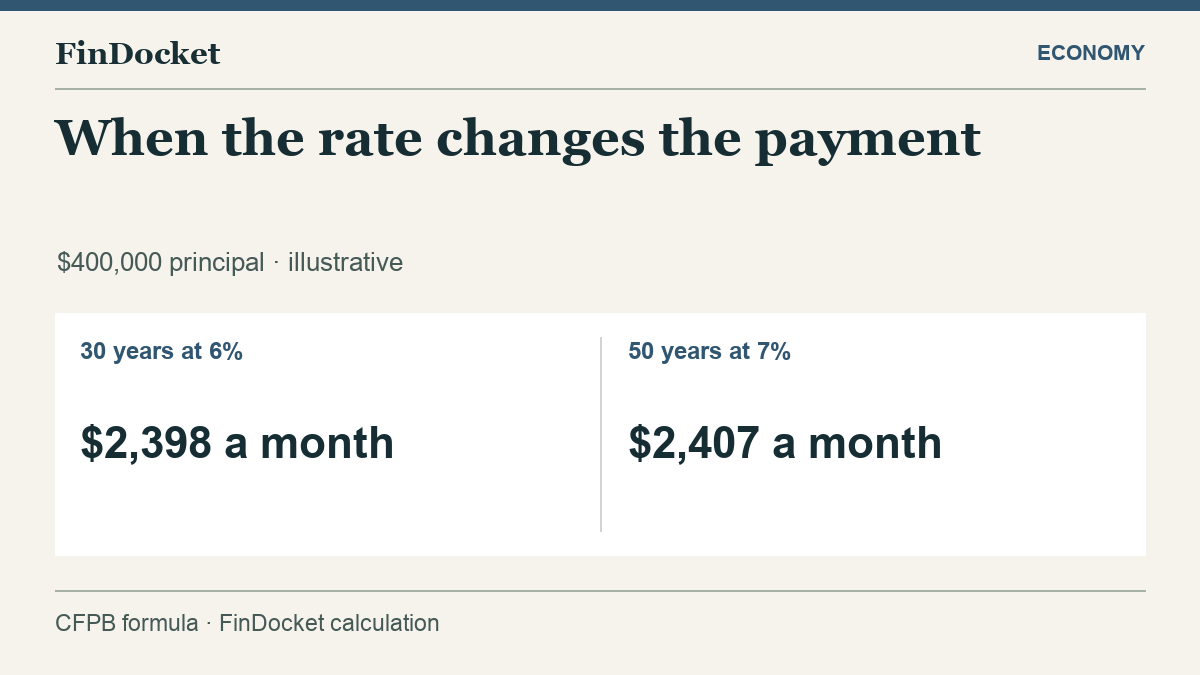
A longer term lowers the monthly payment only if the interest rate does not rise enough to offset it. On a $400,000 mortgage, the difference between a 6% and a 7% offer can use up the entire monthly advantage of switching from 30 years to 50. The example is a sensitivity calculation. It assumes hypothetical loan offers and says nothing about what rate a lender would actually quote.
Hold the 30-year loan fixed at 6%. Its monthly principal and interest payment is about $2,398. At that same rate the 50-year payment is $2,106. Raise the long loan’s rate to 6.5% and its payment becomes $2,255. At 7% it reaches $2,407, about $9 more than the original 30-year loan.
Why the last half-point matters
On the first payment of the 50-year loan, interest alone is $2,000 at 6%, roughly $2,167 at 6.5%, and roughly $2,333 at 7%. A higher rate applies to nearly the full original balance for years because principal declines slowly. Adding installments at the end cannot undo that early interest cost.
An actual comparison also needs points, fees, the expected holding period, and any loan conditions. Property taxes and homeowners insurance sit outside these principal-and-interest figures. If two offers arrive with different rates, calculating the monthly payment on each actual quote is much more informative than assuming both terms get the cheaper advertised rate.