Business · Analysis
Fiserv Q3 2026: The Goodwill Charge and the Margin Repair
Fiserv's SEC filings separate its $6.45 billion goodwill impairment from underlying margin pressure, cash-flow weakness and the enlarged savings target.

Fiserv's third-quarter 2026 results require two separate assessments. A large goodwill impairment recognized a reduction in the estimated value of acquired businesses. Meanwhile, lower adjusted margins and weaker cash generation show pressure in current operations that remains after the impairment is excluded.
The recovery case therefore needs more than an absence of another accounting charge. It needs the operating franchise to earn more from its revenue base while preserving customer relationships and converting the result into cash.
What does the $6.45 billion goodwill impairment mean?
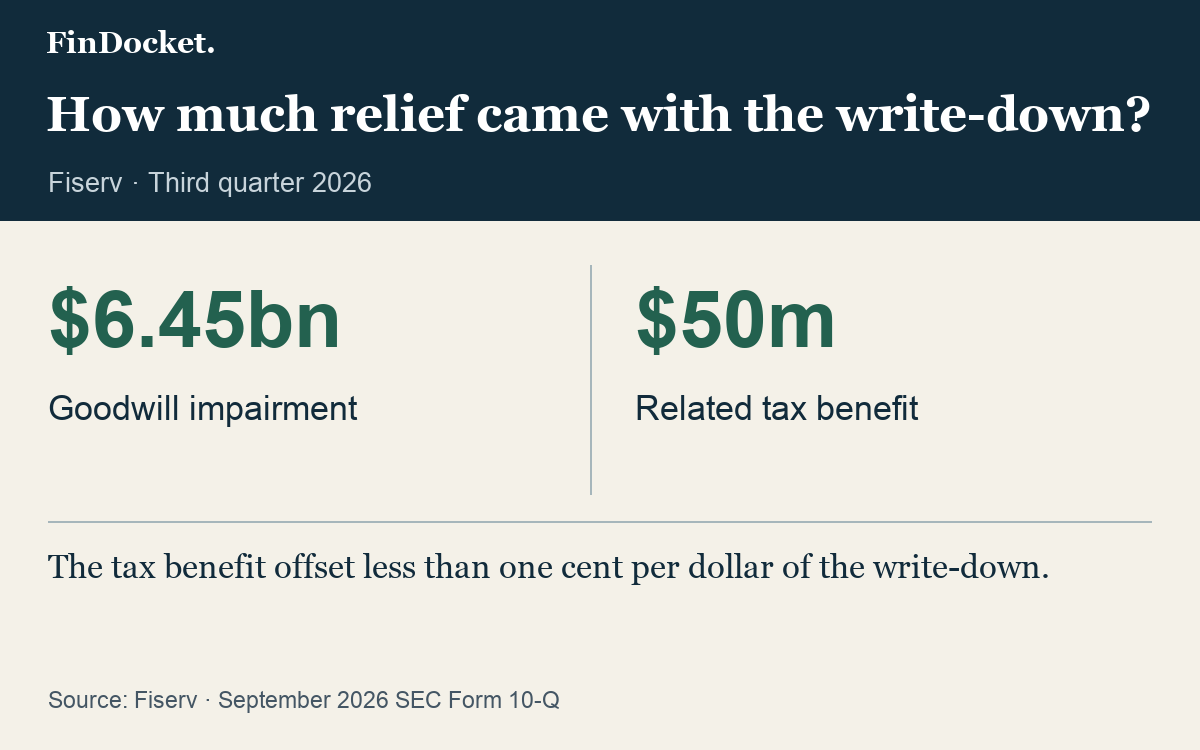
The SEC filing says sustained declines in Fiserv's share price and market capitalization triggered an interim impairment test. The resulting $6.45 billion charge included $3.692 billion in Merchant Solutions and $2.760 billion in Financial Solutions. A related tax benefit was only $50 million.
The charge is noncash in the quarter it is recorded. It does not mean that amount left the bank account during the reporting period. It does mean the carrying values tested were no longer supported by the assessed earning capacity of the relevant businesses.
That distinction connects current accounting with earlier capital allocation. Goodwill arose from prior investments. Reducing its carrying amount recognizes that the expected economic value supporting those balances has weakened relative to the accounting basis.
The small associated tax benefit also matters. The pretax charge and its after-tax impact are close because most of the impaired goodwill did not generate a corresponding tax deduction. Applying a standard tax rate mechanically to the entire charge would misstate the earnings reconciliation.
Removing the impairment helps inspect present operating performance. It does not reverse the acquisition economics or establish that the original investment delivered the return expected when the consideration was paid.
How strong are the assumptions supporting the remaining value?
The quarterly filing discloses impairment-test discount rates of 14% to 18%, revenue growth assumptions of 1% to 8% and terminal growth rates of 0% to 4%. Total remaining goodwill was $30.953 billion. One unimpaired reporting unit had approximately 10% valuation headroom.
These ranges describe different reporting-unit valuations, not a single consolidated forecast. They should not be mixed by selecting the most favorable growth assumption and the lowest discount rate as though that combination applied everywhere.
The mechanics are important. Higher expected cash generation supports a higher value; a higher required return lowers the value of the same projected cash flows. The impairment test incorporates both the operating outlook and the return demanded for the exposure.
A 10% cushion measures the distance between estimated value and carrying value under the test's assumptions. It is not a prediction of another charge. It identifies where a relatively modest change in estimated value could absorb the remaining headroom.
For shareholders, the useful question is whether actual customer and margin performance validates the cash-flow projections. A balance-sheet write-down resets an accounting amount. It does not itself improve the business's ability to generate cash.
Is underlying profitability improving after the charge is removed?
Fiserv's earnings release reports quarterly GAAP revenue of $5.20 billion, down 1%, with organic revenue flat. Adjusted operating margin fell to 31.2% from 37.0%. Financial Solutions organic revenue grew 2%, while Merchant Solutions declined 2%.
The adjusted margin decline is the central operating challenge. It shows that the dramatic GAAP loss cannot be explained solely as a goodwill event. Costs and revenue composition also reduced the earnings retained from the underlying business.
Financial Solutions' positive organic comparison provides evidence of progress within one segment, but consolidated stagnation means the recovery is uneven. A blended revenue figure can hide the difference between a stabilizing business and one still contracting.
The margin problem also has a scale dimension. Restoring 580 basis points on an unchanged revenue base would require a substantial increase in operating profit. That is why incremental customer wins need to translate into retained earnings, rather than merely offset ongoing cost pressure elsewhere.
A sustainable improvement must preserve service quality. Reducing expenses without maintaining reliability and customer retention can weaken the revenue base needed to support the next period's margins.
What must Project Elevate deliver?
The earnings release raises the projected savings target to $1 billion from $500 million. It also reports nine-month operating cash flow of $3.09 billion, versus $4.12 billion, and free cash flow of $2.04 billion, versus $2.88 billion.
A larger savings target increases the potential contribution from execution, but it is not the same as a realized earnings improvement. Timing, implementation spending, reinvestment and revenue changes determine how much reaches the income statement and cash flow.
A useful bridge would distinguish gross cost removed from net savings retained. If resources are redeployed into technology or customer support, the strategic result may still be attractive, but the near-term profit contribution will differ from the gross program target.
The cash-flow comparison supplies an additional check. Free cash flow declined by roughly 29%, faster than the revenue contraction. A recovery supported by both margins and cash conversion would provide stronger evidence than an adjusted earnings measure alone.
Cash also funds competing uses. Technology maintenance, debt service and shareholder distributions all draw on the same available resources. Announced capital returns should be assessed against the cash remaining after the operating system has received the investment it requires.
What would establish a durable Fiserv recovery?
The next stage needs consistent customer retention, comparable revenue growth across the portfolio, improving retained margins and stronger cash generation. Those outcomes would support both the operating turnaround and the values assigned to remaining acquired assets.
The impairment identifies a reset in assessed business value. The adjusted margin and cash-flow figures identify the continuing execution problem. Fiserv's recovery will be established by better economics from its customer base and cost structure, with the enlarged savings program contributing measurable net returns.