Business · Analysis
When does a subscription-free tracker pay for itself?
Feature fees and annual renewal timing can reverse which tracker costs less over two years. A worked comparison makes the trade visible.
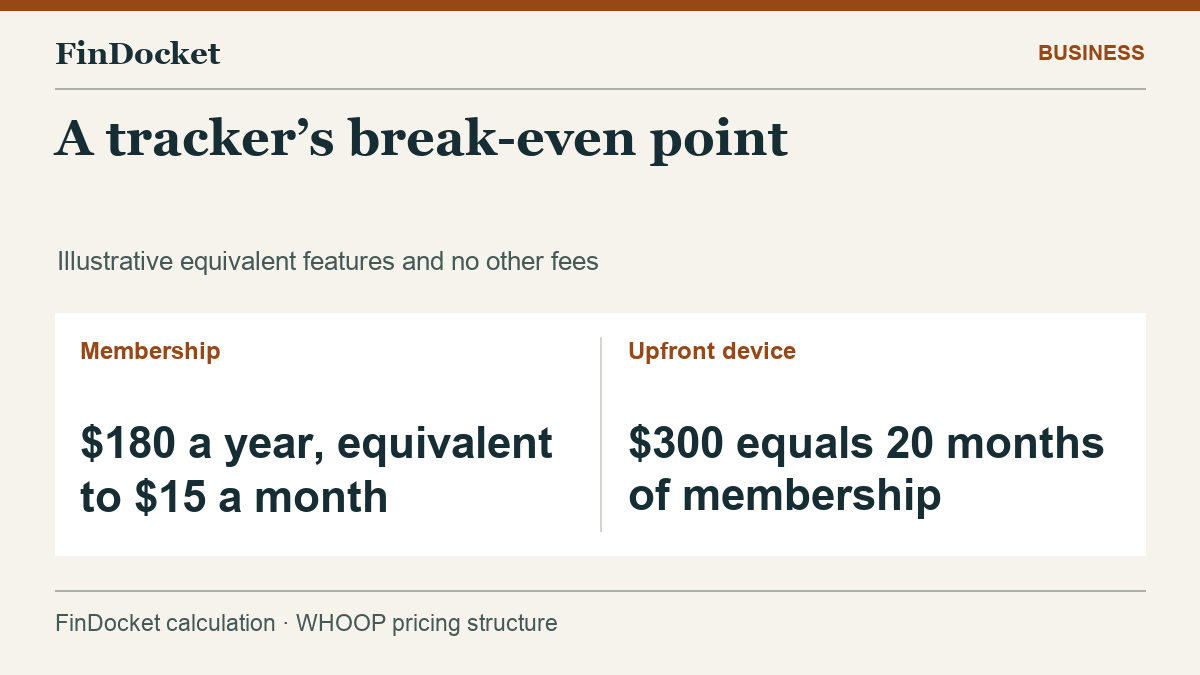
A subscription and a hardware purchase put the price in different places. WHOOP's membership page bundles device access and software features into plans. A competing watch may charge more upfront and keep its basic functions available without an annual payment. Looking at only the price on the first screen favors whichever seller collects its money later.
Consider an illustrative choice between $180 a year and $300 upfront with no recurring fee. At $15 per month of equivalent membership cost, the alternatives cross after 20 months. If annual fees are collected upfront, the actual bank balance changes in steps. A second $180 renewal would bring membership payments to $360 at the start of year two. Cancellation and refund terms determine what fraction of a prepaid year can be recovered.
Now add the feature that prompted the purchase. If the alternative charges $5 a month for that feature, its two-year cost becomes $420. The membership in the example totals $360 over the same period. Hardware replacement, resale value and an insurer or employer subsidy can move the balance again. These are worked prices, separate from WHOOP's current regional offers.
Before comparing brands, write down the measurements you intend to use, where historical data will remain accessible and how long you expect to keep the device. Calculate the cash paid at 12, 24 and 36 months for that same set of functions. A modest-looking recurring fee then becomes directly comparable with the purchase price.