Business · Analysis
Gap Q3 2026 Earnings Expose an Uneven Brand Recovery
Gap's Q3 2026 filing separates brand momentum from tariff refunds and settlement gains. Analyze margins, Athleta, cash flow and capital returns.

Gap’s third-quarter 2026 earnings show a profitable but uneven recovery. The namesake brand generated more than the entire company’s net sales increase, while Old Navy was nearly flat and Athleta declined sharply. Quarterly operating income improved 19%, helped by expense discipline, but the much larger year-to-date profit increase depended heavily on tariff recoveries and a litigation settlement.
The distinction changes the investment question. Gap has ample liquidity and stronger reported cash flow, yet the operating engine still needs broader brand participation. FinDocket’s analysis of the latest SEC quarterly report separates current-quarter execution from exceptional gains and examines what remains after capital spending and shareholder distributions.
Which Gap brands are actually growing?
Third-quarter sales were $4.011 billion, up $69 million, or 1.8%. Gap Global increased revenue by $108 million to $1.059 billion. Old Navy added $21 million, while Banana Republic lost $15 million, Athleta lost $37 million and the other category declined $8 million.
The namesake brand therefore contributed approximately 157% of the consolidated sales increase, offsetting weakness elsewhere. Its 9% comparable-sales growth supports the improvement in dollar revenue. This is a brand-specific recovery rather than a uniformly stronger portfolio.
Old Navy remains the economic center of gravity, with $2.274 billion of sales, or 56.7% of the total. Its comparable sales were flat, following 6% growth in the prior-year quarter. Even with momentum at Gap, the larger business must contribute more for consolidated growth to accelerate materially.
Athleta revenue declined 14.4% to $220 million, with comparable sales down 15%. Banana Republic’s comparable sales fell 3%. Together, those two businesses offset approximately half of Gap Global’s dollar increase. That is why measuring the turnaround through a single successful brand gives an incomplete picture.
Online revenue increased 2.6% to $1.615 billion, compared with 1.2% growth in store and franchise revenue. Online supplied approximately 59% of the consolidated sales increase. The channel classification includes online orders fulfilled by stores, so it should not be interpreted as a measure of purely warehouse-based e-commerce.
What improved quarterly operating profit?
Operating income rose to $396 million from $334 million. Gross profit contributed $35 million of the $62 million improvement, while operating expenses declined $27 million. The quarterly result therefore combined modestly better merchandise economics with lower overhead spending.
Gross margin increased only slightly, to 42.5% from 42.4%. Lower average unit costs, primarily associated with lower tariff rates, benefited merchandise costs. Higher occupancy expenses absorbed much of that improvement. The filing attributes the expense reduction mainly to lower performance-based compensation, partly offset by more advertising.
That composition matters for persistence. Lower incentive compensation helps the current period but does not automatically establish a permanently more efficient expense structure. Advertising and strategic investment also need to generate future demand, particularly in brands where comparable sales remain negative.
Net income increased to $311 million from $236 million, faster than operating profit. Interest income rose $20 million, primarily reflecting interest on tariff recoveries, and the effective tax rate fell to 25.6% from 30%. Diluted shares also declined to 360 million from 380 million, helping EPS reach $0.86 from $0.62.
Why does the nine-month result need adjustment?
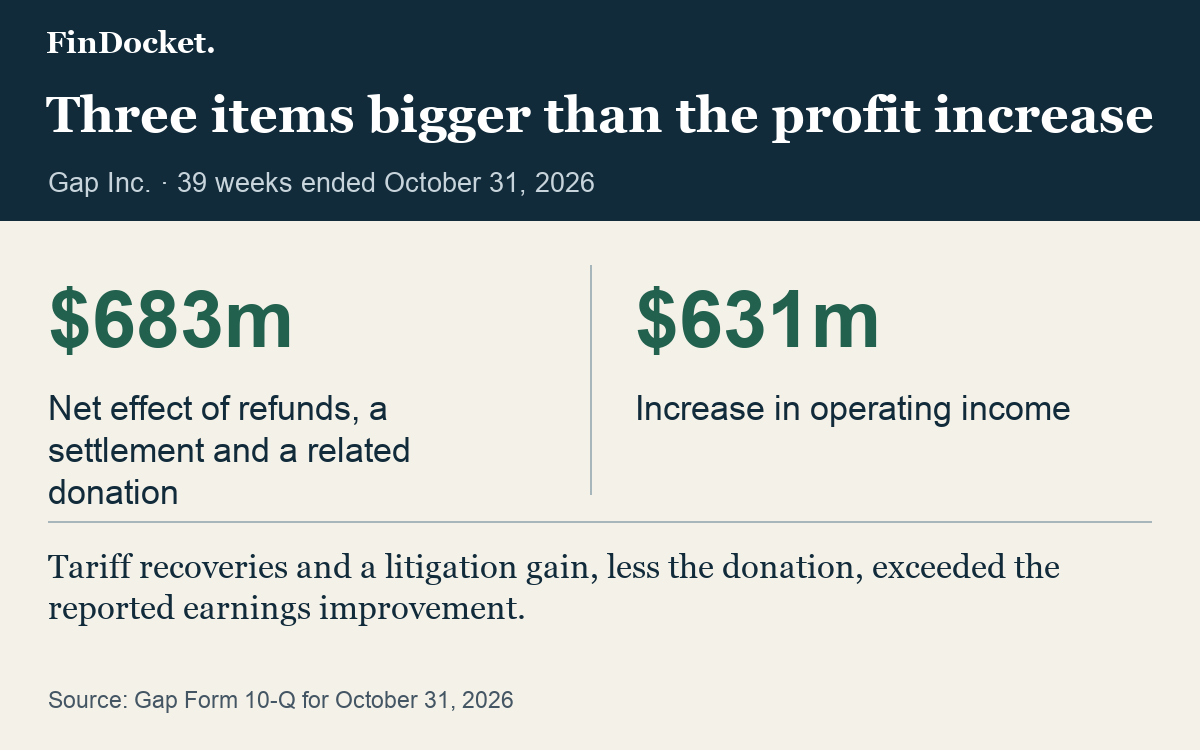
Year-to-date operating income reached $1.517 billion, compared with $886 million. The $631 million increase included $420 million of net IEEPA tariff recoveries and a $313 million litigation-settlement gain, partly offset by a concurrent $50 million charitable contribution.
Together, those three items contributed $683 million to operating profit, more than the total reported increase. Subtracting them produces approximately $834 million of operating income, below the prior-year $886 million. This is FinDocket’s analytical bridge, not a company-reported adjusted result.
The calculation does not remove every difference in tariff costs, promotional activity, store costs or investment. Its purpose is narrower: demonstrate that the reported 71% operating-profit increase is not evidence that the recurring retail operation improved by that amount.
Net tariff recoveries also differ from gross cash refunds. Gap disclosed $515 million of refunds, offset in profit by a $95 million vendor-appreciation commitment. Treating the gross refund as wholly incremental earnings would overstate the economic benefit.
Is the free-cash-flow increase repeatable?
Operating cash flow rose to $1.298 billion from $607 million. Capital expenditure increased to $483 million from $327 million, leaving reported free cash flow of $815 million, compared with $280 million.
The filing identifies approximately $536 million of pretax tariff-refund and related-interest cash effects, as well as the $313 million settlement gain and $50 million contribution. Those exceptional cash effects total approximately $799 million before associated tax and payment-timing differences. That is nearly the entire reported free-cash-flow amount, not a precise estimate of normalized after-tax cash flow.
Inventory also consumed substantially less cash: the year-to-date outflow was $105 million, compared with $386 million. Quarter-end inventory fell 6.3% from a year earlier to $2.305 billion, against 1.8% sales growth. That relationship supports improved inventory efficiency, although it does not establish future markdown levels or assortment quality.
Repurchases consumed $601 million and dividends another $187 million, together absorbing approximately 97% of reported free cash flow. Equity-award tax withholding used a further $71 million. The capital-return program is therefore materially larger than the cash surplus left after the identified exceptional benefits are considered.
The company operated 2,482 stores at quarter-end, compared with 2,497 a year earlier. Its smaller store count and lower inventory show that sales growth did not require simply adding more physical locations or merchandise. The open question is productivity across the remaining estate, particularly whether occupancy investment and advertising can restore demand in the lagging brands.
What would make the recovery more convincing?
Cash and short-term investments totaled $2.972 billion, compared with $1.493 billion of long-term debt carrying value. Operating lease liabilities added $4.280 billion of future store-related obligations. The balance sheet provides flexibility, but store commitments remain central to the business model.
A stronger recovery would pair sustained Gap-brand momentum with renewed Old Navy growth, stabilization at Athleta and cash generation less dependent on refunds and settlements. The latest quarter shows progress in profitability. The portfolio and cash-flow details show exactly where that progress still needs to broaden.