Business · Analysis
GE Vernova Q3 2026: Customer Advances Power the Cash
GE Vernova's Q3 SEC filing shows how customer advances drive cash flow, why slot reservations differ from orders and what that means for capital allocation.
GE Vernova's third-quarter 2026 results show a powerful commercial position: customers are committing to scarce equipment capacity and paying ahead of delivery. That structure produces cash well before the company has completed all the work attached to the orders.
The financial benefit is substantial. So is the obligation embedded in the cash. The SEC filing shows why free cash flow during a rapid order expansion cannot be treated as though every dollar represents profit already earned on completed equipment.
What did GE Vernova report in Q3 2026?
Quarterly revenue was approximately $12.6 billion, up 27%, with 18% organic growth. Adjusted EBITDA was approximately $1.9 billion, with a 15.4% margin. Operating cash flow was approximately $6.1 billion and free cash flow approximately $5.4 billion.
The quarter's cash generation therefore exceeded adjusted EBITDA by a wide margin. That relationship points toward cash timing and balance-sheet movements as major drivers, alongside stronger operating profitability.
This is economically favorable when customer advances reduce the manufacturer's need to finance production itself. It is also different from a mature business generating the same cash after delivering and collecting payment for completed products. The two cash streams carry different remaining obligations.
The nine-month cash statement identifies the driver
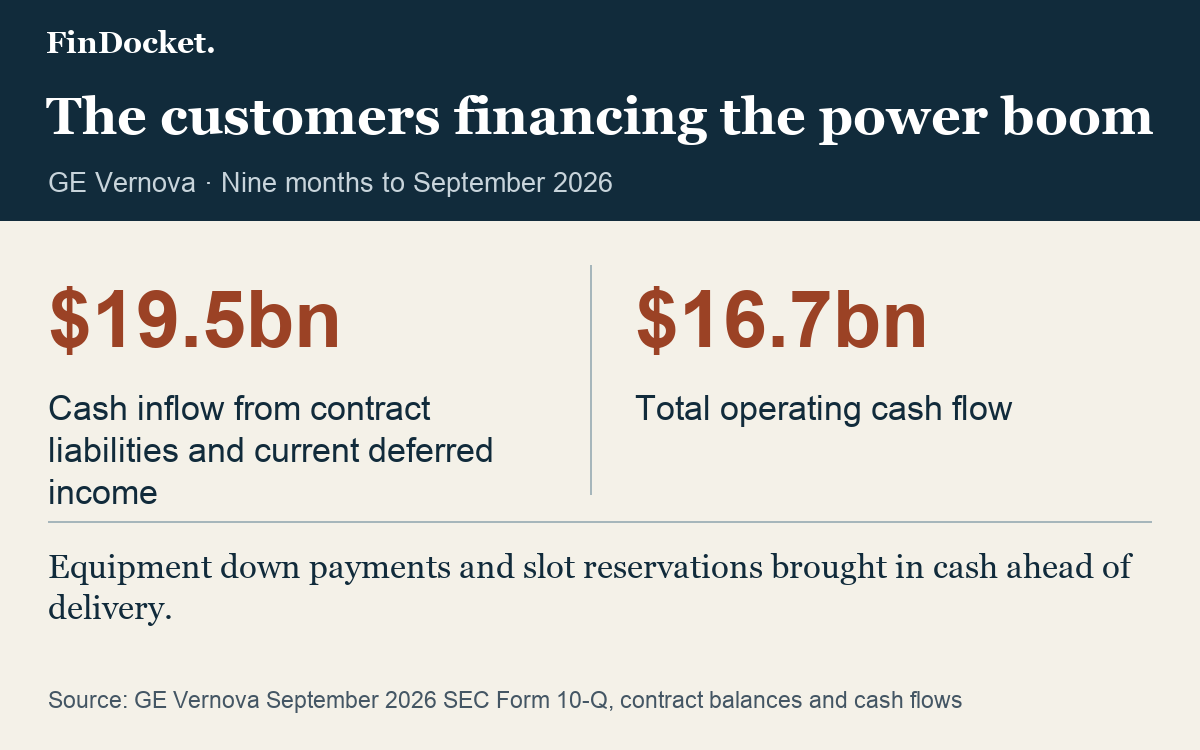
The 10-Q reports nine-month operating cash flow of $16.737 billion and free cash flow of $15.307 billion. Working-capital changes supplied approximately $17.0 billion. Within that movement, contract liabilities and current deferred income contributed approximately $19.5 billion, mainly through customer down payments on equipment orders and slot reservations.
The total working-capital inflow exceeded operating cash flow by approximately $263 million. Mechanically removing that inflow would leave operating cash flow near negative $263 million for the period.
That subtraction is not a normalized cash-flow forecast. It removes an entire category of movements while leaving taxes, pension payments and other period-specific items in place. Its purpose is narrower: to demonstrate that customer funding and other working-capital timing account for the scale of reported cash generation.
The business is earning more, but the cash statement cannot be read as if improved profit alone produced the reported inflow.
The liability side explains whose work remains unfinished
Total contract liabilities and deferred income increased to $45.747 billion from $25.950 billion at year-end. The filing describes contract liabilities primarily as cash received before equipment delivery or servicing the installed base.
The increase was approximately $19.797 billion, or 76%. This balance-sheet change is not identical to the $19.5 billion cash-flow contribution because balance movements and cash-flow movements can differ through acquisitions, currency and other accounting effects.
The balance is a record of future performance obligations associated with customer payments. It is not financial debt in the ordinary bondholder sense, and it should not simply be deducted from cash as though every dollar were immediately repayable borrowing.
It also cannot be ignored when deciding how much cash is economically surplus. The company still needs to manufacture, deliver or service the contracted equipment, and doing so will consume materials, labor and other resources.
Advance-funded growth can be an excellent business model
A manufacturer with attractive payment terms can expand while customers finance a large part of the operating cycle. That can improve liquidity, reduce borrowing needs and increase returns on the capital supplied by shareholders.
The durable value comes from the margin retained after fulfilling the order. Advance collection accelerates the receipt of cash; it does not by itself increase the total profit earned over the contract's life.
If new advances arrive faster than earlier contracts consume cash, reported free cash flow can remain especially strong. If order intake later slows while deliveries continue, that timing benefit can narrow even while the company remains profitable.
The useful forecast therefore needs both an operating earnings model and a contract-cash model. Assuming today's advance inflow repeats indefinitely would convert a commercial timing advantage into an unsupported permanent annuity.
Slot reservations and equipment orders should stay separate
GE Vernova's gas-equipment bridge shows firm backlog increasing from 53 to 64 gigawatts while slot reservations declined from 63 to 58 gigawatts. During the quarter, 13 gigawatts of reservations converted to orders, and five gigawatts of equipment shipped. Combined backlog and reservations reached 122 gigawatts.
The combined measure increased by six gigawatts from 116. Firm backlog increased by 11 gigawatts, while reservations fell by five. That pattern shows both expansion and maturation of the commercial pipeline.
Converting a reservation into an order changes the composition of the pipeline. It is not automatically an additional independent unit of demand on top of the reservation already counted. Adding conversions to both categories would overstate the commercial opportunity.
For investors, conversion is valuable because it can improve the specificity of delivery commitments and commercial terms. The financial outcome still depends on pricing, execution costs, delivery timing and the service opportunity attached to the installed equipment.
Capital allocation needs to reflect delivery obligations
The company is raising full-year free-cash-flow guidance to $16–$17 billion and has expanded its repurchase authorization. These decisions sit within a period of exceptionally strong customer funding.
A large cash balance gives management flexibility to expand manufacturing, pursue acquisitions and return capital. The decision must also preserve the resources required to deliver the backlog at the promised economics.
The relevant stress test is not whether all advances suddenly become debt. It is whether manufacturing capacity, inventory purchases and contract execution can be funded if new customer payments become less favorable while existing delivery commitments continue.
GE Vernova's quarter demonstrates pricing power, demand and unusually favorable funding terms. The shareholder payoff will be established as the company converts those funded obligations into delivered equipment, retained margins and cash that remains after the work is complete.