Business · Analysis
Global Payments Q3 2026: Worldpay Cash and GTCR's Options
Global Payments' SEC filings connect Worldpay integration costs, weak reported cash flow and GTCR's potential acquisition plans. A detailed GPN analysis.

Global Payments' latest SEC filings connect three questions: whether Worldpay is improving the combined merchant business, how much cash integration is consuming and what GTCR's ownership position could mean for control of the company.
The potential ownership transaction does not resolve the operating question. Any buyer would still need to translate the enlarged payments franchise into cash after integration, platform investment and financing costs. Those economics also define the return available to public shareholders if the company remains independent.
What exactly has GTCR disclosed?
The November 20 Schedule 13D reports beneficial ownership of 43.27 million shares, or 16.35%. The reporting persons received their stake through the Worldpay transaction and say they are evaluating strategic alternatives that could include a proposal for additional or all remaining shares. The filing says no definitive determination had been made.
This is evidence of an active strategic evaluation, not an agreed acquisition price. The filing provides no basis for replacing a standalone earnings model with a known cash consideration per share.
The stake is commercially significant because the investor already has exposure to the combined company's outcome. A proposal for the rest of the equity would require evaluating the return on additional capital committed, financing terms and the cash available after the transaction.
For current shareholders, the economic comparison would be between any actual offer and the value of retaining ownership through the integration. Until a concrete proposal exists, the operating cash model remains the foundation of that comparison.
How much growth is visible on a comparable basis?
Global Payments' earnings release reports quarterly GAAP revenue of $3.31 billion and adjusted net revenue of $3.18 billion. Normalized adjusted net revenue growth exceeded 4%. The normalized comparison includes pre-acquisition Worldpay results and excludes Issuer Solutions and other divested businesses.
The normalization is necessary because the company changed what it owns. A simple comparison of reported revenue would attribute the acquired business's existing revenue to new commercial growth.
Adjusted net revenue introduces a separate distinction: it removes certain grossed-up amounts to focus on the economic benefit retained. That can improve comparability, but the same definition must be used in both the current period and the forecast base.
A sensible model consequently needs two reconciliations. The first puts both periods on a comparable business perimeter. The second translates gross revenue into the retained revenue measure. Skipping either can produce an exaggerated impression of growth or an inconsistent margin calculation.
Comparable growth above 4% provides evidence of commercial progress within the enlarged business. The return on acquiring that growth still depends on costs, capital invested and the financing structure supporting the combination.
Which EPS figure describes the continuing business?
The earnings release headlines GAAP diluted EPS of $1.06 and adjusted EPS of $3.58. The quarterly filing separately reports continuing-operations diluted EPS of $0.30. It also records approximately $754.4 million of acquired-intangible amortization in quarterly cost of service.
The different figures answer different questions. Total GAAP EPS incorporates discontinued activities and their associated effects. Continuing-operations EPS narrows the perimeter. Adjusted EPS removes specified items under management's definition.
A valuation multiple must use an earnings figure whose scope matches the business being valued. Applying a continuing-business multiple to total earnings containing discontinued-operation effects would create a mismatch. So would extrapolating a discrete disposal contribution as though it represented ongoing merchant processing.
Amortization is a major part of the adjustment discussion because acquisitions bring customer relationships and other assets onto the balance sheet. Excluding that expense can help assess present operations. It leaves the need to measure returns on the original consideration and to fund the technology and customer investment required to preserve earnings capacity.
The useful bridge therefore runs from recurring customer economics to adjusted operating earnings, then through cash investment, financing, taxes and ownership claims. No single EPS label replaces that work.
What does reported cash generation reveal about integration?
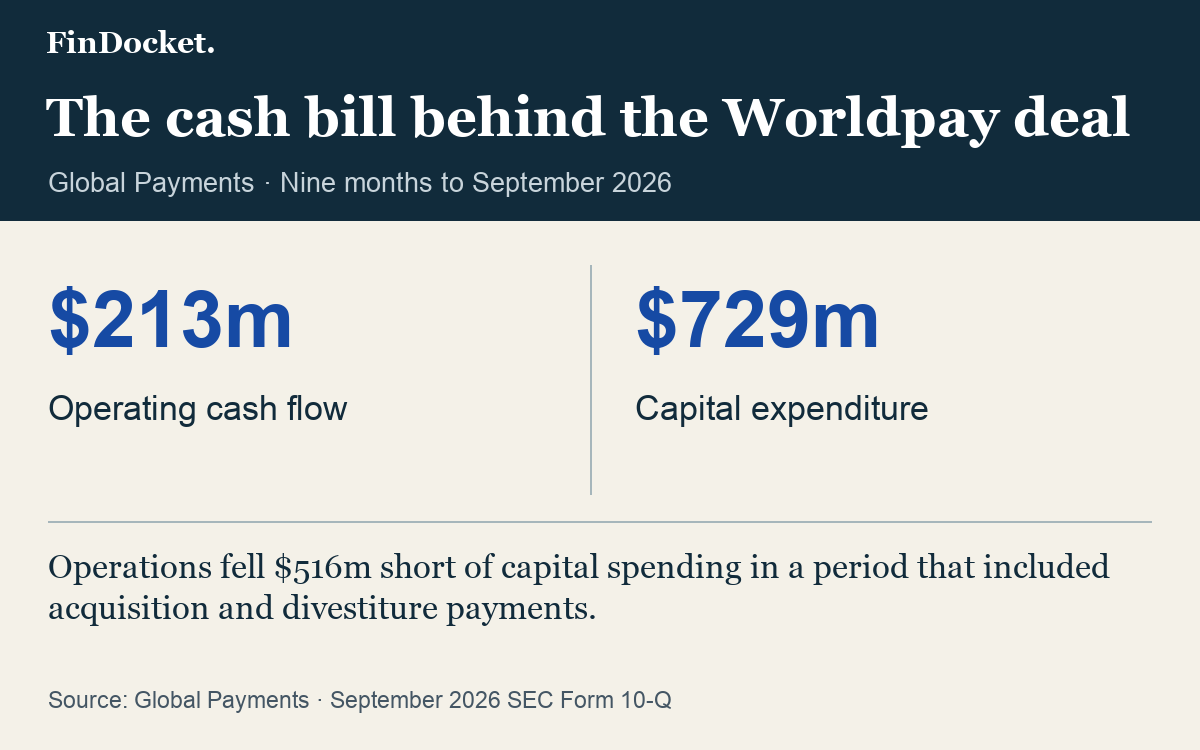
The filing reports nine-month operating cash flow of $212.9 million, versus $2.141 billion, and capital spending of $728.9 million. Cash flows include discontinued operations and payments associated with the acquisitions, dispositions and assumed liabilities. Only $1.289 billion of reported cash was considered available for general purposes.
Subtracting capital spending from reported operating cash flow gives approximately negative $516 million. That is an unadjusted arithmetic cash measure, not the company's adjusted free cash flow or a forecast of normalized cash generation.
The distinction is consequential. Acquisition and integration costs can be excluded from a recurring earnings comparison, yet the cash still has to be funded. A program can have an attractive eventual return and create substantial financing demands during implementation.
Settlement and customer-related cash also cannot be treated as unrestricted acquisition funding. The amount reported on the balance sheet and the amount available for corporate purposes serve different economic roles.
The next cash bridge should identify which integration payments end, which expenditures maintain the platform and which working-capital movements reverse. That would show how much of the current deficit is temporary and how much ongoing investment the enlarged business needs.
Can the synergy target close the cash gap?
The release raises expected annual run-rate integration expense synergies to $650 million. Its nine-month reconciliation excludes $671 million of acquisition, integration and separation expenses, plus other transformation charges.
A run-rate target describes a future annual pace of benefits, while the cost figure covers spending recognized over a defined historical period. Dividing one by the other would not establish a valid payback period: the scopes, timing and cash content differ.
The acquisition creates value when retained future benefits exceed the implementation costs and the return required on the capital committed. GTCR's strategic evaluation adds a possible ownership outcome. Worldpay integration and recurring cash generation will determine the underlying economics of whichever ownership structure emerges.