Business · Analysis
GLPI Q3 2026 Earnings: Chicago Cash and Tenant Credit
GLPI's Q3 SEC filing reveals growing AFFO, deferred Chicago rental income and substantial development spending. Analyze dividend coverage and Bally's exposure.

Gaming and Leisure Properties' third-quarter 2026 earnings show a growing rental business whose cash economics differ from its reported revenue. The clearest example is Bally's Chicago: development funding earns payments before the related rental income is recognized in the income statement.
That timing helps explain why adjusted earnings and GAAP profit tell different stories. The investment question extends beyond the accounting treatment. GLPI is committing capital to a tenant with disclosed liquidity pressure, making the tenant's ability to sustain payments as important as the contractual return on the property.
How fast did GLPI grow in Q3 2026?
The earnings release reports revenue of $435.4 million, up 9.5%, AFFO of $311.7 million, up 10.5%, and adjusted EBITDA of $413.9 million, up 13.0%. AFFO per diluted share and OP/LTIP unit rose 7.2% to $1.04. Net income fell to $213.8 million from $248.5 million. AFFO and adjusted EBITDA are non-GAAP measures.
The gap between total AFFO growth and per-share growth reflects the additional ownership claims supporting the expanded portfolio. For a shareholder, the latter is the more direct measure of progress: a larger rental stream must compensate for the capital issued to obtain it.
Net income moving in the opposite direction requires a separate explanation. The adjusted measures exclude items that affect GAAP profit, including credit provisions and rent timing adjustments. They measure an aspect of the business, rather than resolving every question about the value of its receivables and properties.
Why does Chicago cash differ from reported rental income?
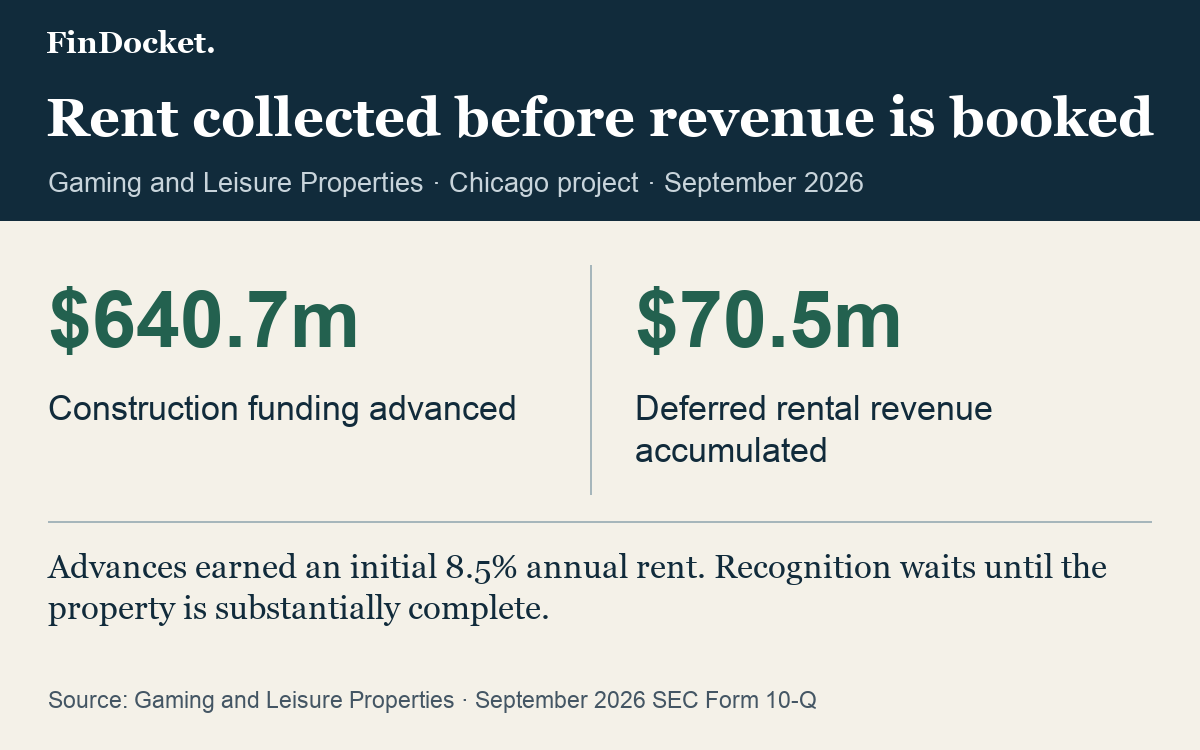
The 10-Q reports $640.7 million funded toward a Chicago construction commitment of up to $940 million. Advances earn an initial 8.5% annual rental yield. Rent is paid monthly, while income recognition is deferred until substantial completion. Accumulated deferred rental revenue reached $70.5 million at September 30, versus $28.7 million at year-end.
Approximately $299.3 million remained under the construction commitment at quarter-end, calculated before subsequent advances. This is a substantial prospective use of capital, even though the funded portion already earns contractual payments.
The deferred revenue balance is not an unpaid customer receivable. In this arrangement, cash received precedes recognition of rental income. Its increase therefore helps explain why evaluating the development solely through current GAAP revenue understates the payments already flowing to GLPI.
Completion will change the recognition pattern, but it will not make all associated economics new. A rise in recognized income after opening must be separated from changes in actual cash rent, additional funding and the release of previously deferred amounts. Otherwise, an accounting transition can be mistaken for a sudden improvement in property-level demand.
What does Bally's financial position mean for GLPI?
The filing says Bally's and affiliates supplied 19.4% of quarterly cash income. It also describes Bally's August disclosure of substantial doubt about its ability to continue as a going concern, based on forecasts excluding financings being pursued. Construction of the permanent Chicago casino continued with an early-2027 opening target.
Those disclosures connect concentration with development exposure. Existing rent receipts are evidence of current payments; they do not eliminate the importance of a tenant's refinancing and liquidity requirements. The landlord's return depends on the operator continuing to meet obligations across a portfolio while bringing a major new property into operation.
Real estate ownership provides an underlying asset claim, but the value and timing of a recovery depend on the asset's condition, completion requirements and alternative use. A partly developed casino is a different economic exposure from a stabilized building occupied by a tenant with ample liquidity.
For Chicago, the key operational milestones are completion, opening and the establishment of a sustainable operating cash stream. The contractual yield defines what GLPI is owed on its funding. The operator's eventual economics determine how comfortably that obligation can be serviced.
Is the dividend covered by adjusted earnings?
The release reports a quarterly dividend of $0.82 and full-year AFFO guidance of $4.11–$4.12 per diluted share and OP/LTIP unit. Guidance includes approximately $800 million of total 2026 development spending. GLPI acquired Bally's Lincoln for $700 million with $56 million of additional annual rent.
The calculated quarterly payout is approximately 78.8% of AFFO per share. Annualizing the dividend produces $3.28, equivalent to about 79.7% of the midpoint of full-year guidance. These comparisons leave a positive adjusted earnings margin above the distribution.
The Lincoln transaction implies the stated 8% initial property yield. Its contribution can increase recurring rental income, but the purchase also requires financing. The gain to shareholders depends on the full funding mix and the resulting per-share earnings, rather than the property yield viewed in isolation.
Development spending and dividends compete for capital even when both support the company's strategy. Retaining roughly one fifth of AFFO after an annualized dividend does not mean that retained earnings alone finance an unusually large construction program.
What does the cash flow statement show?
The SEC filing reports nine-month operating cash flow of $899.5 million, investing outflows of $1.449 billion and dividends paid of $698.4 million. Net common stock proceeds were $350.8 million. Cash ended September at $165.8 million.
Operating cash exceeded common dividends by approximately $201.1 million before investment activity and other financing uses. Including investing outflows produces a roughly $1.248 billion gap between operating cash and the combined investing and common dividend uses. That calculation explains the importance of external funding; it is not a recurring free cash flow margin.
GLPI's expansion is translating into higher adjusted earnings per share. The stronger conclusion depends on the next stage: converting funded development into completed, productive properties while maintaining tenant payments. Chicago's cash receipts are a real current contribution, and Bally's liquidity disclosures remain central to assessing how durable that contribution will be.