Business · Analysis
What would a $15 billion federal loan to Hadrian actually cost?
A proposed $15 billion loan is a face amount. Repayment terms, recoveries and the government's role as customer determine the exposure.
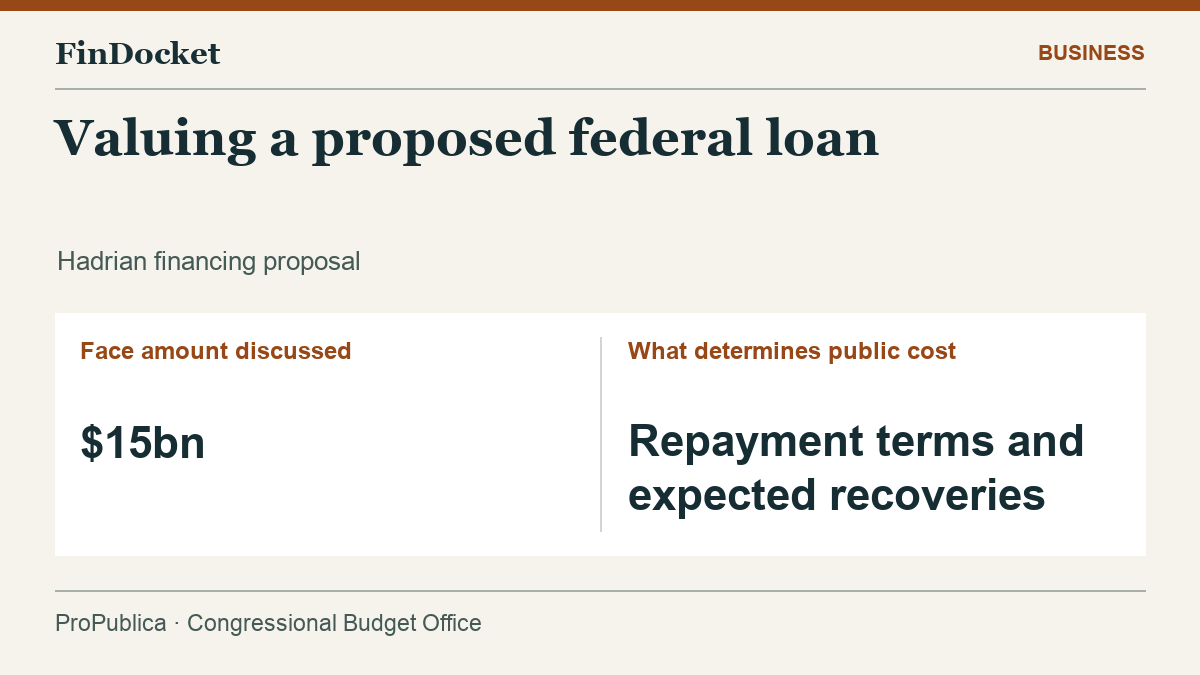
A proposed $15 billion loan and a $15 billion grant have very different economics. ProPublica reported that the Pentagon was considering a loan of that size to Hadrian Automation for a planned factory expansion. The reporting establishes a proposal. It does not establish a binding loan agreement, a disbursement schedule or a final taxpayer loss.
For a lender, principal advanced creates a claim to future payments. Estimating the financial cost requires the interest rate, timing of advances and repayments, risk of default, collateral recoveries and an appropriate discount rate. An illustrative 10% unrecovered principal loss on a fully drawn $15 billion loan would be $1.5 billion before interest, recovery timing and other costs. That is sensitivity arithmetic. It is not an estimate of Hadrian’s default probability or the government’s budget score.
Where two government roles can overlap
ProPublica reported that the expansion would build factories serving defense production. If the government also buys a large part of their output, its purchasing decisions could affect the borrower’s ability to repay. A lender would want to know whether projected sales depend on signed orders, future procurement competitions or assumptions about demand.
The documents that could settle those questions are a signed financing agreement, draw conditions, security terms and actual customer commitments. The company's private funding history and political connections are relevant to scrutiny of the decision. Neither substitutes for the cash-flow terms needed to value the proposed credit.