Business · Analysis
Happen Q3 2026: Loan Growth and the Fair-Value Reset
Happen, formerly LendingClub, grew earnings as loan accounting changed. Analyze its Q3 2026 credit-cost bridge, retained lending and capital requirements.

Happen's third-quarter 2026 earnings show a growing lending franchise, but its lower credit provision does not measure the improvement by itself. The company, formerly LendingClub, changed how it accounts for new investment loans this year. Credit costs now appear across different lines, and more origination fees arrive in earnings immediately.
The central investment question is how much profit the expanded loan business earns after credit, acquisition and funding costs, with a consistent accounting basis. Reading only revenue growth or the provision produces an incomplete answer.
What did Happen report for Q3 2026?
The earnings release reports $3.336 billion of originations, up 26%, and diluted earnings of $0.50 per share, up 35%. Pretax income reached $76.8 million. Revenue declined to $263.2 million from $266.2 million, while the provision changed from a $46.3 million expense to a $15.9 million benefit.
That combination looks contradictory until credit accounting enters the bridge. A lender can report lower revenue and higher earnings if costs previously recorded below revenue move into revenue and other expense relationships change. Neither the top line nor the provision retains its previous standalone meaning.
For valuation, investors need a repeatable earnings base. That requires following the full loan economics rather than extrapolating the fastest-growing reported line. Happen's new presentation demands that work even though the underlying lending process remains familiar: acquire borrowers, fund loans, collect payments and absorb defaults.
Why does fair-value accounting change the comparison?
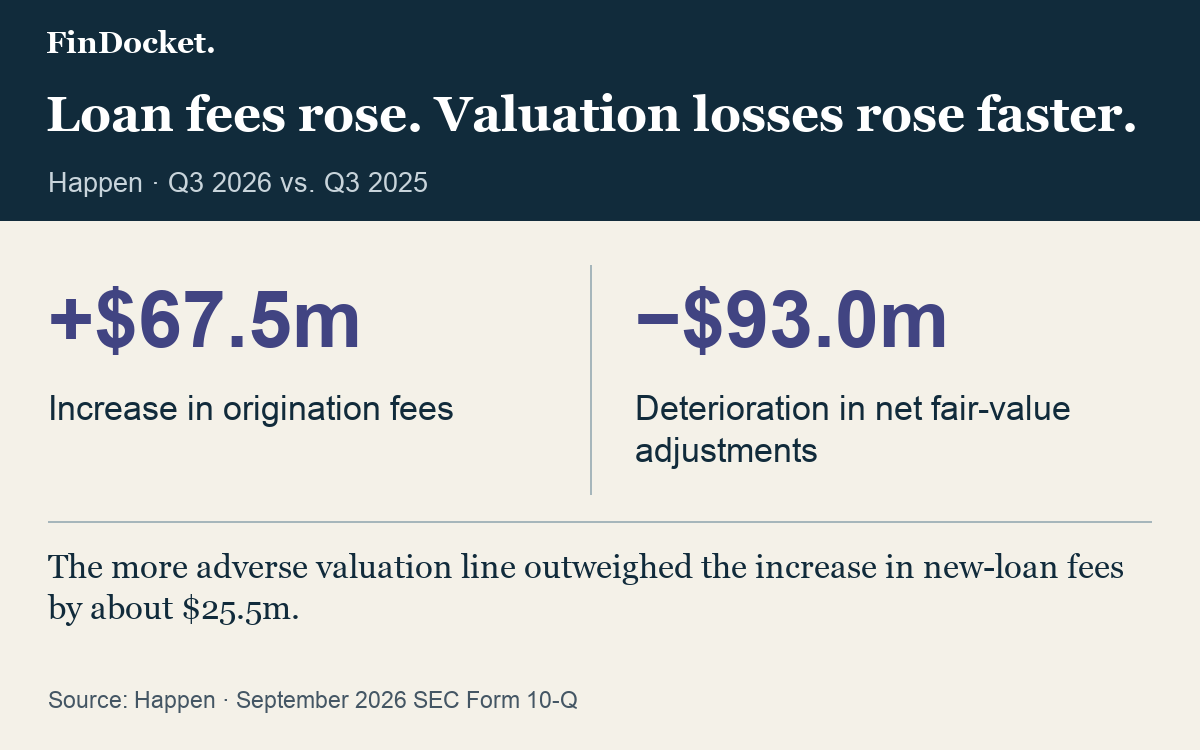
The quarterly filing says new held-for-investment loans originated from January 1 use the fair-value option. Origination fees are recognized immediately rather than deferred. Subsequent valuation changes and realized credit losses enter non-interest income. Net fair-value adjustments were negative $131.4 million, versus negative $38.4 million a year earlier, including $12 million of one-time gains this quarter.
The accounting shift changes timing and location. It does not erase the economic cost of a borrower failing to repay. A model that adds back negative valuation marks while also celebrating the disappearance of the new-loan provision would count the same improvement twice.
Immediate fee recognition creates another timing issue. Rapid originations can accelerate recognized fee income, while the associated loans remain outstanding. Future interest collections, credit performance and funding expenses still determine the ultimate return.
The one-time gains also deserve a separate place in the bridge. Removing them mechanically from pretax income would indicate a lower recurring starting point, but it would not produce a fully normalized earnings estimate. That exercise additionally requires evaluating the recurring marks and the mix of new and seasoned loans.
Does risk-adjusted revenue solve the problem?
Happen defines non-GAAP risk-adjusted revenue as revenue less the credit provision. It reported $279.1 million, up 27%. Non-interest expense increased to $202.3 million from $162.7 million. The resulting pretax gain was approximately $19.5 million year over year.
Using the rounded figures, risk-adjusted revenue increased about $59.2 million, while operating expense absorbed roughly $39.6 million of that increase. Approximately one-third of the incremental amount therefore reached pretax earnings.
This is a more useful operating bridge than comparing revenue alone because it combines two places where credit effects can appear. It still does not eliminate changes in recognition timing, fair-value assumptions or the seasoning of the loan portfolio.
A higher risk-adjusted revenue margin is valuable when it reflects better borrower economics and efficient production. Its durability is weaker when the gain depends on a temporary mix, unusual marks or expense timing. Forecasting should connect each component to the loans that generated it.
How much growth stays on the bank's balance sheet?
The release reports $1.192 billion of quarterly originations held for investment, versus $629 million a year earlier. Originations sold or held for sale increased to $2.145 billion from $2.027 billion. Deposits reached $11.5 billion, and the common equity Tier 1 ratio was 15.7%, versus 18.0% a year earlier.
Calculating from those origination figures, the investment share increased from roughly 24% to 36%. About $563 million of the $680 million increase in total originations came from the retained category, subject to rounding.
That changes the character of growth. Holding a loan can generate interest over its life, but it also commits funding and regulatory capital. Selling a loan produces a different pattern of fees, servicing rights and retained exposure. Similar origination totals can therefore produce different shareholder returns.
Deposit funding supports the retained model, but deposits carry a price and must be managed alongside liquidity. The relevant comparison is the loan's return after expected losses and funding costs against the capital required to hold it. Origination volume alone cannot settle that comparison.
What do the fair-value sensitivities reveal?
The filing values investment loans measured at fair value at $3.139 billion. A hypothetical 100-basis-point increase in their discount rate reduces estimated value by $44.5 million. A separate 10% increase in the annualized charge-off assumption reduces it by $28.7 million. These are individual sensitivities, not a combined forecast.
Relative to reported quarterly pretax income, those amounts equal approximately 58% and 37%, respectively. That scale explains why valuation assumptions deserve attention as the fair-value portfolio expands.
Discount rates incorporate the return demanded for future cash flows. Credit assumptions address how much of those cash flows will be collected. They can move differently, and their effects should not be added without a model of their interaction.
The shareholder test is whether the bank can keep generating attractive loan returns as the portfolio matures, while paying for customer acquisition and preserving enough capital for continued growth. Happen's quarter showed meaningful earnings expansion. Its strongest evidence will be sustained returns across seasoned loans, consistent credit-cost measures and capital that grows alongside the franchise.