Business · Analysis
Hilton Grand Vacations Q3 2026: Behind the Profit Jump
Hilton Grand Vacations' SEC filing shows how construction recognition and a credit reserve change lifted earnings while contract sales and sales productivity fell.

Hilton Grand Vacations' third-quarter 2026 earnings surged, but current sales activity weakened. Construction-related recognition moved previously deferred economics into the income statement, while a change in the credit allowance methodology increased reported revenue. Neither is equivalent to a sudden acceleration in new customer purchases.
The report therefore requires three separate assessments: current selling performance, the timing of revenue recognition and the cash economics of financing vacation ownership. Combining them into one headline growth rate obscures the commercial problem management is trying to fix.
Why did reported earnings jump?
The earnings release reports revenue of $1.961 billion and net income attributable to shareholders of $291 million, against $25 million a year earlier. Adjusted EBITDA attributable to shareholders was $609 million versus $245 million. Current results included a $296 million net construction recognition, compared with a $57 million net deferral previously. Adjusted EBITDA is non-GAAP.
Removing those construction effects from the disclosed EBITDA figures produces $313 million currently and $302 million previously. The calculated increase is approximately 3.6%, substantially below the reported increase.
That calculation isolates one timing item; it does not remove every other influence or establish a fully normalized earnings figure. It is useful because it shows how much of the reported change comes from the completion cycle rather than an equivalent change in contemporaneous sales.
Construction recognition is legitimate revenue accounting with a real economic basis. A completed project allows the company to recognize transactions that had not yet satisfied the applicable conditions. Its timing nevertheless makes a single quarter's reported profit an unreliable proxy for the rate at which new business is being created.
What happened to contract sales?
Contract sales declined 11% to $807 million. Volume per guest fell 12.5%, while tour flow increased 1.7%. Management reduced full-year adjusted EBITDA guidance excluding construction deferrals and recognitions to $1.165 billion–$1.180 billion, from $1.225 billion–$1.265 billion.
More prospective customers entered the selling process, but the average sales output per tour deteriorated. That directs attention toward conversion, transaction size and the effectiveness of selling initiatives rather than solely toward attracting visitors.
The midpoint of the revised outlook is $72.5 million lower, using the published ranges. That reduction shows that management's updated assessment of operating execution weakened despite the exceptional reported quarter.
Improving sales productivity would allow the same marketing infrastructure to generate more value. But the improvement needs to survive the costs of incentives, financing and expected credit losses. A sale made on less attractive terms can improve gross activity while reducing the return earned on the capital supporting it.
How did the credit estimate change affect results?
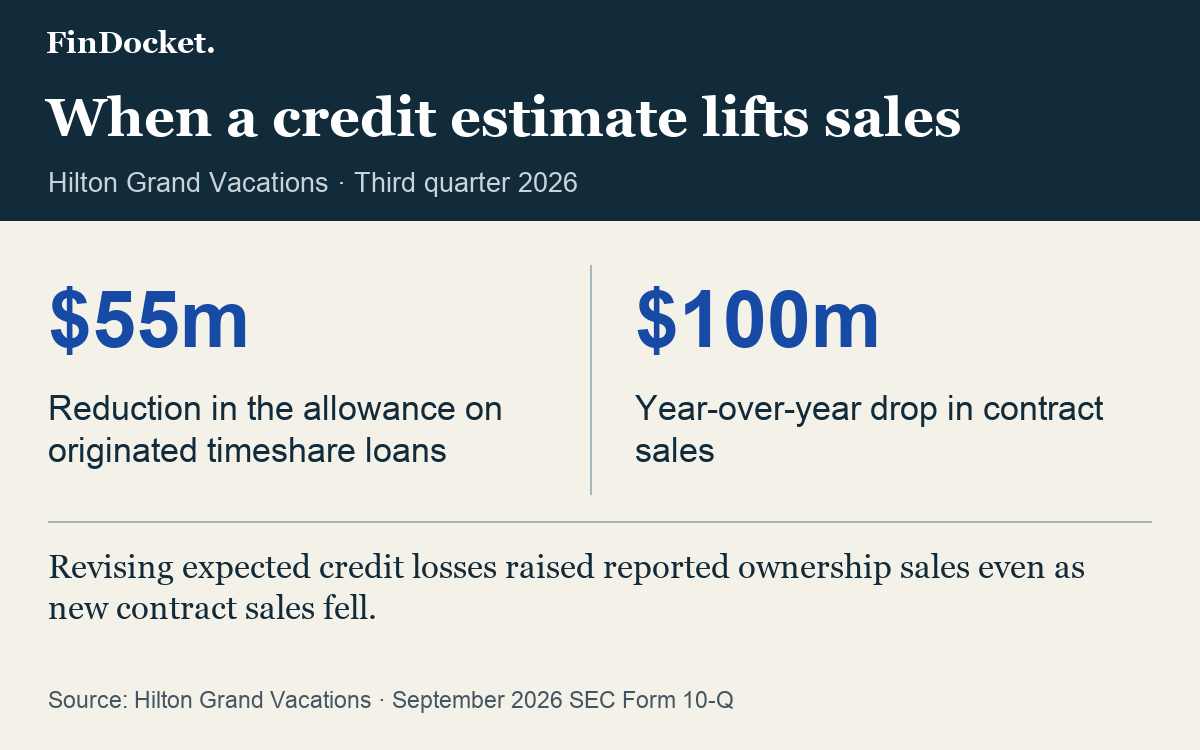
The 10-Q reports combining historical receivable performance from acquired businesses into one static pool model, segmented by FICO score and buyer equity. The prospective estimate change reduced the originated loan allowance by $55 million and increased net vacation ownership sales revenue by reducing the loss provision.
This is an assumption-driven earnings benefit. It does not mean customers paid an additional $55 million during the quarter. The revised estimate reflects management's view of future performance under the integrated model.
A more representative model can improve measurement when businesses and underwriting standards become integrated. The test is how subsequent collections and losses compare with the estimates applied to the relevant borrowers.
The benefit also remains within the reported operating results after removing construction timing. Subtracting one prominent adjustment is therefore insufficient to label the rest of the quarter recurring. Investors need to identify each material influence before estimating the earning power that can persist.
Reserve methodology and sales execution should be evaluated independently. Better expected collections can increase estimated profit on the loan book even when the business is generating fewer new sales. Those are different sources of value and require different evidence.
Why does construction affect margins so much?
The filing explains that revenue and related direct costs for projects under construction are deferred until completion, while indirect marketing and selling costs are expensed as incurred. Recognition periods can therefore show stronger margins after some selling expenses were recorded earlier.
The commercial activity and the accounting recognition do not occur on an identical schedule. A project can absorb marketing expense before its revenue appears, then contribute a large reported profit when completion permits recognition.
A better measure of project economics considers the whole selling and construction cycle. It includes the costs incurred before recognition as well as the revenue recognized at completion. Annualizing the completion quarter's margin would assign the business an earnings rate that ignores those earlier expenses.
The same reasoning applies to cash. Customers can pay deposits, receive financing or make installment payments on schedules that differ from revenue recognition. The income statement needs the cash flow statement to establish when money actually arrives.
What did cash generation support?
Nine-month operating cash flow was $349 million. Property capital expenditure was $23 million and capitalized software spending was $53 million. The cash statement also records $410 million of share repurchases, $103 million of acquisition spending and $139 million of net non-recourse debt repayments.
Operating cash less property and software spending leaves $273 million. Buybacks exceeded that calculated remainder by $137 million, before considering the acquisition and net receivable financing repayments. Inventory and related development cash flows already sit within operating activities and should not be deducted twice.
The comparison identifies the capital allocation burden without assuming that every payment must be financed from that period's operations alone. Borrowing and available liquidity can bridge spending, but they have a cost and require future cash support.
Hilton Grand Vacations' reported profit reflects the completion of previously sold projects and a more favorable credit estimate. The commercial recovery depends on improving sales conversion and transaction economics. Sustainable shareholder value requires those improvements to produce collected cash after funding receivables, maintaining inventory and servicing the capital structure.