Business · Analysis
Humana Q3 2026: Clinic Options and the Cost of Growth
Humana's Q3 2026 filings show insurance losses and a new clinic joint venture. Our analysis separates option gains, future capital needs and operating recovery.

Humana's third-quarter 2026 results combine rapid expansion, weak current underwriting and a significant change in how its primary-care network is financed. The new CenterWell joint venture improves financial flexibility by removing an investor put option. It does not remove the capital required if Humana eventually chooses to own the clinics outright.
The distinction is central to evaluating the recovery. Accounting gains from revised option values, lower contractual funding pressure and stronger clinic operating earnings are different sources of value. The latest filings allow investors to separate them rather than treat a larger reported earnings number as evidence that all three have improved together.
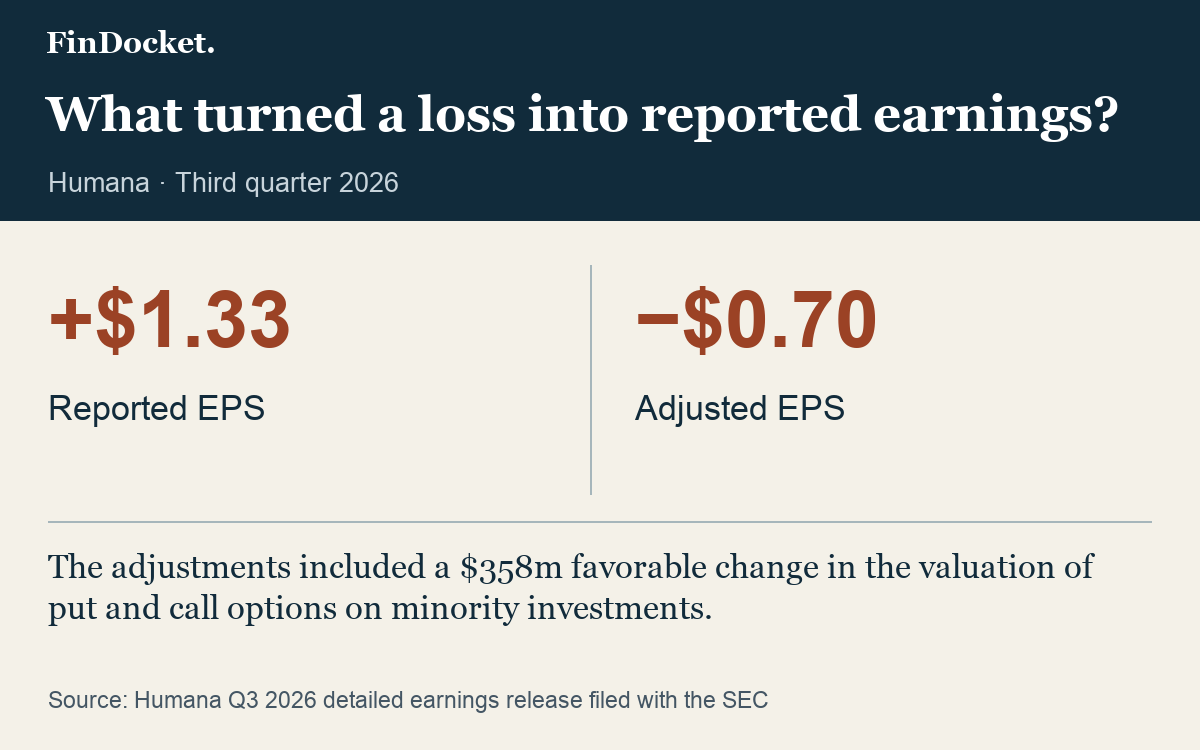
Why did Humana report profit and an adjusted loss?
The earnings release reports quarterly revenue of $41.155 billion, versus $32.649 billion. GAAP EPS was $1.33, while adjusted loss per share was $0.70. A $358 million favorable pretax put-and-call valuation adjustment helped GAAP earnings; excluding that and other specified items produced an adjusted pretax loss of $104 million.
Revenue increased approximately 26%, yet the adjusted result was negative. That is a direct warning against using enrollment or sales growth as a substitute for earning power. Growth in a medical-risk business adds claims exposure as well as premium income. The outcome depends on pricing, risk adjustment, patient mix and the cost of delivering care.
A favorable option remeasurement is also different from collecting operating revenue. It changes the estimated value of contractual rights and obligations. The gain belongs in the financial statements, but it does not demonstrate that the insurance book or clinic network generated an equivalent amount of additional recurring cash profit.
The release raises full-year adjusted EPS guidance to at least $9.50 from $9.00. That improves the company's expected annual outcome while leaving a difficult quarterly operating comparison. Beating a loss expectation can be progress without establishing that the underlying business has already returned to sustainable profitability.
The new clinic arrangement removes an important obligation
The 10-Q describes an October joint venture with BlackRock-managed funds replacing the prior Welsh, Carson, Anderson & Stowe arrangements. The old net option liability was approximately $1.2 billion at September 30 and was expected to reverse in Q4. The new arrangement removes the put option and initially carries an estimated $255 million net option liability.
The put's removal matters because it changes who controls a potential transaction. An investor's right to require a purchase can create funding demands at an inconvenient time. A purchase option held by Humana gives management more discretion over timing and capital allocation.
A smaller recorded liability therefore reflects a real contractual change. It should still be evaluated alongside the economics of the replacement arrangement, including the outside investor's protections and eventual exit rights. A financing structure can become more flexible without making all of its future capital needs disappear.
The accounting reversal is expected in the fourth quarter, after the September reporting date. It should not be confused with the favorable valuation movement already included in the third-quarter result. Keeping those events separate prevents double counting the benefit.
Owning the clinics later remains a substantial capital decision
Under the new arrangement, CenterWell can begin purchasing clinics in 2028. The 10-Q estimates that exercising the earliest successive options could require approximately $1.1 billion in 2028, $1.1 billion in 2029 and $1.2 billion in 2030. Exercise is discretionary, and the estimates depend on future operating and transaction assumptions.
Those amounts total approximately $3.4 billion. They are potential acquisition spending, rather than fixed annual debt maturities. That distinction gives Humana flexibility, but it also means an ownership-based valuation needs to include the purchase price alongside the future clinic earnings being acquired.
An investor cannot assign all of the clinics' future earnings to Humana shareholders while ignoring the cost of obtaining the remaining ownership interests. Conversely, choosing not to acquire every clinic preserves capital but leaves some economics with the outside investor. The relevant return is the incremental cash profit purchased per dollar invested.
This framework also explains why a liability reduction and an acquisition opportunity are not interchangeable. One changes an existing obligation; the other offers a future choice. Each needs its own financial analysis.
Insurance and CenterWell still need operating improvement
The release reports a $303 million insurance operating loss, compared with $251 million of profit, and a benefit ratio of 93.7%, versus 91.1%. CenterWell operating income declined to $243 million from $305 million despite revenue rising to $7.157 billion from $5.879 billion.
CenterWell revenue grew roughly 21.7%, while operating profit fell approximately 20.3%. Its calculated operating margin declined from about 5.2% to 3.4%. Expansion has therefore not yet translated into improved aggregate profitability at the care platform.
These figures make operating execution more important than the financing headline. Outside capital can fund clinics and improve flexibility, but the clinics ultimately need reimbursement and patient economics that cover clinical labor, administration and the cost of capital. Insurance pricing must likewise compensate for the medical risk being assumed.
The recovery depends on converting new scale into better returns
Management's prepared remarks report year-to-date individual Medicare Advantage membership growth of approximately 1.208 million, or 23%, and primary-care patient growth of 146,800, or 30%. Management continues to target a sustainable individual Medicare Advantage pretax margin of at least 3% in 2028 and expects the Q4 insurance benefit ratio just above 95.5%.
That creates a clear test for the recovery: the expanded population must become more profitable as pricing, care delivery and operating costs adjust. Growth creates the opportunity, but the current quarter does not prove the eventual return.
Humana's revised clinic financing removes an important constraint and increases management's choices. Shareholder value will depend on exercising those choices at attractive prices while restoring insurance and care-delivery margins. The strongest evidence will be recurring operating earnings that improve independently of option remeasurements.