Business · Analysis
The hybrid boom in US showrooms is mostly in cars without plugs
Conventional and plug-in hybrids moved in opposite directions in US sales figures, with implications for dealerships and charging demand.
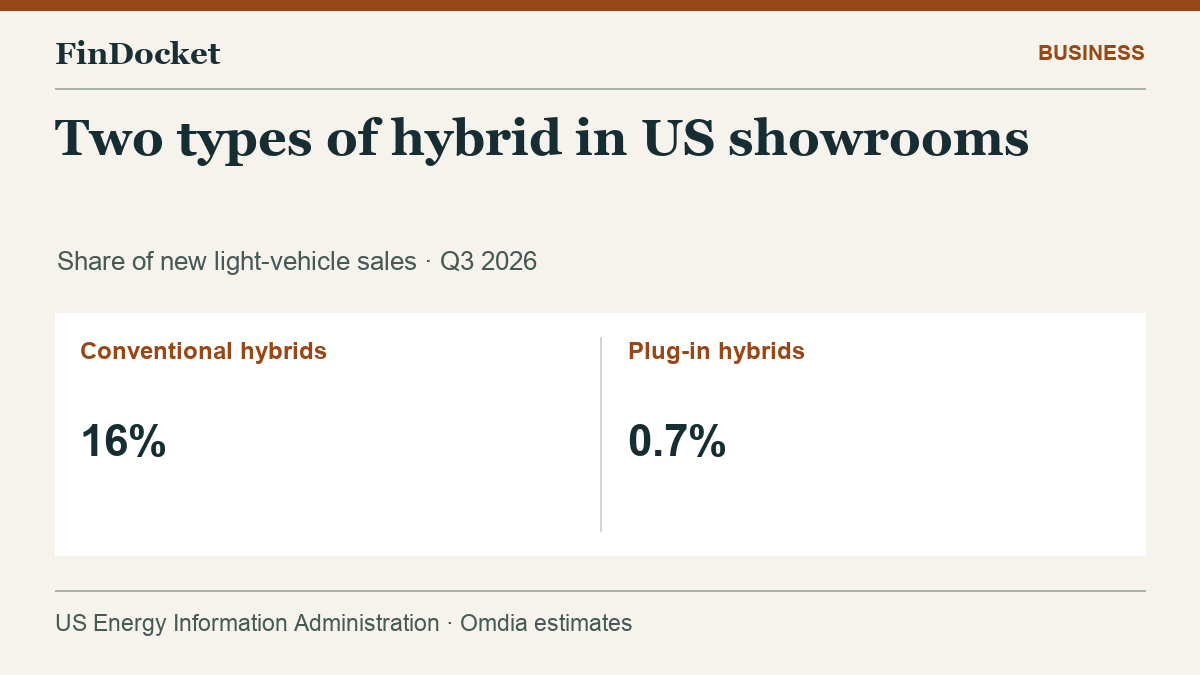
Automakers trying to follow US buyers into hybrids face a product choice hidden by the category name. Conventional hybrids reached 16% of new US light-duty vehicle sales in the third quarter of 2026. Plug-in hybrids accounted for 0.7%, down from 1.8% a year earlier. The Energy Information Administration reported those estimates using Omdia sales data.
A conventional hybrid still relies on liquid fuel and does not connect to the grid. A plug-in hybrid offers an externally rechargeable battery as well as a combustion engine. Its attraction to a buyer depends in part on access to charging and the value of electric driving. A factory equipped to produce components for one type cannot infer demand for the other from a combined “electrified” sales chart.
Which comparison matters to a supplier?
Battery-electric vehicles accounted for about 6% of new sales in the quarter, down from 10% a year earlier. The EIA notes that federal clean-vehicle credits expired at the end of September 2025 and that conventional hybrids were ineligible for those credits. The year-earlier quarter also contained a rush in battery-electric sales ahead of expiration. A simple year-over-year comparison therefore contains both product demand and an unusual starting period.
For a supplier estimating new orders, the useful inputs are units by powertrain, components per vehicle and the models it actually supplies. Multiplying total hybrid sales growth by the content of an average plug-in vehicle would materially misstate the opportunity.