Economy · Analysis
What India’s defence production figure measures about self-reliance
Production, procurement and local value added track different outcomes. Imported components can sit inside a locally produced final order.
India's government initially reported defence production of ₹1.51 lakh crore for fiscal 2024–25. A later official summary put it at ₹1.54 lakh crore. The figures concern the value of production in the sector. A current account of that year should identify the publication date and use a consistent vintage when calculating growth.
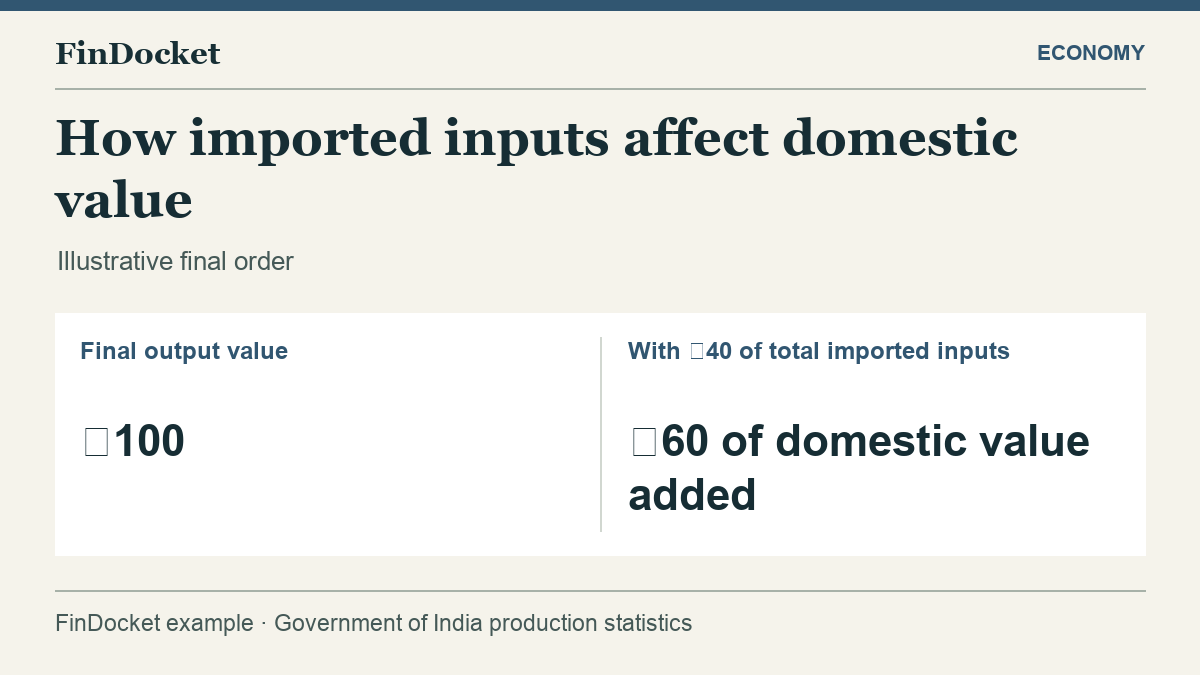
An increase in domestic production is commercially meaningful. It does not, by itself, tell a reader the proportion of value created inside the country. Suppose a final order sells for ₹100 and incorporates imported inputs costing ₹40. In a simplified chain with no other foreign inputs, ₹60 remains for domestic value added along the chain. If the domestic assembler bought subcomponents from a local company that itself imported parts, tracing only direct imports would overstate that domestic share.
There are other questions hiding under the term self-reliance. The percentage of procurement contracts awarded to local firms measures where buyers place orders. Export receipts measure sales to foreign buyers. Ownership of designs and the ability to purchase critical inputs on acceptable terms address still different dimensions. None can be derived by dividing one aggregate production figure by an unrelated import total.
A stronger scorecard would report domestic value added on comparable contracts, direct and indirect imports, and export earnings over the same fiscal years. That would let readers distinguish growth in local industrial activity from a measurable reduction in dependence on foreign suppliers.