Economy · Analysis
Why a family’s food inflation can run above India’s headline rate
India’s new food weight and a simple household budget show why reported inflation and a family's real wage can diverge.
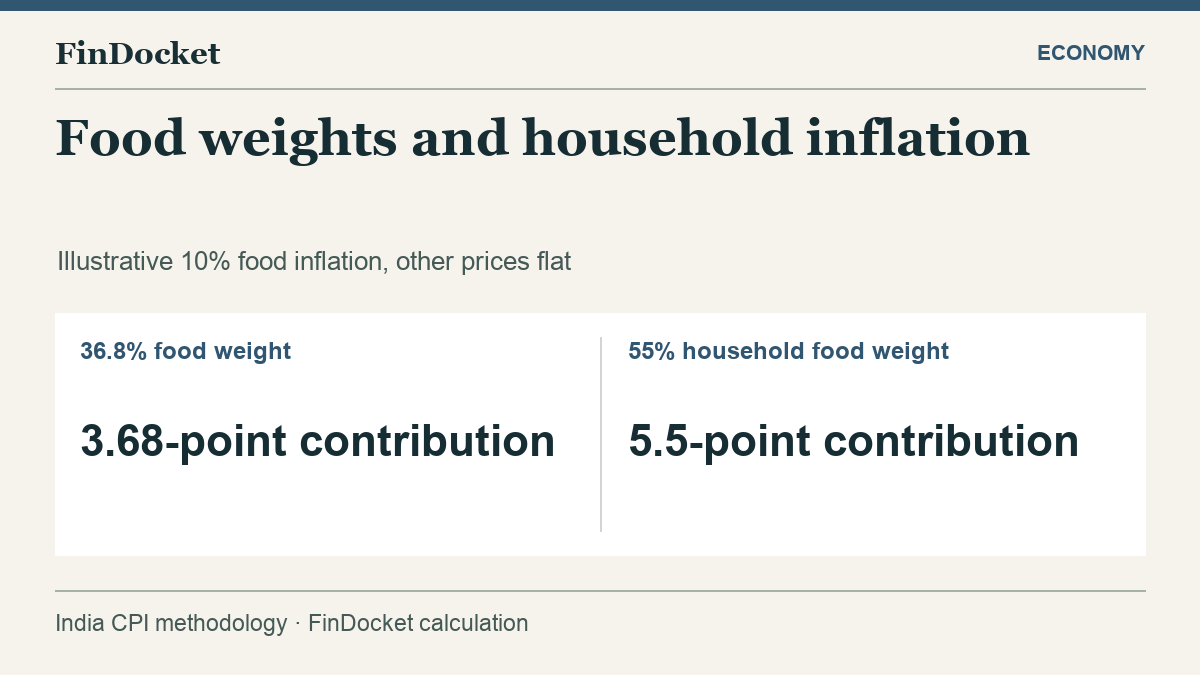
A national inflation index describes a weighted basket. A family pays for its own basket and earns its own wage. Those two facts explain why an accurate official inflation number can differ from the budget pressure reported by a household spending heavily on food, rent and school fees.
India's revised consumer price index uses a 2024 base. The Reserve Bank of India’s annual report puts food and beverages at about 36.8% of the national basket, compared with 45.9% in the old classification. Some of the difference reflects reclassification. Reading the entire change as a fall in household food spending would be a mistake.
For a first-pass illustration, let food prices rise 10% and every other price stay flat. At the new national weight the contribution is about 3.68 percentage points. For a family spending 55% of its budget on the same food, its comparable increase is 5.5%, a gap of 1.82 points. These are assumed price changes and a hypothetical household, separate from the latest measured CPI reading.
Wages complete the picture. A 3% pay rise alongside a 5.5% increase in the family basket reduces purchasing power by roughly 2.4%, calculated by dividing 1.03 by 1.055. To investigate a reported squeeze, collect actual wage changes and spending shares for the affected households. The national index supplies a benchmark, while the household records explain who experiences the larger loss.