Business · Analysis
The gap between India’s solar-pump opportunity and a manufacturer’s order book
A large potential market for solar pumps reaches suppliers through funded tenders, delivery and payment. The distinction matters to forecasts.
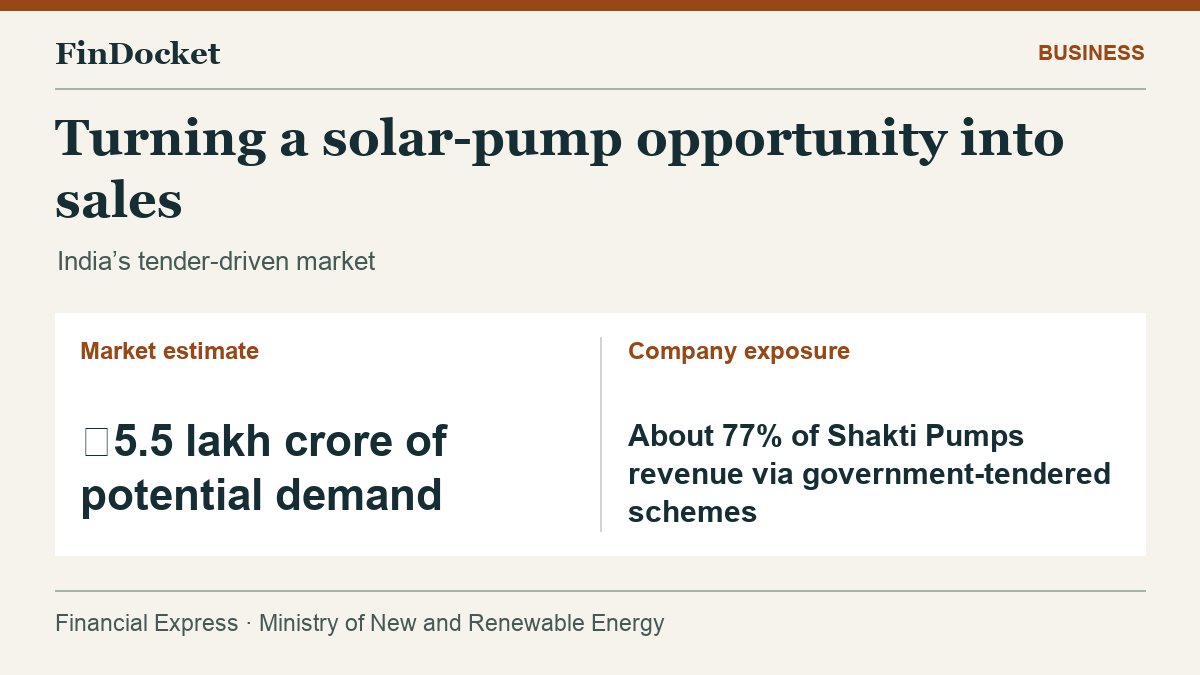
India’s estimated solar irrigation opportunity includes two groups with quite different buying decisions. Financial Express counted about 80–90 lakh diesel pumps already in use and a further 120–135 lakh pumps that might be needed to meet future irrigation demand. One lakh is 100,000. Replacing machines that already exist and financing pumps for new demand can take different lengths of time.
The publication put the potential market at ₹5.5 lakh crore. For a manufacturer, revenue recognition requires a much narrower route through farmer demand, funding, a tender, an award and installation. Financial Express reported that about 77% of Shakti Pumps’ revenue comes through government-tendered solar pumping schemes. That leaves its order flow exposed to procurement calendars and available subsidy budgets, even where the long-term case for replacing diesel is strong.
What would show that demand is converting?
Start with awarded units and the contracted price, then compare completed installations with cash collected. Financial Express reported 51,543 installations for Shakti in the first half of fiscal 2027. That is an operating figure for a particular period. It can be compared with future half-years on the same basis. A national opportunity estimate has a different scope and no equivalent delivery date.
An earnings multiple can look inexpensive if recent profit includes unusually rapid installations. The important follow-up is how many orders remain funded and executable, what margin the next batch carries and how long the company must finance receivables after installing each pump.