Economy · Analysis
Why the richest fifth collects more than half of Indonesia’s fuel subsidy
A discount per litre directs more of Indonesia’s subsidy to heavy fuel users. The distribution changes when assistance is paid per household.
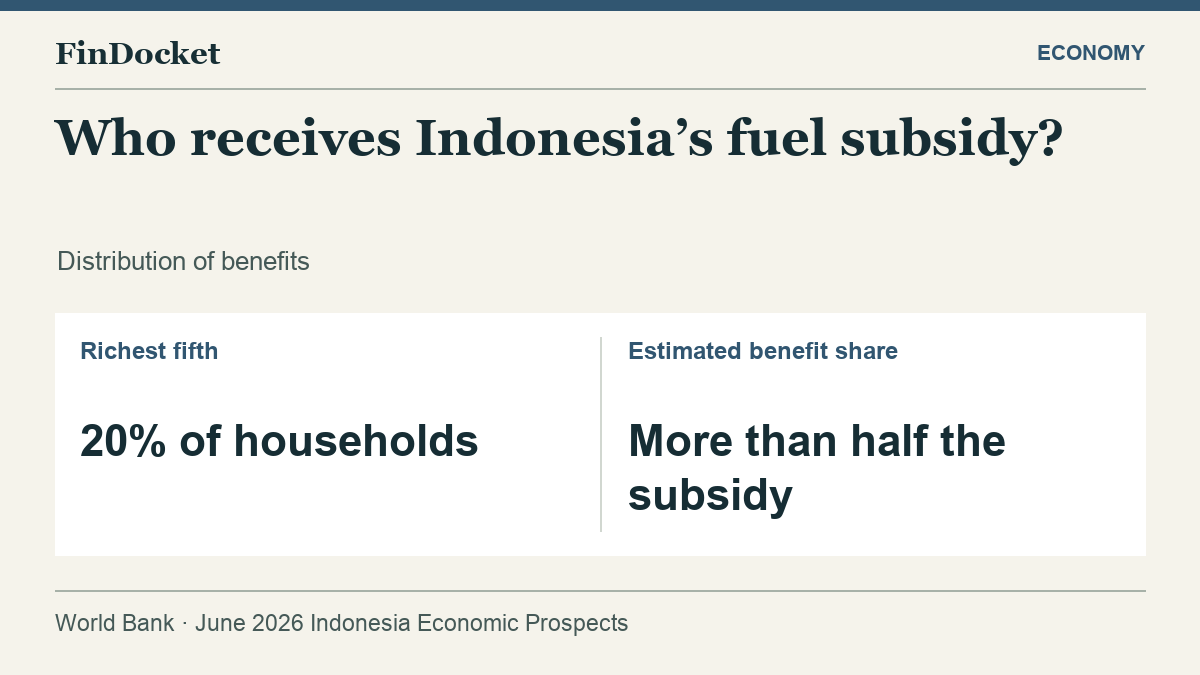
A discount at the pump pays out each time someone fills a tank. Indonesia’s richest 20% of households receive more than half of fuel-subsidy benefits, according to the World Bank’s June 2026 economic report. Their collective share exceeds 2.5 times their share of households. That arithmetic helps explain how a policy aimed at affordability can direct a large amount of public money toward high-consuming families.
Consider two households buying the same subsidized fuel. If one buys ten litres and the other buys forty, a uniform discount delivers four times as much money to the second household. The smaller benefit could still matter more to the first family’s weekly budget. The amount of subsidy received and the hardship caused by losing it answer different policy questions.
What would a different subsidy buy?
The World Bank describes a package that would narrow the gap between domestic and market prices and compensate the poorest 40% through targeted cash transfers. Paying a household an amount independent of its fuel purchases changes the incentive on the next litre. Families can retain support while choosing whether to use the money on transport or another expense.
The trade-off lies in delivery. A lower pump price helps immediately whenever fuel is bought. A cash payment reaches households only if they are identified correctly and paid on time, including families affected indirectly by higher transport costs. The useful budget comparison therefore includes compensation and delivery costs alongside savings at the pump. The original subsidy’s headline size alone cannot establish the net saving.