Business · Analysis
Intuit Q1 FY2027 Earnings Put the Mailchimp Sale in Focus
Intuit Q1 FY2027 earnings show stronger QuickBooks growth and a $3.68 billion Mailchimp sale agreement. Our SEC analysis examines margins and buybacks.

Intuit’s first-quarter fiscal 2027 earnings show a growing QuickBooks ecosystem and a sharper portfolio decision. Revenue increased 12%, operating income rose 63% and management agreed to sell Mailchimp for approximately $3.68 billion. The planned use of cash proceeds for repurchases links that divestiture directly to future per-share economics.
The November 19 SEC filings also change how adjusted earnings should be read. Intuit now includes equity compensation in its non-GAAP measures and has restated the historical comparisons presented. FinDocket’s analysis examines the operating improvement, the business being sold and the capital required to sustain the buyback program.
What did Intuit report for Q1 FY2027?
For the quarter ended October 31, revenue increased to $4.354 billion from $3.885 billion. GAAP operating income reached $868 million, compared with $534 million. Net income increased to $695 million from $446 million, and diluted EPS rose to $2.59 from $1.59.
FinDocket calculates operating margins of approximately 19.9% and 13.7%, respectively. The $334 million operating-income increase represented approximately 71.2% of the $469 million revenue increase. That is substantial operating leverage within the quarter’s particular mix of revenue and expenses.
The diluted weighted-average share count declined to 268 million from 281 million, approximately 4.6%. That reduction helped EPS grow faster than net income. Operating improvement increased the earnings pool, while the smaller share base increased each remaining share’s participation.
What is driving the core business?
Global Business Solutions revenue increased 15% to approximately $3.1 billion. Its Online Ecosystem grew 20% to approximately $2.4 billion. QuickBooks Online Accounting increased 19%, with the company identifying effective prices, mix and customer growth as drivers.
Those drivers have different implications. More customers expand the addressable revenue base. Higher realized prices and richer product configurations increase revenue from the existing base. A combination can support growth even when customer additions vary, while retention and customer value determine how durable the pricing benefit becomes.
Online Services increased 21%, driven by money and payroll. The broader ecosystem therefore earns revenue from multiple business workflows beyond accounting subscriptions. Its economic opportunity is to expand the services used by each customer while controlling delivery, support and credit-related costs.
Consumer revenue increased 7% to $958 million. Credit Karma grew 9% to $708 million, while TurboTax and ProTax supplied the remainder. Because tax preparation is seasonal, the opening quarter’s consumer mix provides a different picture from the full-year revenue base. It should be evaluated within that annual cycle.
Why does the Mailchimp sale matter?
Intuit agreed to sell Mailchimp to Bending Spoons for approximately $3.68 billion, comprising approximately $3.31 billion of cash and $368 million of stock at the signing-date valuation. The transaction is expected to close in early calendar 2027, and Intuit intends to use the cash proceeds for repurchases during FY2027 after closing.
The equity portion is economically distinct from the cash portion. The number of Bending Spoons shares was fixed at signing, but their fair value will be determined at closing. They will also carry a six-month contractual sale restriction. The total signing-date consideration therefore does not represent immediately deployable cash.
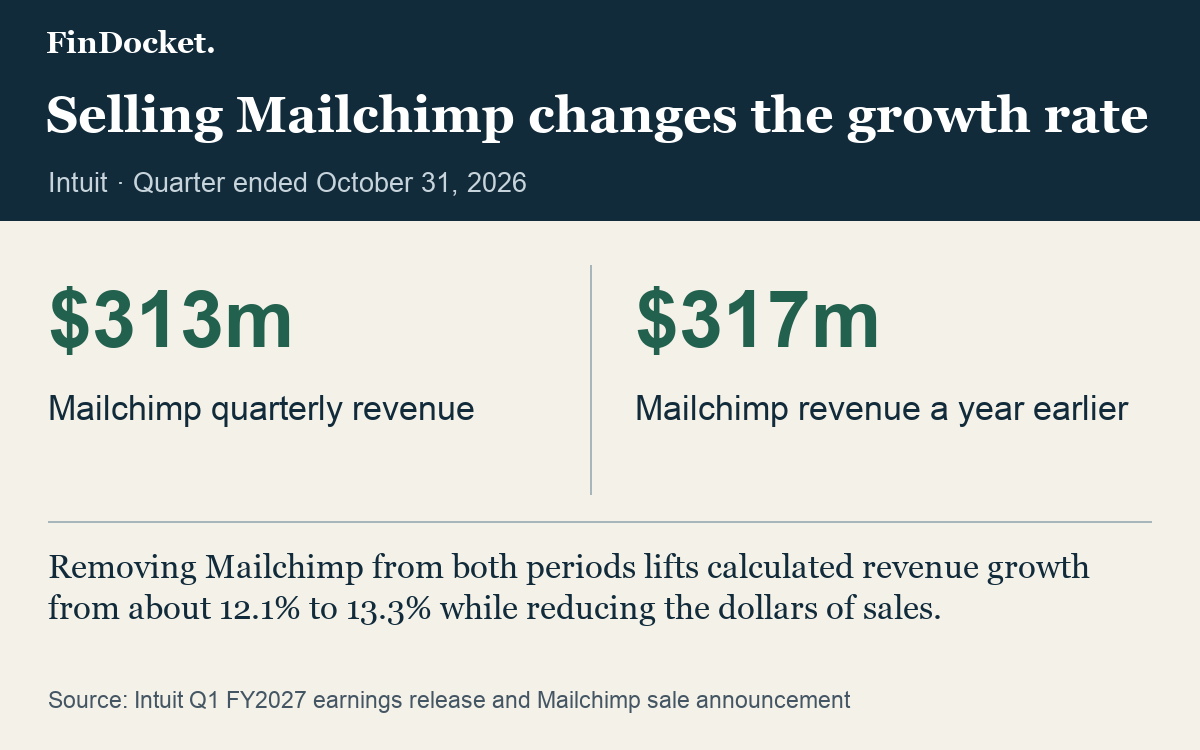
Mailchimp generated $313 million of quarterly revenue, down from $317 million. Removing it from both consolidated periods gives an illustrative revenue comparison of $4.041 billion versus $3.568 billion, or approximately 13.3% growth. Selling the slower-growing business would improve the growth mix, while reducing the revenue base.
The current full-year Mailchimp revenue outlook is $1.256 billion to $1.266 billion. Dividing signing-date consideration by that midpoint gives approximately 2.9 times forecast annual revenue. This simple transaction-size comparison describes the relationship between price and sales. It does not establish the value of the retained business or the final accounting gain.
Is Intuit selling an unprofitable business?
The latest segment disclosure reports $202 million of Mailchimp operating income, compared with $139 million a year earlier. Revenue declined, while lower staffing, marketing and outside-services costs lifted segment profit. The figures show that slower growth and current profitability can coexist.
Segment income excludes certain unallocated items, including equity compensation and acquired-intangible amortization. It therefore differs from the contribution that would remain after every corporate cost and purchase-accounting charge. Removing the business requires an assessment of which costs disappear and which stay with Intuit.
Mailchimp became a separate segment in August, and the filing recasts prior-year revenue and expenses to match. That treatment improves comparability. It also makes the cost-allocation details important when estimating the sale’s eventual effect on consolidated margins.
How has the adjusted earnings definition changed?
Beginning in Q1 FY2027, Intuit stopped excluding share-based compensation from non-GAAP earnings. Total quarterly equity compensation was $495 million, down from $543 million. It remains included in both GAAP and the revised adjusted performance measures.
Non-GAAP operating income was $1.046 billion, compared with $868 million under GAAP. The remaining reconciliation primarily includes acquired-technology and other intangible amortization, plus smaller restructuring and transaction-related items. The gap is therefore narrower than it would be under a definition that also excluded equity compensation.
The recast historical comparisons need to be used consistently. Comparing the new guidance with an older, unrevised adjusted EPS figure would mix definitions and distort the apparent earnings trajectory.
Can current cash generation fund the buybacks?
Operating cash flow increased to $1.062 billion from $637 million. After $75 million of property and equipment purchases, cash after capital expenditure was $987 million. That represents approximately 22.7% of quarterly revenue.
Intuit repurchased approximately $1.5 billion of shares during the quarter, exceeding that cash measure before considering dividends and other uses. The company also ended October with approximately $5.3 billion of cash and investments and $6.9 billion of total debt.
The planned sale proceeds would provide substantial additional capacity, while also removing Mailchimp’s future earnings and cash contribution. The relevant test is whether the retained business and the lower share count produce better long-term per-share economics after that exchange.
What should the next results establish?
Intuit’s FY2027 revenue outlook is $23.081 billion to $23.365 billion, and revised non-GAAP EPS guidance is $22.88 to $23.12. Both outlooks exclude the pending sale’s impact and will need updating at closing.
The clearest operating evidence will come from sustained QuickBooks ecosystem growth and disciplined expense retention. The divestiture then adds a separate capital-allocation test. Intuit must demonstrate that the proceeds and increased strategic focus create more value than the earnings stream being sold.