Business · Analysis
Intuitive Q3 2026: Robot Placements and Lease Returns
Intuitive Surgical's Q3 2026 SEC filings reveal the economics behind robot placements, usage-based leases and recurring revenue as procedure volume expands.

Intuitive Surgical's third-quarter 2026 growth reflects more procedures and a larger fleet of systems, but the relationship between placements and revenue depends on how hospitals obtain the equipment. Usage-based operating leases reduce customers' initial capital commitment while leaving Intuitive more exposed to future utilization.
That structure can support adoption and produce attractive lifetime economics. It also means a placement count is not equivalent to a completed equipment sale. The quarter's most useful operating question is how effectively the expanding installed base turns into procedures, instrument demand and cash over time.
Placements grew faster than procedures
The earnings release reports 546 da Vinci placements versus 427, while da Vinci procedures grew approximately 14%. The installed base increased 12% to 12,094 systems. Ion procedures grew approximately 31%.
Da Vinci placements increased approximately 28%, about twice the procedure growth rate. That relationship does not automatically indicate excess capacity. Placements can include replacements, upgrades and systems that have not yet reached normal usage. A new installation also takes time to translate into a fully developed surgical program.
Still, the distinction matters for evaluating capital efficiency. The company benefits most when its installed technology supports growing procedure volume, rather than merely expanding the equipment footprint. Training, scheduling, clinical adoption and hospital staffing determine how quickly a placement becomes productive.
The 10-Q reports a 2% increase in da Vinci utilization. That supports the view that growth is coming from both a larger fleet and more use of existing capacity. Utilization is the more direct indicator of activity per system, while placements measure the flow of equipment entering customer sites.
Usage-based leases change who carries the risk
The release identifies 291 da Vinci operating-lease placements, including 160 usage-based arrangements, versus 231 and 115 a year earlier. Usage-based placements therefore increased approximately 39%, faster than the total placement count.
The operating-lease share of quarterly placements was approximately 53%, slightly below the prior year's 54%. There is no broad quarterly shift from sales into operating leases on that measure. Within the lease category, however, usage-based arrangements became more prominent.
The 10-Q says usage-based arrangements generally have no minimum payments, and customers can leave without a financial penalty. Revenue is recognized as procedures occur. Fixed-payment operating leases recognize revenue over time, while sales and sales-type leases recognize system revenue upfront.
These structures solve different customer problems. A hospital with uncertain procedure volume can avoid committing a large purchase price before developing its program. Intuitive accepts more of the risk that the installed equipment will not generate enough usage to recover its cost.
The arrangement can still be economically attractive when procedure adoption is strong and the system supports recurring instrument and service demand. But the company's return needs to be evaluated across the full deployment period, including equipment cost, support, service, idle capacity and any eventual buyout.
Recurring revenue contains different degrees of predictability
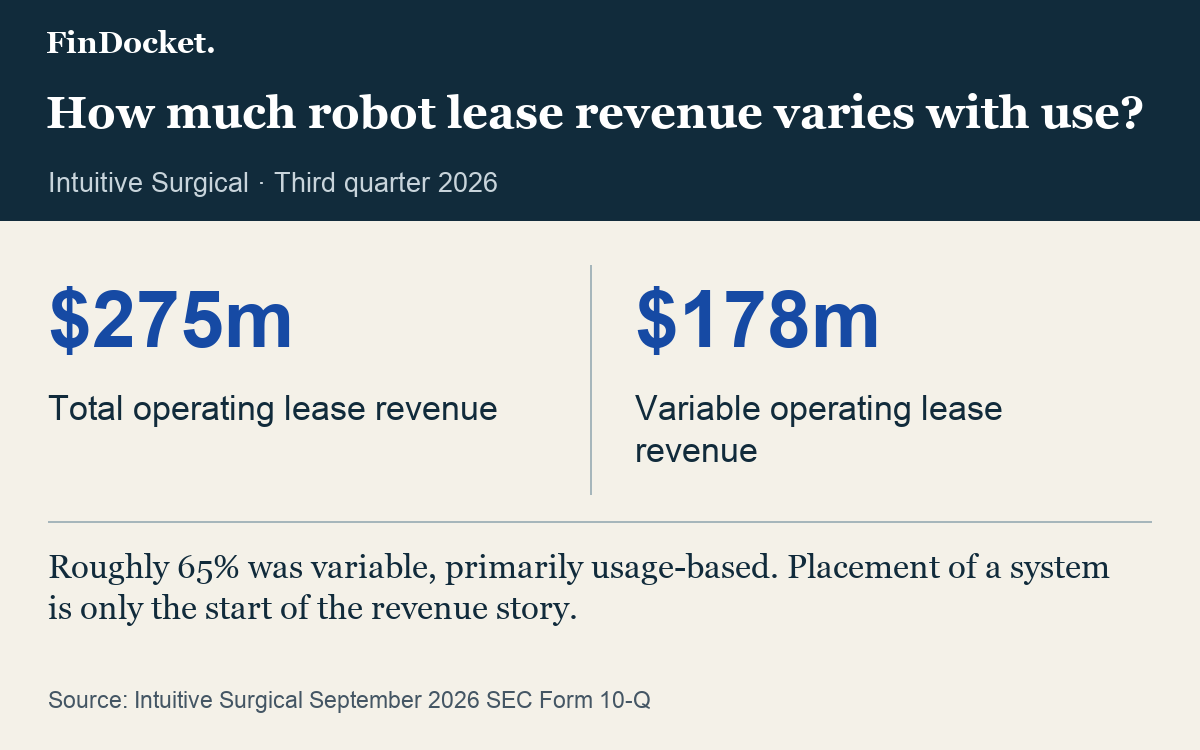
The 10-Q reports $275 million of operating-lease revenue, including $178 million of variable revenue, compared with $223 million and $138 million. Variable revenue supplied approximately 65% of the current operating-lease total and approximately 77% of its dollar increase.
The expanding lease stream is consequently tied heavily to activity. Calling it recurring describes the mechanism through which revenue repeats; it does not establish a fixed contractual payment in every future period.
Instrument purchases also repeat as procedures occur, but their timing can reflect customer inventories and purchasing patterns. Service contracts have another cadence. Combining these streams is useful for understanding the installed-base model, provided the components retain their individual economic meaning.
A strong recurring business has customers repeatedly obtaining value from the technology and paying enough to support its continuing delivery. The label alone does not eliminate volume variability or the capital needed to maintain the installed base.
The most informative trend would pair growing variable lease revenue with stable or improving utilization and controlled support costs. That combination would show the financing model supporting productive adoption, rather than simply moving more equipment into hospitals.
Lease buyouts add another timing effect
The 10-Q reports $45 million of lease-buyout revenue versus $22 million. These purchases occur when customers exercise options on previously leased systems, so their timing can vary materially.
Buyout revenue more than doubled, but the increase represents monetization of existing deployments rather than a new placement in every case. Counting the revenue as evidence of current equipment adoption without recognizing that history would overstate what the transaction demonstrates.
From an economic perspective, the buyout can complete part of the system's capital recovery and transfer ownership to the customer. Evaluating it alongside prior lease payments provides a better view of lifetime returns than treating it as an isolated equipment sale.
That is why a simple system average selling price cannot be applied across the entire placement count. The fleet includes different financing structures, revenue-recognition schedules and product configurations. Multiplying every placement by an upfront sale price would create revenue the company has not earned or recognized.
The settlement explains much of the reported earnings decline
The release reports revenue of approximately $3.05 billion and GAAP EPS of $1.49, compared with $1.95. A proposed antitrust settlement produced a $450 million pretax charge, or $0.99 per share after tax, and remained subject to court approval. Non-GAAP EPS was $3.00 versus $2.40.
The charge is large enough to change the direction of the headline earnings comparison. Separating it helps evaluate current procedures and equipment economics, while its eventual payment remains part of shareholder cash allocation. Excluding an expense from an operating comparison does not make the obligation disappear.
The quarter's lasting investment question lies in the installed base. Intuitive is expanding access through equipment sales and alternative financing while procedures grow. Sustained value creation requires those deployments to generate attractive lifetime cash returns, with utilization keeping pace with the resources committed to the fleet.